

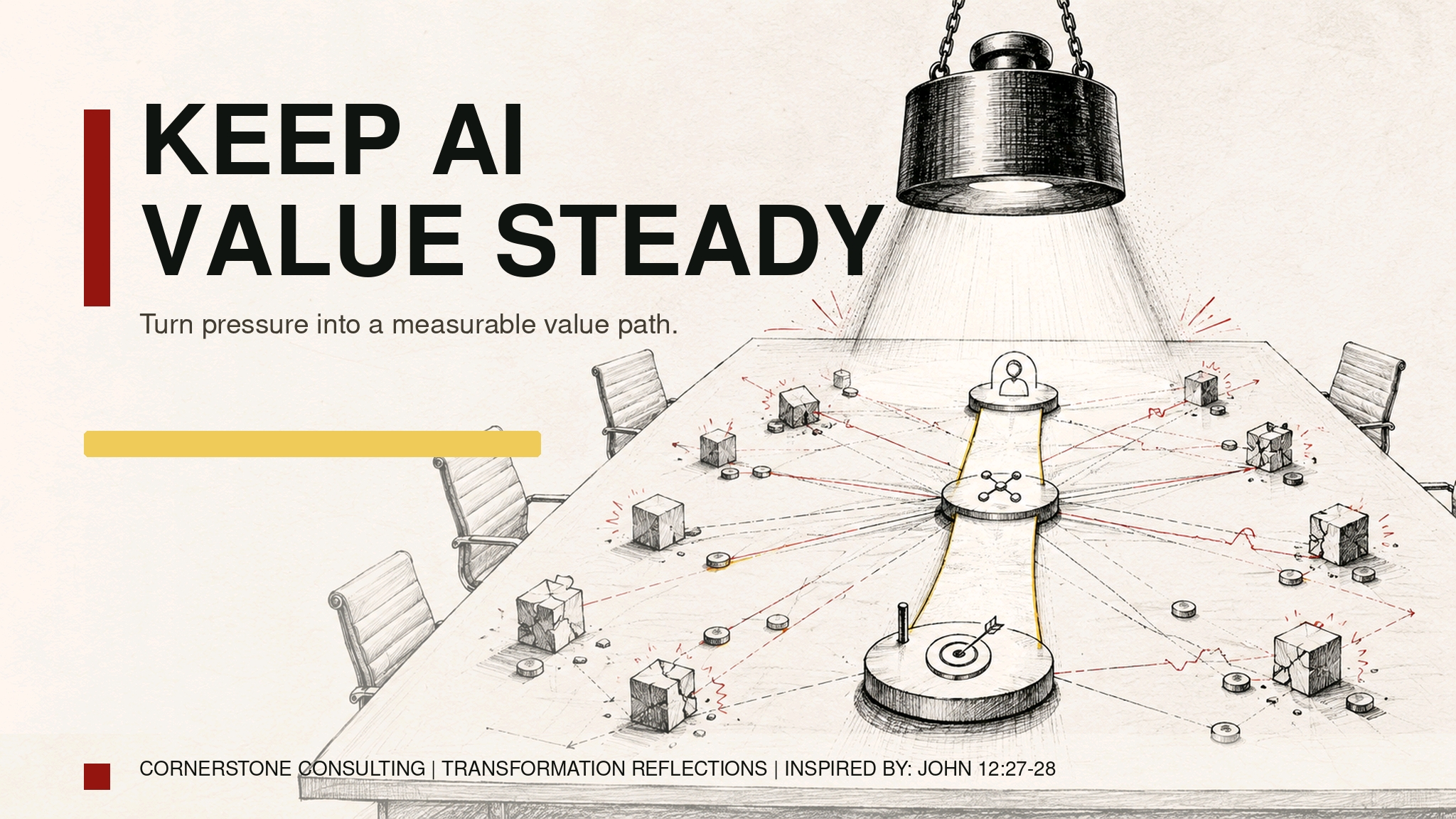
AI investments often begin with confident language: productivity, automation, better decisions, lower cost, faster service, stronger insight. Then the work meets organizational heat. Savings are harder to trace than expected. Adoption varies by team. Pilots multiply without changing core workflows. Data, policy, integration, risk, and operating ownership become more important than the demo.
That pressure is not proof the investment is wrong. It is evidence that value needs a clearer path. AI does not become valuable because the technology is impressive. It becomes valuable when the enterprise can name the business change it is trying to create and then align the system around that change.
Reflection
For a C-level leader, the central question is not, “Do we have AI activity?” Most organizations do. The sharper question is, “Which decision, cost, customer moment, control, capacity problem, or workflow will this investment improve, and who is accountable for proving it?”
Practice
Pick one active AI initiative. Write the expected value in one sentence. Name the accountable executive. Identify the workflow that must change, the metric that will prove movement, and the three enterprise dependencies that must be funded. Then remove one activity that does not help prove value.
Conclusion
Pressure can make leaders chase visible movement: more pilots, more vendor conversations, more announcements, more dashboards. Those things may have a place, but they cannot substitute for ownership. If an AI initiative cannot name the benefit owner, the process that will change, the metric that will move, and the dependencies that must be funded, the portfolio is carrying hope where it needs evidence.
Enterprise architecture helps because it connects ambition to the operating system of the business. It can show which capabilities are ready, which dependencies are fragile, which data or integration issues will slow adoption, and which initiatives are pretending to be independent. AI value rarely arrives from one team. It depends on finance, risk, technology, operations, legal, customer channels, and frontline adoption moving together.
When AI funding gets uncomfortable, do not defend the noise or abandon the goal. Use the pressure as evidence. Turn it into a clearer value owner, a tighter capability map, and a measurable path from investment to enterprise action.
Inspired by: John 12:27-28 (NIV)
27 “Now my soul is troubled, and what shall I say? ‘Father, save me from this hour’? No, it was for this very reason I came to this hour. 28 Father, glorify your name!”. Then a voice came from heaven, “I have glorified it, and will glorify it again.”
Darin Paton is the Owner of Cornerstone Consulting Inc., an Alberta-based enterprise architecture and SAP ERP transformation advisory firm serving organizations across complex business and technology change for over 15 years. 30+ years as an EA and SAP.

Leave a Reply