

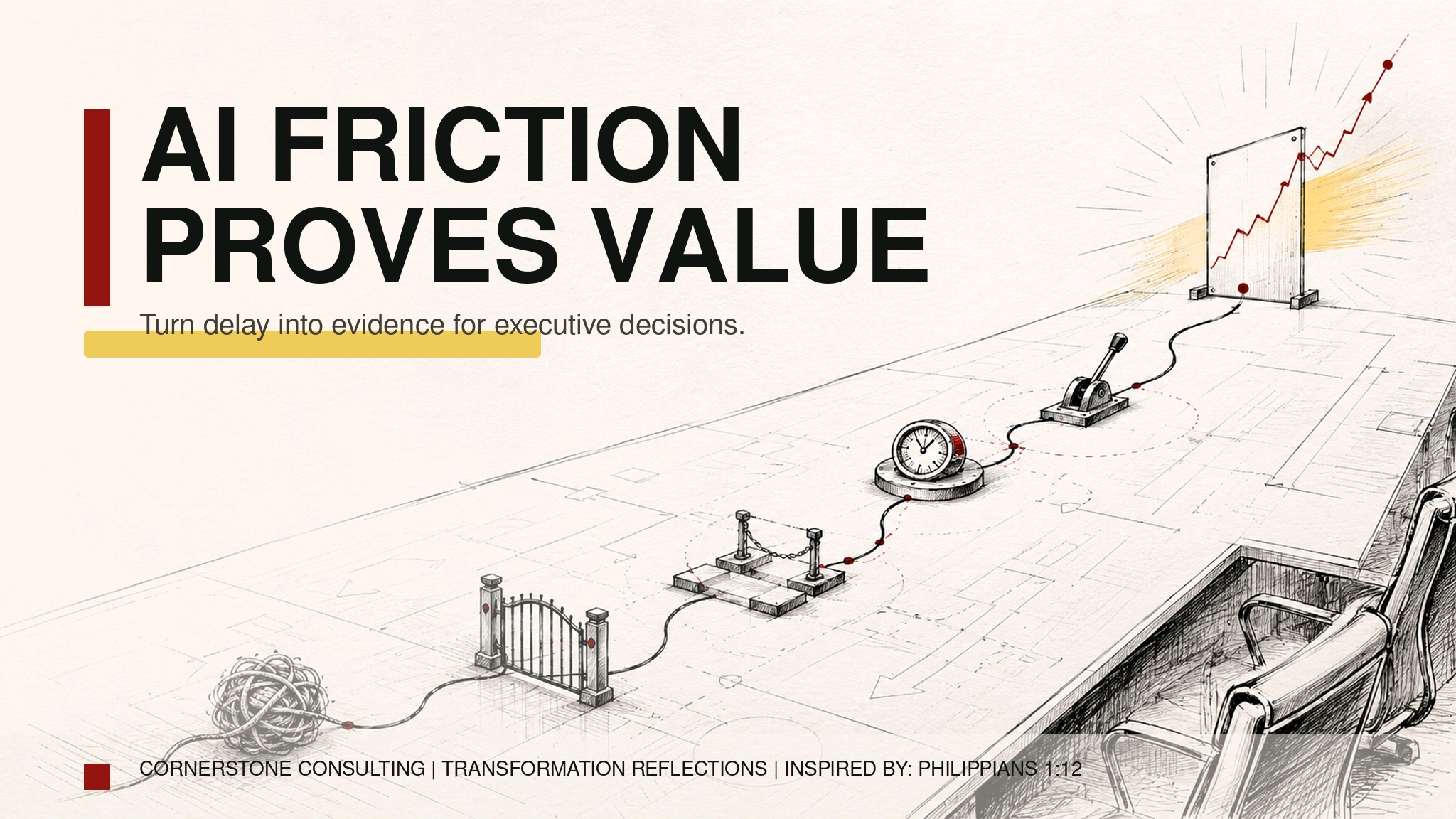
AI friction is not just a delay.
It is evidence.
Executives can use it to strengthen the value case.
I have seen AI initiatives look strong in demos but struggle in real operations. Over time, they became evidence of missing design. The friction showed what was unclear, who needed to own it, and what had to change before AI could scale.
A better executive reaction is curiosity. Friction is often the first honest measurement system. It shows where the value case is vague, where ownership is weak, where the operating model has not changed, and where enterprise dependencies were underestimated. Used well, it can move AI investment from optimistic narrative to practical proof.
The key is to stop treating friction as an exception to the plan. It is part of the plan. If the organization cannot explain how an AI use case will move through data, architecture, security, process change, adoption, measurement, and benefit tracking, the investment is still incomplete. The obstacle is pointing to missing design.
That is especially important for C-level teams because AI investments can create false alignment. Everyone may support the idea until trade-offs appear. Then the real questions surface: Who gives up budget? Who changes a process? Who accepts new accountability? Who owns risk? Who stands behind the result when the first metrics are disappointing?
Enterprise architecture gives leaders a way to turn those questions into structure. It maps dependencies, clarifies decisions, and links capability change to measurable outcomes. Cornerstone Consulting at www.cornerstonea.com coaches leaders through that translation so AI friction becomes an input to better enterprise action, not a reason to retreat into disconnected pilots.
The next time an AI initiative slows down, do not only ask who missed the date. Ask what the friction is teaching you about the value path. The answer may be exactly what the executive team needs to make the investment worth scaling.
Before acting, pause long enough to ask what the friction is really revealing. Is the issue a delivery delay, or is it exposing a weak value case, unclear ownership, missing architecture, poor adoption design, or an executive trade-off no one has named yet?
The first executive move is not to demand more speed. It is to interpret the signal. If friction is treated only as resistance, the organization may push harder on a flawed plan. If it is treated as evidence, leaders can use it to strengthen the investment before scaling it.
Reflection
Ask yourself: what must become clearer before this AI initiative deserves more funding, more attention, or broader adoption?
Practice
Hold a friction review for one AI initiative. Capture each delay as evidence of a missing decision, dependency, capability, control, or adoption requirement.
Comment-Generating Questions
– What recent AI delay revealed something useful about your value case?
– Which executive trade-off has your AI roadmap avoided naming?
– Where could friction become proof instead of blame?
Darin Paton is the Owner of Cornerstone Consulting Inc., an Alberta-based enterprise architecture and SAP ERP transformation advisory firm serving organizations across complex business and technology change for over 15 years. 30+ years as an EA and SAP.

Leave a Reply