

Most initiatives do not suffer from too many architects.
They suffer from architectural judgment arriving too late.
Here is the team structure Enterprise Architects should shape before delivery pressure takes over.
Depending on the organization, I have witnessed Architects invited into initiatives after the machinery is already moving. In some cases, way under utilized resulting in implications before, during, and post go-live.
The project manager is named. The business leads are booked. The system integrator is scheduling workshops. Workstreams are forming opinions. Decisions are starting to harden.
Then the architecture question appears: who is actually watching enterprise consequence?
That is why architecture team structure is not an administrative detail. It is a transformation risk control.
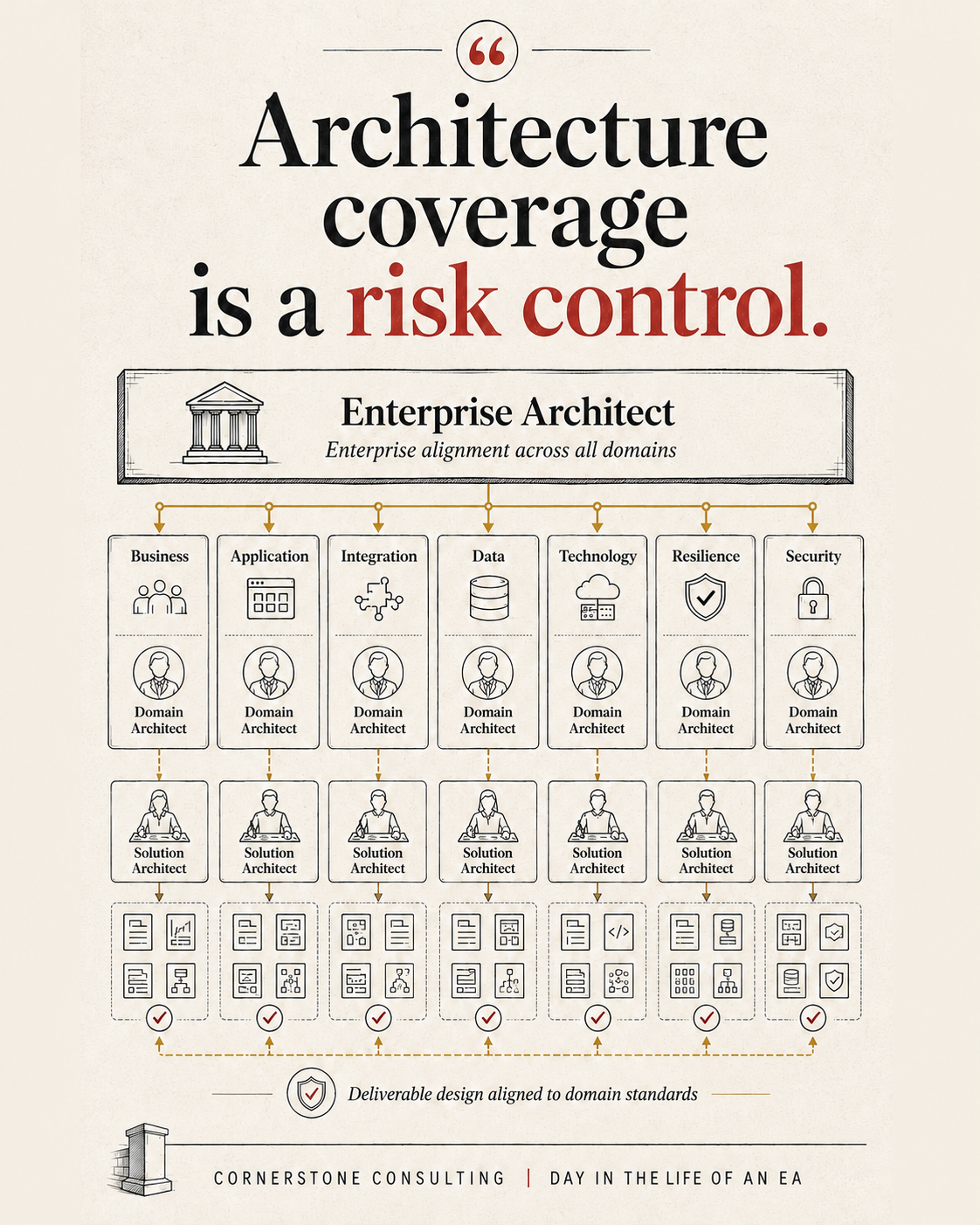
After acting as an Enterprise Architect on many large initiatives over the I’ve seen the need for three connected architecture altitudes.
- The Enterprise Architect keeps the initiative aligned to the business outcomes, architecture principles, portfolio direction, operational readiness, and most importantly long-term enterprise value.
- The Domain Architect protects coherence, standards, and policies across business, application, development and integration, data and analytics, cloud and technology, business continuity, disaster recovery, and cyber and information security. Critical for customer and system integration alignment.
- The Solution Architect protects aligned and consistent buildability across configuration, user experience, extensions, development, integration, conversion, data, cloud, resilience, and security design.
These roles do not always need to be full-time and can be delegated over one or many employees. In many initiatives, the Enterprise Architect, Domain Architects, and Solution Architects support are only partial capacity.
That is fine, as long as it is intentional.
The problem starts when partial capacity becomes accidental coverage.
Problems arise:
- If the Enterprise Architect is pulled too deeply into solution detail, design, and execution where the enterprise alignment weakens.
- If the Domain Architect layer is missing, domain decisions fragment resulting in compliance and control issues.
- If the Solution Architect role is light, the design may look clean in governance but result in operational inefficiencies or technical debt.
A day in the life of an Enterprise Architect should include shaping this coverage model early on in the conception phase.
This is also a coaching moment. The Enterprise Architect helps the initiative understand that architecture questions are not limited to diagrams or review boards. They appear in RFPs, statements of work, change and extension requests, interface designs, data assumptions, security controls, disaster recovery decisions, and handover plans. When the team recognizes those moments earlier, architecture becomes part of execution discipline instead of a late-stage approval step.
The real work is not adding more architects. It is making sure the right architectural judgment is present at the right level, at the right time.
That is how architecture protects value before avoidable complexity becomes permanent.
Reflection
Where is your current initiative relying on informal architecture coverage instead of an explicit Enterprise Architect, Domain Architect, and Solution Architect structure?
Practice
Before the next major design checkpoint, map the initiative’s highest-risk decisions to Enterprise Architect, Domain Architect, and Solution Architect coverage. Identify one gap where architecture involvement is too late, too light, or unclear.
Love to hear your experiences and comments.
Darin Paton is the Owner of Cornerstone Consulting Inc., an Alberta-based enterprise architecture and SAP ERP transformation advisory firm serving organizations across complex business and technology change for over 15 years. 30+ years as an Architect and involved in SAP.
#EnterpriseArchitecture #EnterpriseArchitect #TransformationLeadership #ERPTransformation #SolutionArchitecture #DomainArchitecture #ArchitectureGovernance #CornerstoneConsulting

Leave a Reply