

How do we manage AI propagation?
Most AI governance fails too late.
The model is already in workflow.
AI conversations move faster than governance. On real projects, I’ve observed the better executives pause early, clarify ownership, and make control evidence part of the decision before scale creates cost.
AI governance often becomes a meeting after the meeting. A model has already been placed in a process, a vendor has already shaped the roadmap, a team has already changed a decision rule, and only then does the executive table ask whether the controls are strong enough. By then, governance feels like delay.
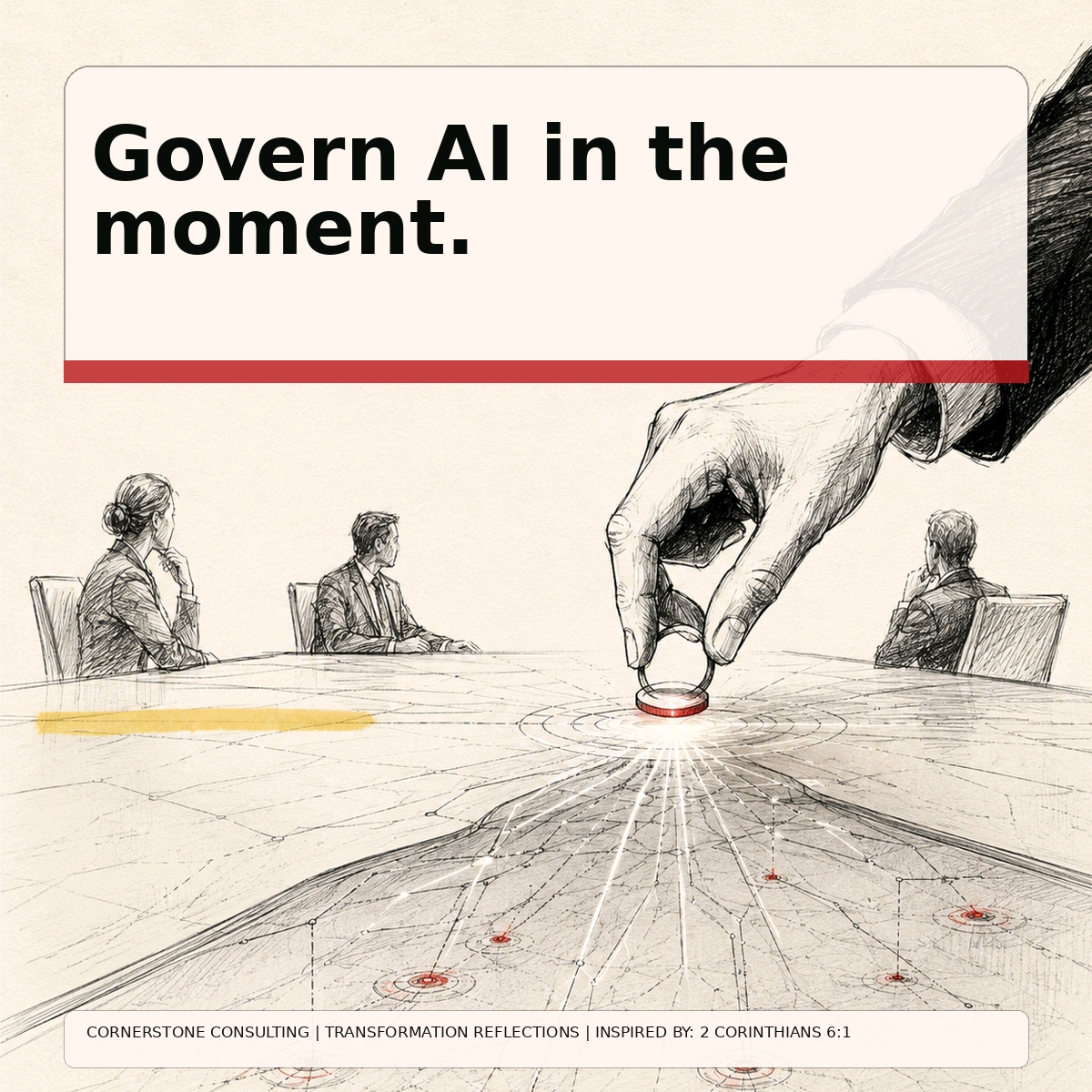
The better executive move is to govern while the decision is live. That does not mean slowing every AI initiative. It means making sure the enterprise has usable judgment at the moment risk is being created. Who owns the model outcome? Which data can it use? What human review is required? What customer, employee, financial, legal, and operational consequences need to be visible before scale?
This is where enterprise architecture earns its place. Architecture connects AI choices to capability, data, integration, controls, process ownership, cyber exposure, vendor dependency, and benefit measurement. EA coaching helps leaders ask better questions early enough that the answer can still change the design.
The daily executive habit matters. Every investment review, vendor discussion, product demo, and steering committee can become a small governance checkpoint. The point is not to create ceremony. The point is to bring accountable judgment into the room while the decision is still movable.
For a C-Level Executive, the discipline is not to wait for the perfect governance forum. Use the forum you have today. Put one accountable owner beside each high-impact AI use case. Require evidence of data lineage, decision rights, monitoring, exception handling, and value measures. Make the path from experiment to production explicit. If the AI work cannot explain how it will be governed in operation, it is not yet ready to carry enterprise trust.
The practical issue is timing. Governance that arrives after adoption becomes cleanup. Governance that is present inside the decision becomes confidence. The organizations that scale AI well will not be the ones with the most policy language. They will be the ones whose leaders can draw on governance in the exact moment a consequential AI decision is made.
Reflection
Where is AI already influencing executive choices before the governance model has caught up?
Practice
Before the next AI funding or steering decision, ask for one page showing owner, data source, human review, exception path, monitoring, and value measure.
Are you experiencing this now? How’s it working out?
Inspired by: 2 Corinthians 6:1 (NIV)
Darin Paton is the Owner of Cornerstone Consulting Inc., an Alberta-based enterprise architecture and SAP ERP transformation advisory firm serving organizations across complex business and technology change for over 15 years. 30+ years as an EA and SAP.

Leave a Reply