

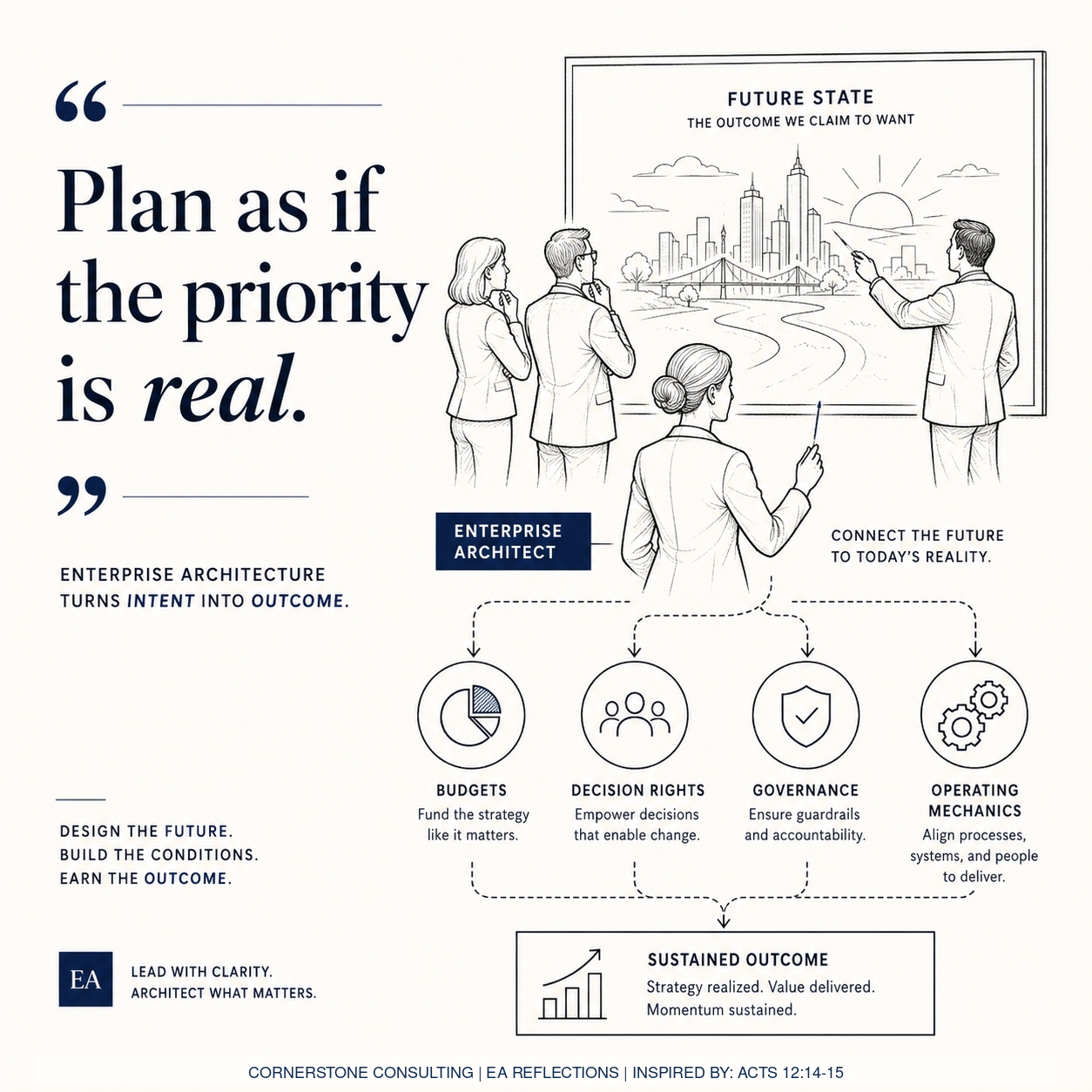
Many organizations ask for outcomes they are not prepared to receive.
Strategy is not believed until calendars, budgets, and decision rights change.
Plan as if the priority is real.
Most organizations I am in, support a strategy verbally while leaving the old mechanics untouched. The architecture work becomes valuable when it asks what must change in funding, decisions, and culturally for priorities to become real.
Organizations often ask for outcomes they are not prepared to receive. They ask for transformation but keep the old funding model. They ask for data-driven decisions but tolerate unclear ownership. They ask for agility but preserve approval paths designed for fear. They ask for simplification but reward local optimization.
This gap is one of the most important places an Enterprise Architect can work.
It is easy to say the right words in a steering committee. It is harder to adjust the enterprise so those words can become real. A strategy that is genuinely believed changes calendars, budgets, decision rights, measures, incentives, and governance. If nothing changes around the request, the request may be more aspiration than commitment.
The test is simple: are we preparing for the thing we say we want?
If leaders ask for standard platforms, are they willing to retire duplicate tools? If they ask for faster delivery, are they willing to remove decision queues? If they ask for better customer experience, are they willing to expose the handoffs customers actually feel? If they ask for resilience, are they willing to fund boring capabilities before the incident?
Architecture can help close the gap between stated intent and operational readiness. Not by shaming the organization, but by making preparation visible. What would need to be true? Who would need to decide differently? Which constraints are real, and which are inherited habits? What evidence would show that we are serious?
The most dangerous form of misalignment is polite agreement without movement. Everyone nods, but no team changes its backlog. Everyone supports the principle, but no budget shifts. Everyone wants the outcome, but no one accepts the cost of becoming ready for it.
An architect should listen for that contradiction. When the organization says it wants a future state, the architect helps translate desire into preparation. The work is not merely to draw the target architecture. The work is to ask whether the enterprise is arranging itself to walk toward it.
This is why architecture must connect strategy to operating mechanics. A future state without preparation becomes theatre. A roadmap without changed decision rights becomes decoration. A capability model without funding choices becomes language without leverage.
Today, choose one declared priority and test it gently but honestly. Are we planning as if it will happen, or merely speaking as if it matters?
Reflection:
What would change this week if we genuinely expected our stated priority to become real?
Practice:
List three preparations that would prove commitment:
- one decision,
- one budget movement, and
- one behaviour change.
Questions:
- What is one sign that a strategy is being admired but not prepared for?
- Which operating mechanic most often exposes whether transformation is serious?

Leave a Reply