

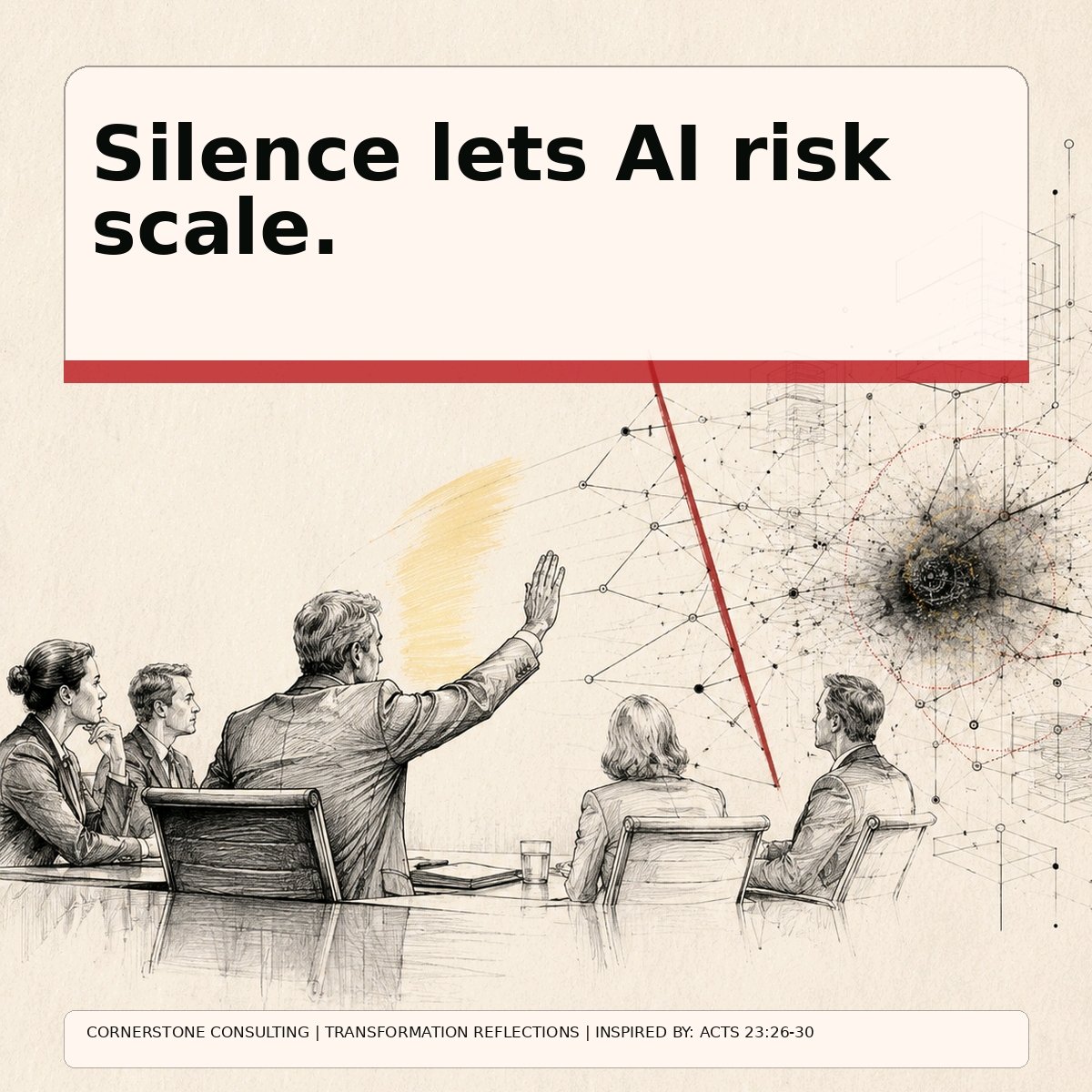
AI governance needs executives who interrupt early.
The quiet risk is rarely quiet for long.
One missed question becomes a pattern.
AI concerns become large program risks when nobody had permission to interrupt. On stronger projects, executives welcome early challenges because it protects value before risk scales.
AI risk usually gives executives a small window before it becomes expensive. Someone notices that a model recommendation is being trusted too quickly. A business team starts using an unapproved tool because it is faster. A vendor embeds AI into a process without clear accountability. A dashboard looks confident, but nobody can explain the data behind it.
That is the moment to speak up.
For a C-Level Executive, speaking up is not theatrics. It is the disciplined act of naming risk while the organization can still respond without shame, blame, or panic. AI governance at enterprise scale depends on leaders who are willing to interrupt momentum with useful questions: What decision is this model influencing? Who is harmed if it is wrong? Who can override it? What evidence would make us pause, adjust, or stop?
The most dangerous AI governance gap is not always technical. It is often social. People see the issue, but they assume it belongs to someone else. Legal waits for Technology. Technology waits for the business. The business waits for the vendor. Finance waits for proof of value. Meanwhile, the operating model quietly absorbs a new risk.
Enterprise architecture helps turn that concern into action. It gives executives a map of where the AI decision touches capabilities, data, systems, controls, customers, employees, vendors, and regulators. EA coaching can create the language for raising the concern without sounding anti-innovation. The message is simple: we are not stopping AI; we are making it safe enough to scale.
A strong executive culture does not punish the person who asks the hard governance question early. It thanks them for protecting the enterprise before the issue becomes public, regulated, costly, or irreversible.
In the day-to-day life of the executive, this may look like pausing a steering committee for ten minutes, asking for an AI risk owner, requesting a model-use register, or insisting that an exception path be documented before launch. Quiet risk becomes enterprise risk when everyone stays quiet. Governance starts when someone with authority speaks clearly enough for others to act.
Reflection
Where has the organization made it harder than necessary for people to raise AI risk early?
Practice
Add an explicit red-flag moment to every high-impact AI review: one person must name what could go wrong, who would feel it, and what decision would change.
Living this? Share your experiences.
Inspired by: Acts 23:26-30 (NIV)
Darin Paton is the Owner of Cornerstone Consulting Inc., an Alberta-based enterprise architecture and SAP ERP transformation advisory firm serving organizations across complex business and technology change for over 15 years. 30+ years as an EA and SAP.

Leave a Reply