

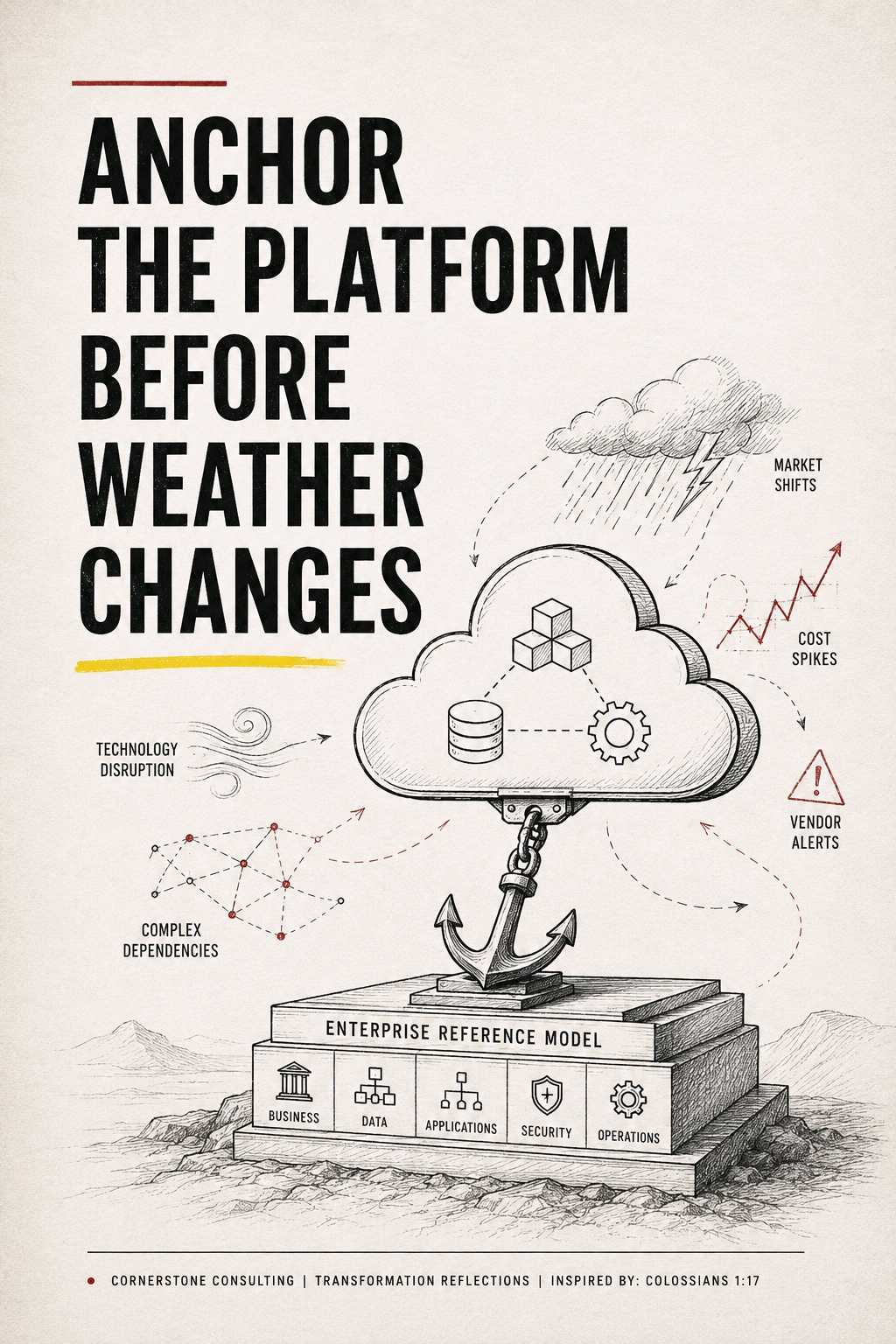
Conditions will keep changing around the platform, especially AI.
Leaders need something steadier than reaction.
Architecture can provide an anchor.
Platform decisions, from my observations, improve when leaders share one trusted view of capabilities, costs, owners, controls, and dependencies. It does not remove uncertainty, but it helps keeps pressure from turning every issue into a separate concern. For instance, I’m starting to see how the changing AI platforms will be impacted by billing, modal routing, frontier model usage… will impact many customers.
Unpredictable conditions expose whether a platform has a real anchor. Cloud prices shift. Vendors change terms. AI demand increases compute pressure. Cyber expectations rise. Integration volume grows. A business unit launches faster than the shared services model can absorb. None of this is unusual anymore.
For an Enterprise Architect, the question is not whether conditions will change. They will. The question is whether leaders have a stable reference point for making platform decisions when the weather changes.
That anchor is not a single diagram. It is a connected view of business capabilities, critical applications, cloud services, data flows, cost drivers, resilience expectations, security controls, vendor dependencies, and accountable owners. When that view is current enough to trust, leaders can respond to change without reinventing the enterprise every time pressure arrives.
Without an anchor, each new platform issue becomes a separate argument. Finance sees spend. Cyber sees control exposure. Operations sees support strain. Product teams see constraints. Executives see delay. Architecture creates value by showing how those views connect, where the real trade-offs sit, and which decisions protect the enterprise outcome.
The anchor also gives delivery teams freedom. When principles, ownership, guardrails, and platform patterns are clear, teams do not have to guess which choices are safe. They can move with more confidence because the enterprise has already named what must hold together.
This is where EA coaching becomes practical. It helps leaders move from abstract platform concern to decision-ready questions: What must remain stable? What can flex? What cost is justified by resilience? Which dependency needs an owner? Which service should be simplified before it becomes strategic drag?
A trusted platform anchor does not remove uncertainty. It gives the enterprise a way to think clearly inside it. When conditions shift, leaders need more than reaction. They need a shared map of what holds the operating model together.
Reflection
What platform reference point do leaders trust when cost, vendor, security, delivery, and resilience conditions start changing at the same time?
Practice
Create or refresh one platform anchor view: critical capabilities, applications, data flows, cloud services, cost drivers, owners, controls, and resilience expectations. Use it in the next platform decision meeting.
Do you have volatile platform?
Inspired by: Colossians 1:17 (NIV) 17
Enterprise Architects support success by helping executives, finance, cyber, operations, data, product, and delivery teams use one platform anchor to make clearer trade-offs under changing conditions.
Darin Paton is the Owner of Cornerstone Consulting Inc., an Alberta-based enterprise architecture and SAP ERP transformation advisory firm serving organizations across complex business and technology change for over 15 years. 30+ years as an EA and SAP.

Leave a Reply