

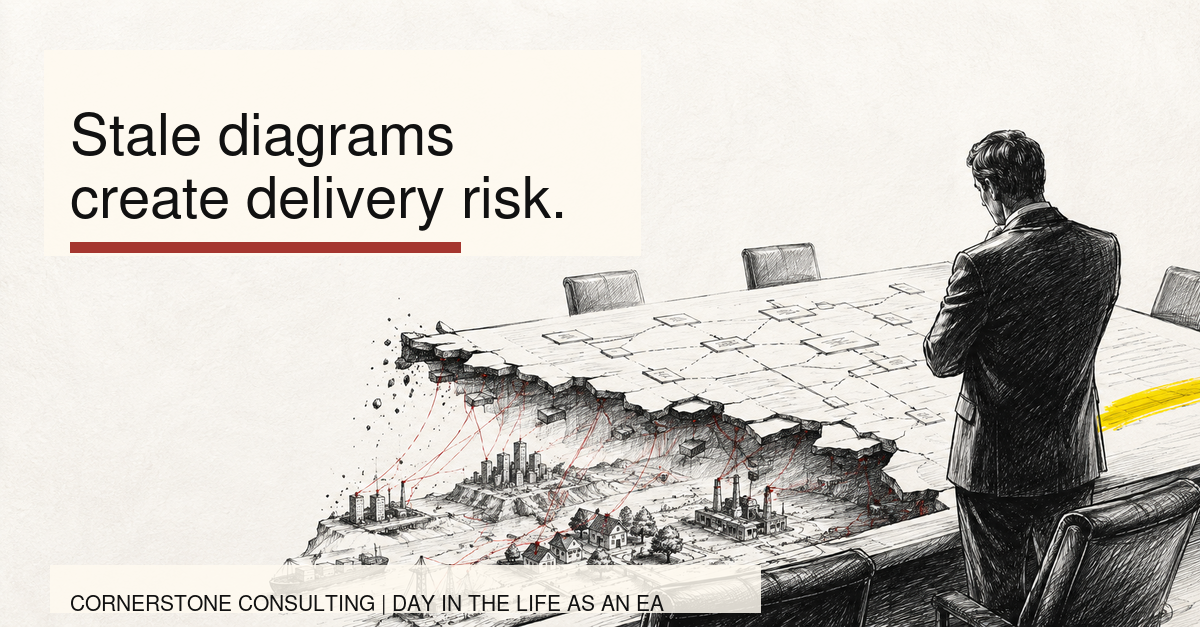
Your next project or roadmap may already be carrying yesterday’s architecture.
Not because the team is careless.
Because the diagram stopped learning.
Many organization I am at struggle to keep their architecture up to date. So this series will provide a practical EA leadership series on why current-state architecture, domain roadmaps, and initiative governance matter.
This series helps leaders, architects, and delivery teams understand how living current-state architecture and domain roadmaps turn enterprise complexity into clearer decisions, better investment sequencing, reduced risk, and more successful change.
Every architecture repository or diagram has a half-life.
It may be accurate when it is drawn, but every project, exception, integration change, policy decision, vendor update, and local workaround starts to move the enterprise away from the picture.
That gap is not harmless. It becomes with risks.
A stale diagram tells the steering committee the landscape is cleaner than it is. It tells delivery teams that dependencies are simpler than they are. It tells security, data, operations, and integration teams that someone else has already checked the impact.
Then the initiative starts, and reality arrives late.
The EA move
An Enterprise Architect treats current-state architecture as a living enterprise asset, not a documentation artifact. The question is not, “Do we have a diagram or an inventory of…?” The better question is, “Would this view help us make a better funding, scope, risk, or sequencing decision today?”
If the answer is no, the artifact is not current enough to guide investment.
This matters in large transformations, ERP, cloud, data, AI, and modernization work because small inaccuracies compound. One missing interface can affect testing. One outdated ownership model can slow decisions. One invisible data dependency can reshape migration risk. One undocumented exception can become the pattern everyone copies.
Good EA capabilities help teams update architecture at the speed of meaningful change. That does not mean documenting everything. It means keeping the critical architecture that influence decisions current enough to reduce rework, expose tradeoffs, and protect enterprise coherence. EA tools like Avolution Abacus can optimize this capability.
The practical takeaway
A useful current-state view starts with answering three simple questions:
What exists today?
What risk or constraint does it create?
What decision should this change next?
If your architecture cannot answer those questions, it may still be interesting, but it is not yet useful.
For the Enterprise Architect, the discipline is to keep architecture close to reality by just doing enough to add value. That is where governance becomes practical. That is where transformation assurance earns trust. This is where services like Cornerstone’s EA coaching and ERP transformation advisory can quietly help leaders move from assumption to decision confidence.
Reflection
Where are we still making decisions from architecture that describes the enterprise as it used to be, rather than as it is today?
Practice
Before the next intake, funding, or design conversation, choose one active relevant portfolio or ecosystem and mark three things: what changed recently, what decision the view now supports, and what risk remains unclear.
What have your experiences been?
Darin Paton is the Owner of Cornerstone Consulting Inc., an Alberta-based enterprise architecture and SAP ERP transformation advisory firm serving organizations across complex business and technology change for over 15 years. 30+ years as an EA and using SAP.
Enterprise Architecture, Current-State Architecture, ERP Transformation, SAP, Architecture Governance, Transformation Assurance, EA Coaching, Delivery Risk, Decision Confidence

Leave a Reply