

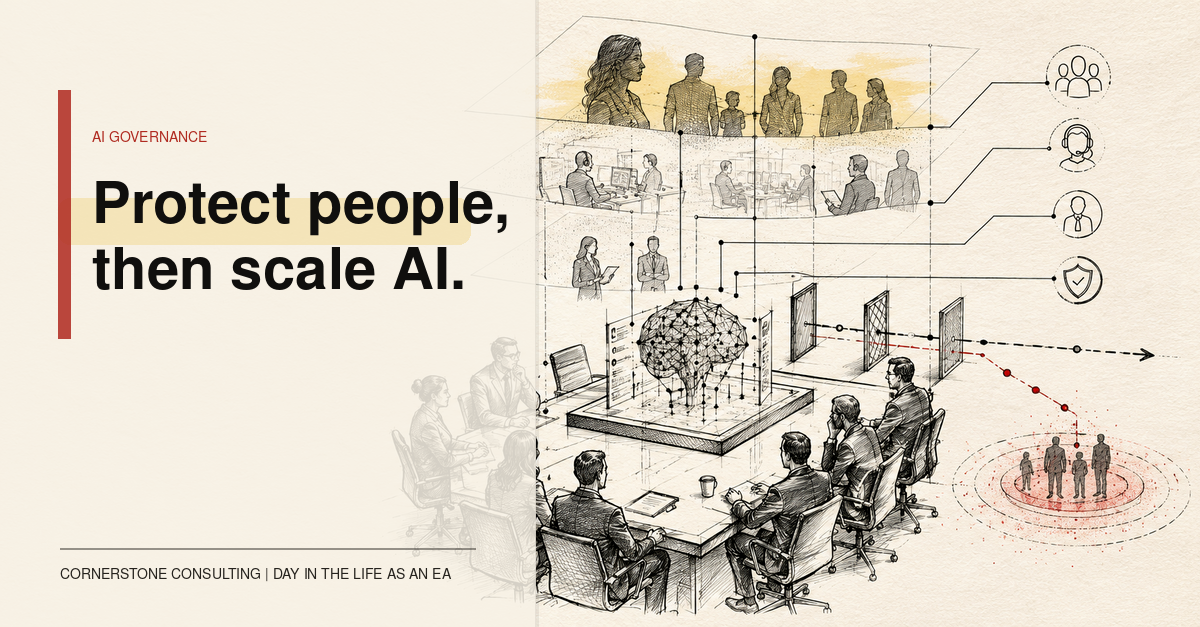
Who is close enough to be affected by this AI decision?
AI governance at enterprise scale must protect people.
Scale only what you can protect.
AI governance can become abstract very quickly. The language moves to frameworks, policies, model inventories, regulatory exposure, and committee design. Those things matter. But an executive should keep asking a simpler question: who is close enough to be affected by this AI decision?
In enterprise work, the affected person is not always visible. It may be a customer whose request is scored by a model, an employee whose workload changes because automation moved the exception path, a support team absorbing new confusion, a frontline leader explaining a decision they did not design, or a risk owner discovering too late that control evidence is missing.
This is why AI governance at enterprise scale must protect people before it protects the program narrative. A model can be efficient and still create unfair burden. A workflow can reduce cost and still hide accountability. A dashboard can look precise and still mislead a leader who does not understand the assumptions beneath it.
Enterprise architecture helps executives see those consequences before they harden. It traces AI-enabled decisions across capabilities, data, process steps, integrations, controls, roles, service channels, and customer outcomes. Enterprise architects can help leaders translate that map into practical choices: where human review stays, where communication is needed, where support capacity must change, where bias or error could hurt trust, and where value should be measured in lived operational outcomes.
For an executive, the governance question is not only, Can we do this? It is, Who carries the consequence if we do this poorly? That question changes the conversation. It moves AI from a technology agenda to an enterprise responsibility.
The best AI governance does not slow progress for its own sake. It makes progress more worthy of trust. It ensures that scale does not outrun accountability, that efficiency does not erase care, and that people affected by AI decisions are not treated as distant edge cases. If the enterprise cannot name the neighbor in the decision path, it is not ready to scale the decision.
Reflection
Who is most exposed to the consequences of your highest-impact AI decisions, and have they been represented in governance?
Practice
For one AI use case, map the affected people: customer, employee, support team, control owner, data owner, and decision owner. Then add one protection for each group.
What is one signal that a strategy is moving from aspiration to commitment?
Where do architects add the most value in turning intent into operating change?
Inspired by: Luke 10:29
Darin Paton is the Owner of Cornerstone Consulting Inc., an Alberta-based enterprise architecture and SAP ERP transformation advisory firm serving organizations across complex business and technology change for over 15 years. 30+ years as an EA and SAP.

Leave a Reply