

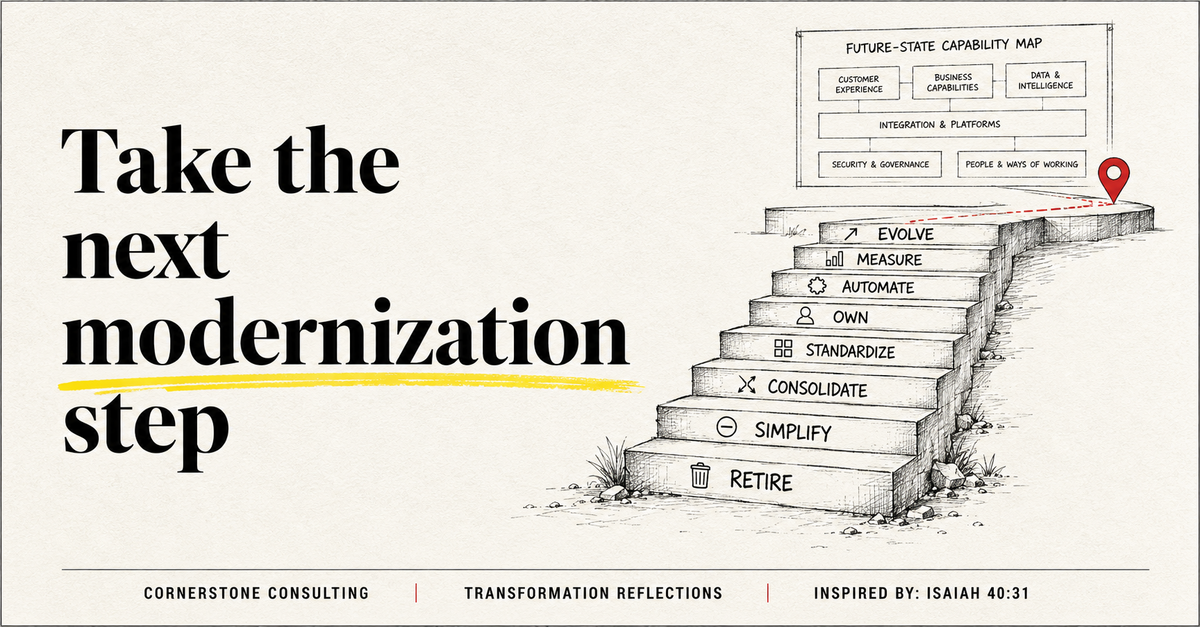
Modernization can look too large to start.
The portfolio will not move all at once.
Architects help leaders take the next step.
I have seen teams freeze because modernization feels too large. Progress usually starts when architecture turns the landscape into one clear next decision, one owner, and one measurable step.
Application rationalization often becomes overwhelming because the full landscape is too large to absorb at once. Hundreds of systems, years of custom work, uncertain ownership, duplicate capabilities, brittle integrations, missing documentation, and competing priorities can make modernization feel like a staircase with no landing. When the work feels that big, leaders may delay until the cost, risk, or transformation pressure becomes unavoidable.
An Enterprise Architect helps by turning the big problem into a disciplined next step. That does not mean shrinking the ambition. It means sequencing it. Which application must be assessed first because it blocks AI readiness, cyber control, cloud movement, SAP transformation, cost reduction, or data trust? Which decision needs ownership? Which dependency must be exposed? Which duplicate capability can be retired without harming operations? Which modernization move creates confidence for the next one?
The value of EA is not only the future-state picture. It is the ability to help the enterprise move toward that picture without pretending everything can change at once. Good rationalization work gives leaders a path: assess, decide, retire, simplify, migrate, measure, and learn. Each step should reduce uncertainty, improve decision quality, and release capacity for the next step.
This also keeps the portfolio conversation from becoming performative. A large roadmap can impress people while still leaving them unsure what to do on Monday. A useful architecture plan makes the next decision small enough to act on and important enough to matter. It connects near-term movement to long-term simplification.
This is also where coaching matters. Teams may know the current state is costly, but they need help turning pressure into manageable action. Enterprise architecture can hold the wider map while guiding leaders through the next practical decision. The portfolio changes when people can see both the destination and the next safe foothold. Modernization is sustained by disciplined movement, not heroic leaps.
Reflection
Where has the size of the modernization problem made the next decision harder to see?
Practice
Choose one rationalization candidate and define the next step only: evidence needed, decision owner, affected teams, dependency risk, value measure, and review date.
Does this resonate? Feel free to ask any questions you might have.
Darin Paton is the Owner of Cornerstone Consulting Inc., an Alberta-based enterprise architecture and SAP ERP transformation advisory firm serving organizations across complex business and technology change for over 15 years. 30+ years as an EA and using SAP.
enterprise architecture, application rationalization, modernization roadmap, technical debt, SAP transformation, portfolio management, transformation leadership, Cornerstone Consulting

Leave a Reply