

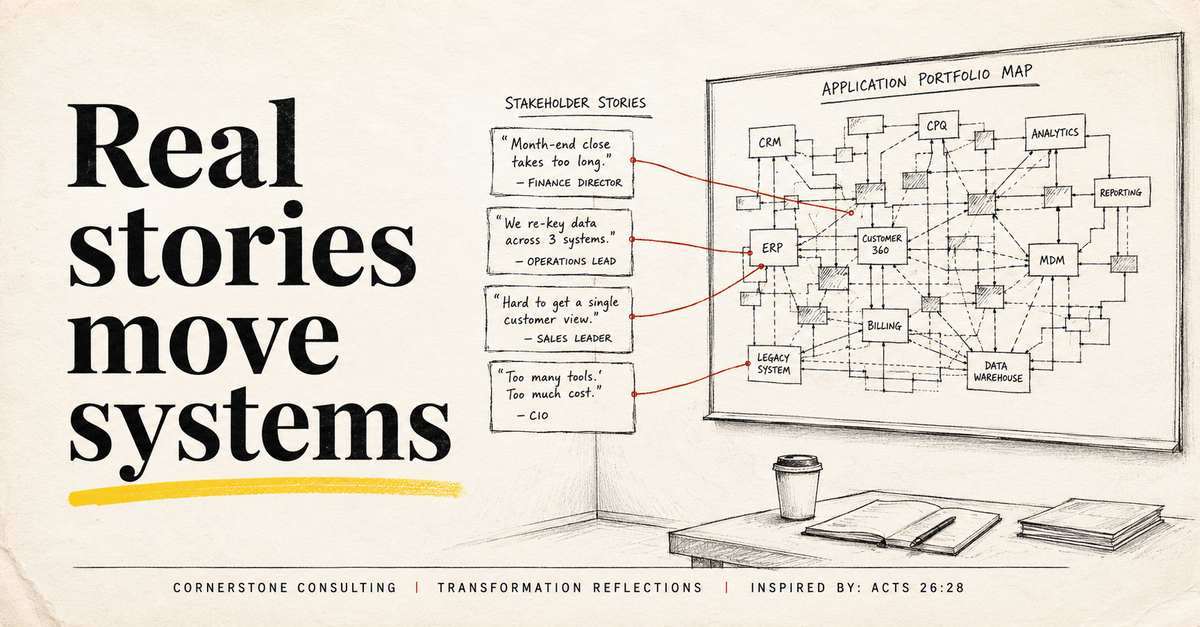
Architecture evidence is not only diagrams.
Sometimes the clearest proof is a real story from the work.
Here is why testimony matters in modernization.
A single honest project story do what ten diagrams could not: help leaders feel the cost of complexity. Architecture gets stronger when lived experience and hard evidence meet. Story-telling is such an important skill as an EA.
Application rationalization can become trapped in abstract language. Heat maps, cost models, lifecycle scores, interface counts, and risk ratings all matter, but they rarely move a room by themselves. Leaders need evidence they can trust, and sometimes the most useful evidence is a simple story from the work: the customer delayed by duplicate data, the analyst reconciling reports every Friday, the plant team using a spreadsheet because the core system cannot support the process, or the project team paying for the same capability twice.
For a Strategic Enterprise Architect, stories are not decoration. They are operating evidence. A well-chosen story turns technical debt into lived business consequence. It helps leaders understand why a rationalization decision is not only an IT cleanup exercise. It is a choice about speed, trust, risk, cost, employee effort, customer experience, and transformation capacity.
The discipline is to keep the story honest. Do not exaggerate it. Do not use it to embarrass a team. Connect it to the architecture facts: which capability is affected, which application is involved, which data dependency is weak, which process workaround has become normal, and which investment decision would remove or reduce the burden. When story and architecture evidence meet, the conversation changes. People stop debating whether the diagram is technically correct and start asking what decision the enterprise has avoided.
That combination also protects the architect from becoming either too technical or too theatrical. The story creates attention. The architecture evidence creates credibility. The recommendation creates movement. When all three are present, rationalization becomes less about defending a spreadsheet and more about helping the enterprise understand what its own work is already saying.
Good EA communication does not hide complexity. It translates it. The strongest rationalization case often combines one clear human example with a small set of hard evidence. That mix gives executives and delivery leaders enough context to care, enough confidence to act, and enough discipline to avoid making the story bigger than the facts support.
Reflection
What real work story would help leaders understand the cost of one application or data problem?
Practice
Pair one rationalization recommendation with a short field story, then validate it against portfolio, cost, risk, and ownership evidence before using it with leaders.
Darin Paton is the Owner of Cornerstone Consulting Inc., an Alberta-based enterprise architecture and SAP ERP transformation advisory firm serving organizations across complex business and technology change for over 15 years. 30+ years as an EA and SAP.
enterprise architecture, application portfolio management, application rationalization, technical debt, executive communication, modernization, SAP ERP, Cornerstone Consulting

Leave a Reply