

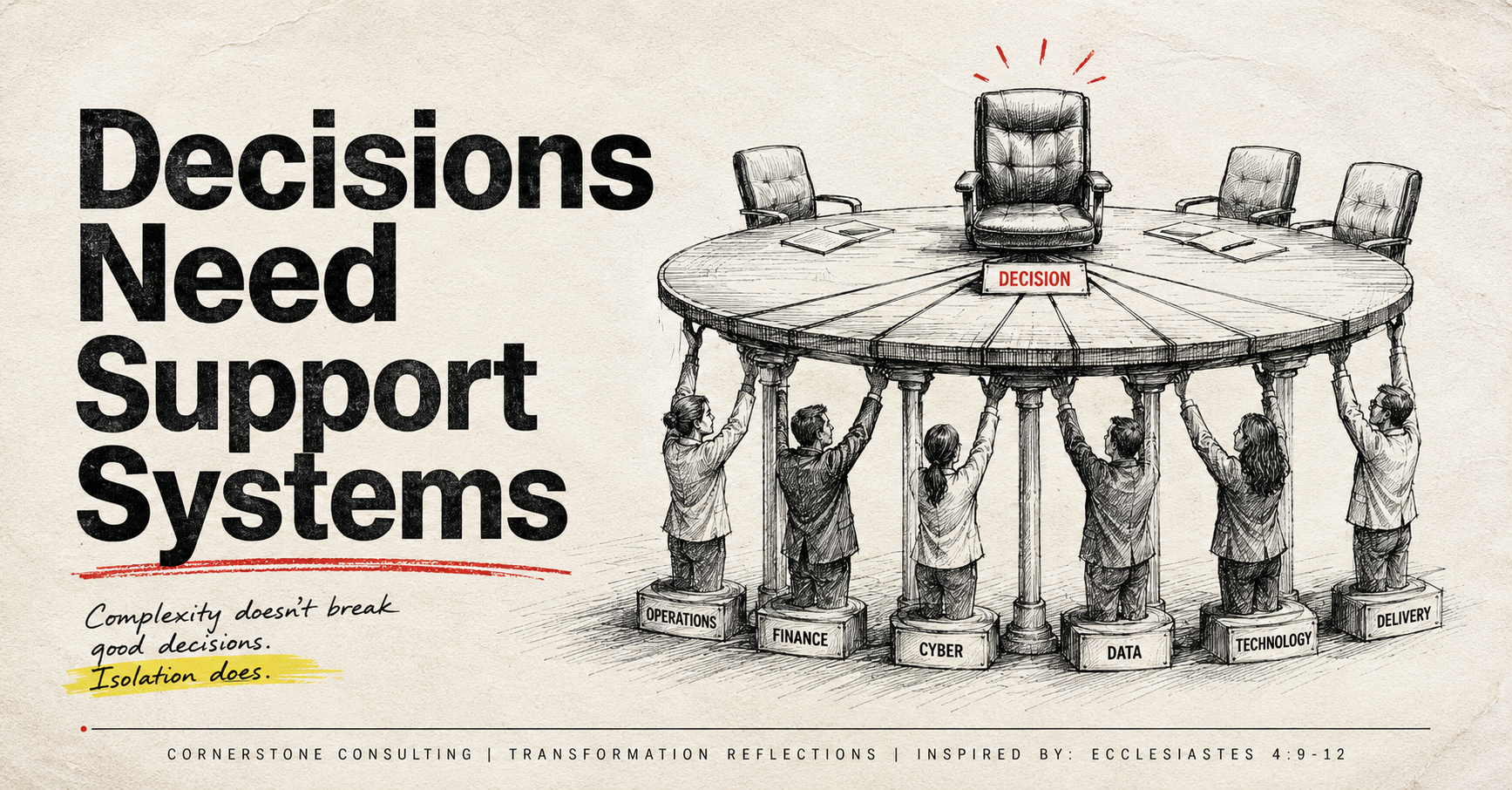
The org chart says who owns the decision.
The operating model shows who carries it.
That gap is where transformation slows down.
The org chart may name one accountable executive, but enterprise decisions are rarely carried by one person. They move through finance, operations, cyber, data, technology, procurement, legal, delivery teams, support teams, and the people who inherit the changed way of working.
That is why decision rights cannot be treated as a neat box on a governance slide. A decision right is only useful if the organization around it can help the decision stand up.
When a transformation stalls, leaders often look for the person who failed to decide. Sometimes that is fair. More often, the operating model made the decision lonely. The accountable leader had the title, but not the dependency view. The delivery team had the urgency, but not the authority. Finance had the cost lens, but not the capability impact. Cyber had the risk signal, but not the forum to change the sequence. Everyone had part of the truth, but no one had the whole load.
C-level leaders can change that pattern. Rewiring decision rights is not just assigning approval levels. It is designing how people help each other make better decisions before pressure hardens the wrong choice. This is where enterprise architecture earns its practical value. Capability maps, dependency views, integration models, risk paths, data ownership, and benefit measures are not architecture paperwork. They are the shared evidence that lets executives see who must be in the decision, who will carry the consequence, and what support the decision needs after approval.
A strong operating model makes teamwork visible. It shows when a decision needs challenge, when a team needs authority, when a dependency needs funding, and when an executive forum needs to slow down long enough to protect the outcome.
The best leaders do not make every decision alone. They build a decision system where the right peers can help the enterprise stand back up when complexity knocks one part of it down.
Reflection
Where are your decision rights clear on paper but lonely in practice? Look for the places where one executive owns the outcome while key peers hold pieces of the evidence, authority, risk, cost, or operating impact.
Practice
Pick one recurring transformation decision. Map who approves it, who informs it, who absorbs the consequence, who can challenge it, and who supports it after approval. If those groups are different, redesign the forum before the next major decision.
Darin Paton is the Owner of Cornerstone Consulting Inc., an Alberta-based enterprise architecture and SAP ERP transformation advisory firm serving organizations across complex business and technology change for over 15 years. 30+ years as an EA and using SAP.
enterprise architecture, C-level leadership, operating model, decision rights, transformation governance, SAP transformation, executive decision making, capability planning, Cornerstone Consulting

Leave a Reply