

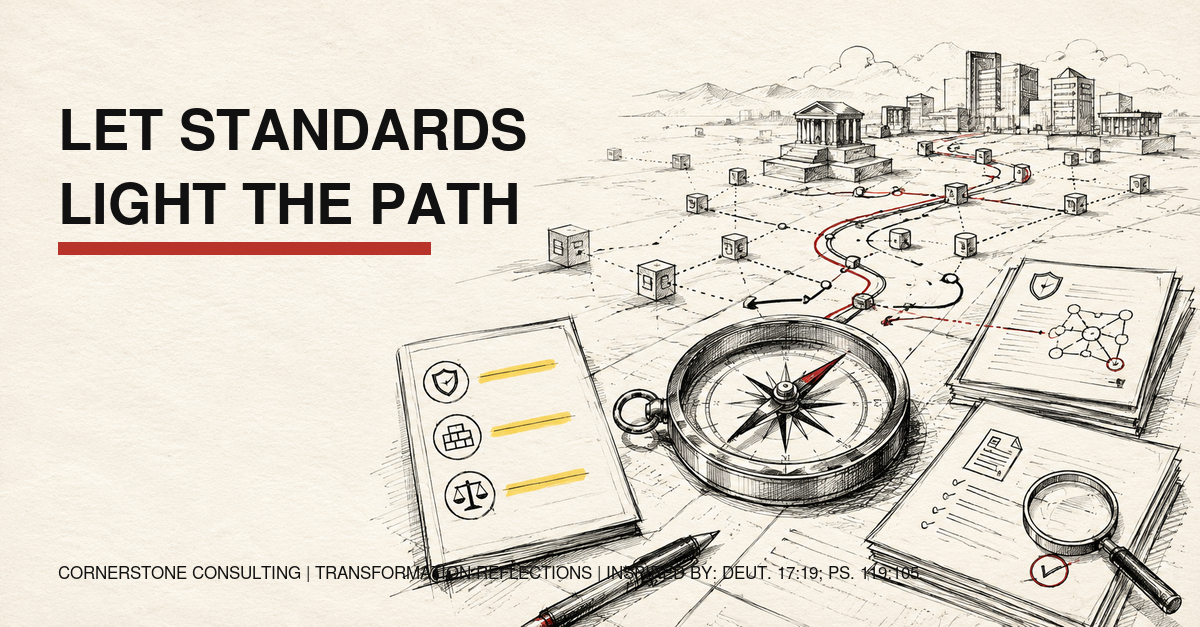
Standards are useless in a drawer.
They matter when pressure arrives.
That is when architecture needs a visible path.
I am amazed at how many organizations do not have standards defined. Standards are critical and gain respect when teams can use them in the moment of decision or aligning with external service providers. Architecture becomes practical making work more efficient when standards are defined that people can follow.
Every enterprise has rules. The question is whether those rules actually guide decisions when the work gets complicated.
For an Enterprise Architect, security, resilience, and regulatory traceability cannot live only in policy documents, reference models, or compliance portals. They need to become usable guidance in the path of real delivery. Otherwise teams make local choices under pressure, and the enterprise discovers later that nobody can explain the control, prove the lineage, recover the service, or defend the exception.
Good standards are not heavy because they exist. They become heavy when people cannot see how to use them.
The architecture discipline is to turn standards into decision support. What does this control mean for the product team? What evidence does the audit team need? What standards led approaches help delivery move without creating unmanaged risk? Which resilience tier fits the business process? Which data classification changes the integration design? Which exception needs an expiry date and owner?
This is where enterprise architecture can quietly strengthen the whole organization. It creates a practical line between policy intent and system reality. It helps cyber, data, risk, operations, and delivery peers work from the same map. It gives executives confidence that security and resilience are designed into the operating model rather than attached afterward.
EA advisory and coaching work is useful here because many organizations do not need more abstract standards. They need standards that travel into decisions, funding, delivery, ERP and cloud design, vendor choices, and operational support.
The architect’s work is to make that travel possible. A good standard should help a product owner, solution architect, security lead, data steward, and executive sponsor reach the same decision for the same reason, even when they enter the conversation from different pressures.
A standard that cannot guide a decision is only a document. A standard that lights the path becomes architecture people can actually follow.
Reflection
Which security, resilience, or compliance standard in your organization is respected in principle but hard for teams to apply in practice?
Practice
Choose one standard and turn it into a one-page decision guide: when it applies, who owns it, what evidence is required, what pattern is preferred, and how exceptions expire.
Leave a indicator if you have standards defined in your organization.
Darin Paton is the Owner of Cornerstone Consulting Inc., an Alberta-based enterprise architecture and SAP ERP transformation advisory firm serving organizations across complex business and technology change for over 15 years. 30+ years as an EA and using SAP.
enterprise architecture, architecture standards, security architecture, resilience planning, regulatory compliance, decision guidance, EA coaching, Cornerstone Consulting, SAP ERP, transformation leadership

Leave a Reply