

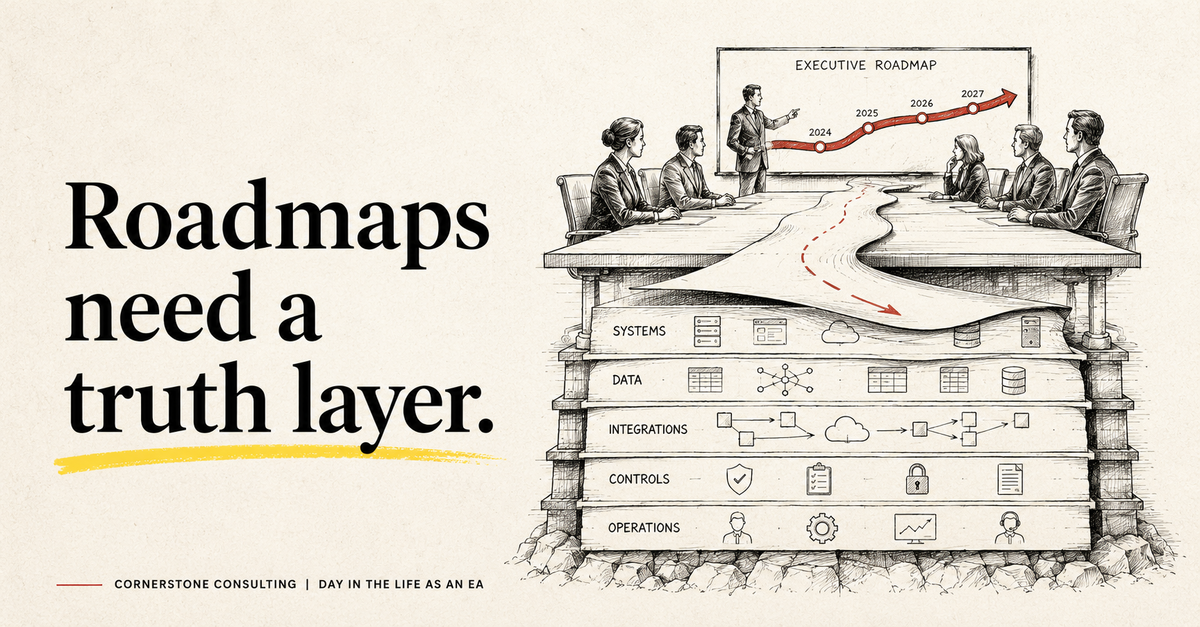
Most roadmaps look confident on slides.
The trouble starts when the baseline is assumed.
Execution needs more than ambition.
It needs current-state architecture.
A roadmap without current-state architecture is just aspiration.
I have seen strong roadmaps lose credibility when the current-state architecture was assumed instead of verified. The decisions becomes clearer when enterprise architects, business owners, delivery, data, security, operations, and SAP peers build the roadmap from facts the enterprise can trust.
It may have dates, workstreams, dependencies, and a polished executive story. But if it is not grounded in what exists today, it can quietly become a promise the enterprise is not ready to keep.
Enterprise Architects see this every day. A business roadmap says modernize the platform. A program roadmap says simplify integration. A portfolio roadmap says retire legacy capability. Those are useful intentions, but they are not yet executable. The missing question is practical: what must be true in the current-state architecture before this roadmap can move safely?
Current-state architecture gives the roadmap a truth layer. It shows the systems already carrying business processes, the data ownership that will slow migration, the integrations that cannot be broken, the controls that must stay intact, and the operational teams that will inherit the change. Without that baseline, sequencing becomes guesswork. Funding goes to visible projects while invisible prerequisite work waits until delivery is already under pressure.
For an Enterprise Architect, this is not a theoretical discipline. It is the daily habit of keeping capability, application, data, integration, risk, and operating catalogues and views close enough to reality that leaders can make better calls. The value is not the data or the diagram. The value is the decision it makes possible.
This is where EA coaching and architecture advisory matter. Not as more documentation, but as disciplined translation between strategy, portfolio, SAP or ERP transformation, delivery, security, data, and operations. The Enterprise Architect helps leaders see whether the roadmap is an executable path or a collection of hopeful milestones.
A useful roadmap should answer three minimalistic questions. What exists today? What constraint or risk does it create? What decision must change because of it?
When answers are visible, executives can fund dependencies earlier, delivery teams can plan with fewer surprises, and architecture governance becomes a way to improve decision quality rather than slow the work down.
The test is simple. If the roadmap cannot explain the current-state facts behind its sequence, it is not ready to be trusted as an execution plan. It may still be a good ambition. It is just not yet an enterprise roadmap.
Reflection
Where does your current roadmap depend on assumed current-state facts rather than verified architecture evidence?
Practice
Before the next roadmap review, ask the Enterprise Architect to identify the three current-state facts that most affect sequencing: a dependency, a risk, and a decision that must change.
Any experiences or frustrations to share?
Darin Paton is the Owner of Cornerstone Consulting Inc., an Alberta-based enterprise architecture and SAP ERP transformation advisory firm serving organizations across complex business and technology change for over 15 years. 30+ years as an EA and using SAP.
#EnterpriseArchitecture, #EnterpriseArchitect, #Roadmaps, #CurrentStateArchitecture, #SAP, #ERPTransformation, #TransformationGovernance, #CornerstoneConsulting

Leave a Reply