

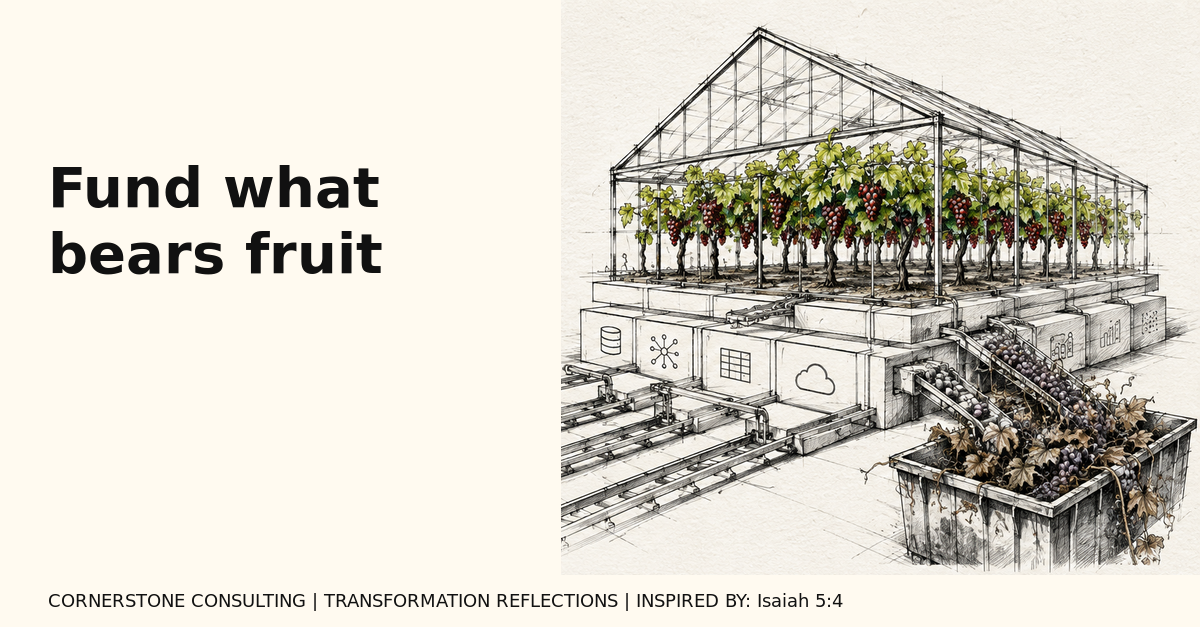
The enterprise has funded the foundations.
Now leaders must ask what they produced.
That question is uncomfortable for a reason.
I see it everytime, strong investments disappoint because no one defined the fruit or have over committed the expectations. The shift came when leaders named the business outcomes the foundation had to support and governed those outcomes.
Executives can invest heavily in modernization foundations and still avoid the hardest question: what did those foundations actually produce? The enterprise may have funded a data platform, integration tooling, process redesign, cloud migration, reporting cleanup, and governance forums. Those are real investments. But investment alone is not fruit.
Fruit looks like trusted decisions, lower manual effort, cleaner customer experience, faster change, reduced control risk, better cost transparency, reusable integration patterns, and business teams that can act without waiting for hidden technical rescue. If those outcomes are not visible, the executive team should not simply approve the next funding wave. It should ask what condition is still missing.
Maybe the technology was installed but ownership stayed unclear. Maybe the data model was built but business definitions were never reconciled. Maybe integration standards exist but exceptions are easier than compliance. Maybe modernization removed old systems but kept old process behavior. Maybe governance meets often but does not change decisions.
This is not a reason to shame delivery teams. It is a reason to inspect the operating system around the investment. Enterprise architecture is useful here because it connects the visible spend to the capabilities, decisions, dependencies, and measures that should prove value. A good architecture view helps executives ask, “What did we expect this foundation to enable, and where is the evidence?”
EA advisory should quietly reinforce that modernization is not a technology purchase. It is a managed change in how the enterprise makes decisions, shares data, integrates work, controls risk, and sustains value after launch.
The executive discipline is to expect fruit from funded foundations. If the enterprise has provided time, money, platforms, people, and authority, then leaders should look for outcomes. If the outcomes are not there, do not hide behind activity. Find the missing condition, fix the ownership, and make the foundation productive.
Reflection
Where has my organization funded modernization foundations but failed to define the business fruit those foundations must produce?
Practice
Pick one major foundation investment and write five expected outcomes in business language. Then test whether each outcome has an owner, measure, dependency map, and review date.
I’m interested in hearing what other leaders are experiencing in their organizations.
Darin Paton is the Owner of Cornerstone Consulting Inc., an Alberta-based enterprise architecture and SAP ERP transformation advisory firm serving organizations across complex business and technology change for over 15 years. 30+ years as an EA and using SAP.
C-level leadership, enterprise architecture, modernization value, data platforms, integration strategy, transformation outcomes, business value, Cornerstone Consulting

Leave a Reply