

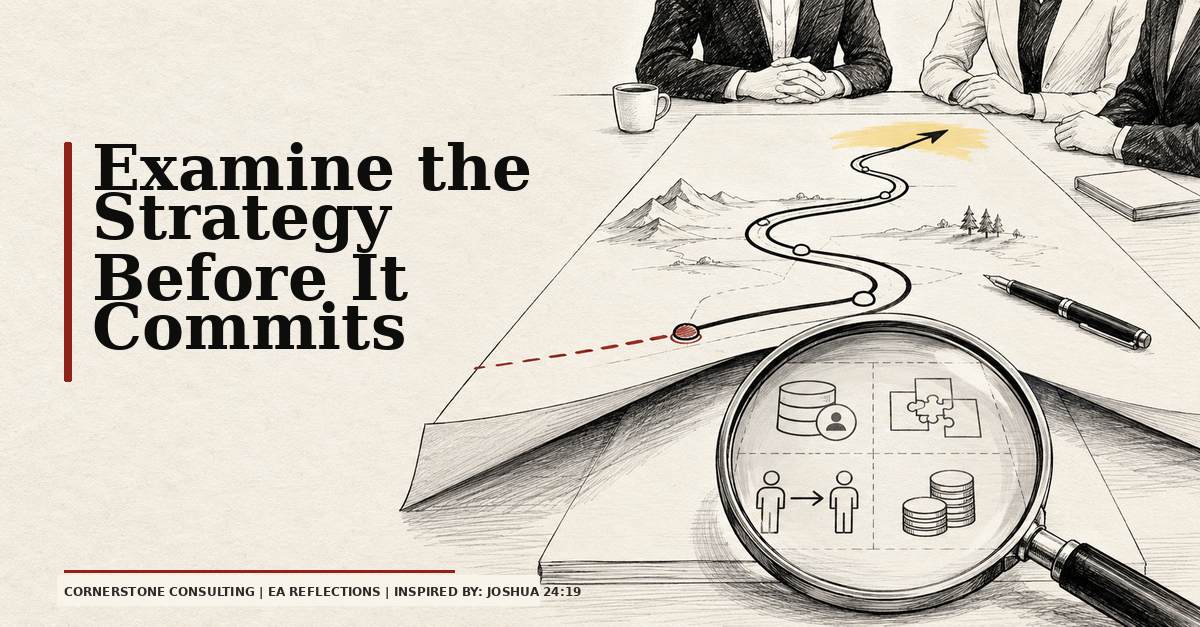
Some strategies are too confident too early.
They sound aligned, funded, and ready.
Then capability reality quietly says: not yet.
I have watched strong strategies struggle because hidden capability assumptions were never tested early. The useful EA move is often simple: help leaders see what the promise requires before the enterprise commits to carrying it.
Capability translation is not only the art of explaining a future state. It is also the discipline of testing whether the enterprise is ready to live with the promise it is making.
An Enterprise Architect often enters when a proposal already has energy around it. Sponsors want a roadmap. Delivery teams want scope. Finance wants confidence. Technology leaders want the platform direction to settle. In that moment, the easiest move is to help the commitment look organized. The harder and more useful move is to examine the hidden reliance inside the strategy.
What capability is being assumed but not funded? What data ownership is being treated as solved? Which integration dependency is sitting quietly under the timeline? Which operating role has accountability without authority? Which SAP process, cloud service, vendor constraint, control expectation, or reporting obligation is being carried as a footnote instead of a design condition?
The question matters because weak translation usually hides in respectable language. “We will standardize the process” can hide five regional operating models. “We will improve reporting” can hide unresolved master data ownership. “We will modernize the platform” can hide an integration pattern no one wants to fund. Strategy becomes safer when these phrases are opened before they become commitments.
That examination is not negativity. It is respect for the enterprise. A strategy that cannot survive honest capability questions is not ready for commitment. It may still be a good direction, but it needs a clearer bridge between ambition and operating truth.
This is where enterprise architecture and EA coaching create value without becoming promotional noise. They help leaders see the connection between current capability, target outcome, investment sequence, decision rights, and transformation gaps before the organization hardens around a weak promise.
The architect’s work is to make the commitment more truthful. Not heavier. Not slower. More truthful.
Reflection:
Where is your current strategy relying on a capability that has not yet been named, owned, funded, or tested?
Practice:
Before the next approval conversation, write one page with four columns: strategic promise, required capability, current evidence, and gap to close. Bring the gap to the decision while it can still change the plan.
Where are you seeing tension between what is designed and what is actually lived?
Darin Paton is the Owner of Cornerstone Consulting Inc., an Alberta-based enterprise architecture and SAP ERP transformation advisory firm serving organizations across complex business and technology change for over 15 years. 30+ years as an EA and involved with SAP implementations.

Leave a Reply