

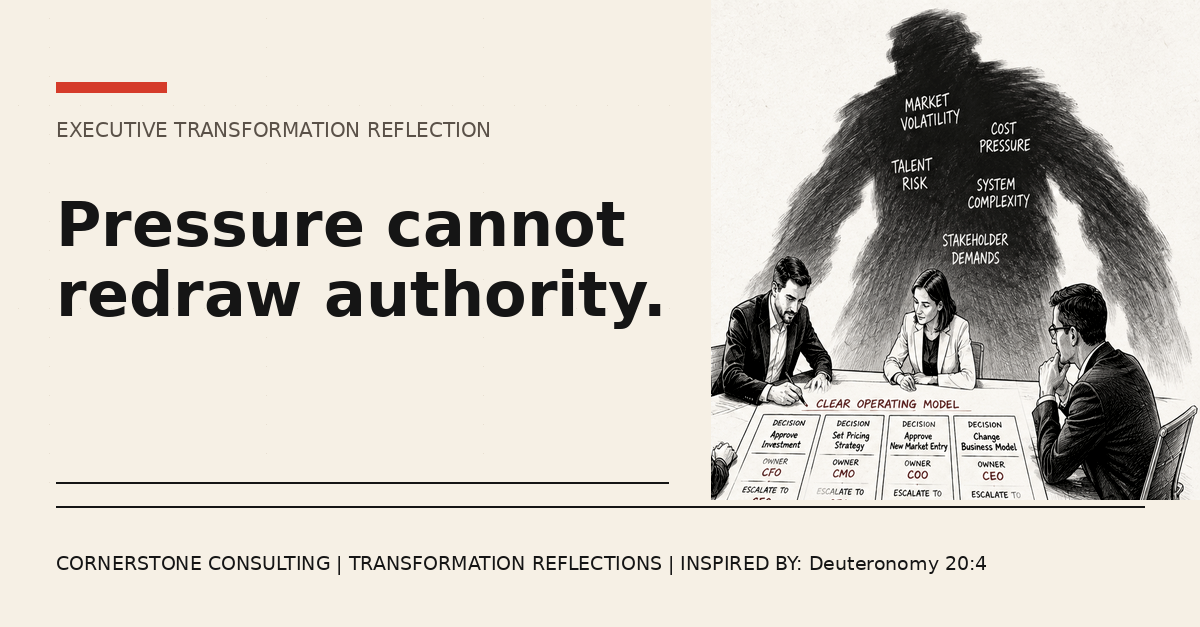
Big problems quietly rewrite decision rights.
That is where operating models either hold or disappear.
Here is how leaders keep authority from drifting.
I have witnessed big problems quietly move decision rights to whoever feels most urgent. Stronger transformations name the pressure, then protect the authority model before the work starts improvising around it.
Every executive eventually faces a problem that looks bigger than the organization’s design. The market turns. A regulator moves. A transformation deadline collapses. A system limitation becomes public. Suddenly the room is tempted to let the giant define the operating model.
That is a dangerous moment. Under pressure, decision rights often move without being named. A steering committee becomes symbolic. A project lead starts making enterprise trade-offs. A senior sponsor bypasses controls to create momentum. A vendor becomes the practical decision-maker because internal ownership is unclear.
The issue is not courage. Executives need courage. The issue is where courage is anchored. If courage is only personal will, the organization may attempt something large while leaving the operating model too weak to carry it.
If courage is anchored in clear authority, evidence, and ownership, the enterprise can take on difficult work without surrendering its structure.
This is where enterprise architecture and EA coaching help the executive team slow down just enough to protect the work. The question is not, “Can we overcome this?” It is, “What authority, capability, data, risk ownership, and control path must be real for this attempt to be responsible?”
A large challenge can reveal design weakness. That is useful. It can expose unclear decision forums, missing escalation routes, unowned data, brittle ERP dependencies, control gaps, and adoption assumptions. But the challenge should not be allowed to redraw the enterprise by force.
The better executive posture is disciplined resolve. Name the giant, then name the operating model that will face it. Decide who owns the call, what evidence will guide it, what risks are acceptable, and where the organization must not improvise. Make the escalation route visible before the room becomes emotional. Confirm who can trade scope, cost, control, and timing.
Big work does not need heroic confusion. It needs authority that holds. When pressure is high, the strongest executive move may be to protect the decision design before pushing the decision itself.
Reflection
What current enterprise challenge is large enough to tempt people into bypassing the operating model?
Practice
Name the challenge, then name the authority design: who decides, who advises, who can trade scope/cost/control/timing, what evidence is required, and when escalation is mandatory.
Darin Paton is the Owner of Cornerstone Consulting Inc., an Alberta-based enterprise architecture and SAP ERP transformation advisory firm serving organizations across complex business and technology change for over 15 years. 30+ years as an EA and advising SAP transformations.

Leave a Reply