

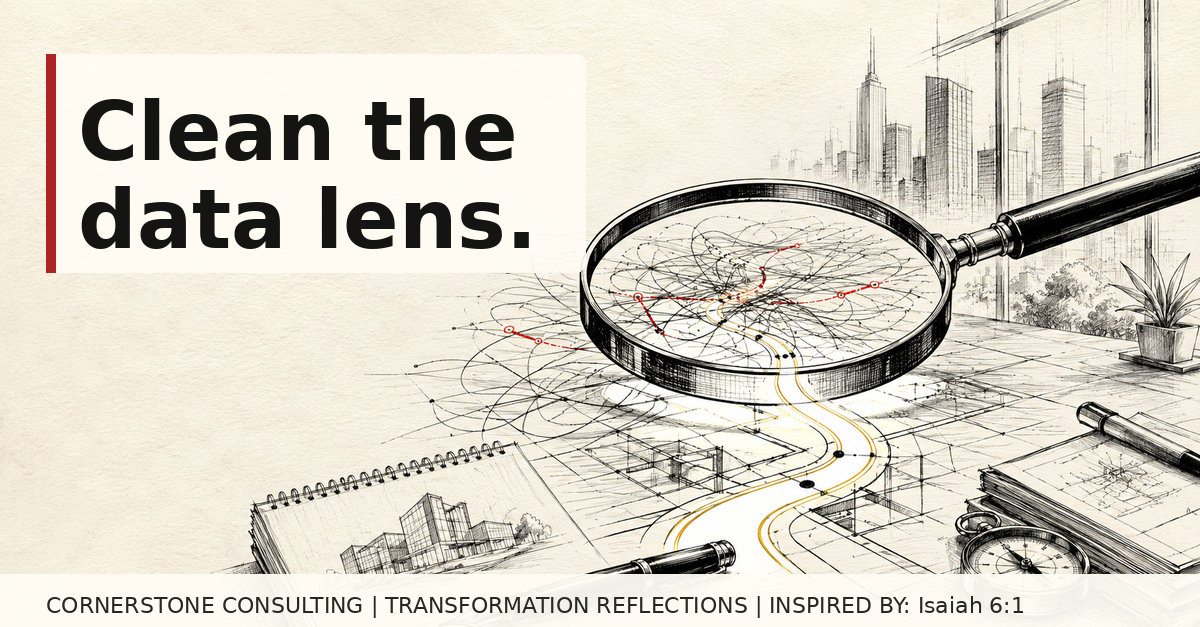
Leaders rarely make decisions from raw truth.
They make decisions through the lens the enterprise gives them.
If that lens is distorted, the decision will be too.
I have watched strong leaders make weak decisions because the data lens looked cleaner than it was. On complex programs, the architect’s value is often helping teams trace the view before the decision hardens.
Every enterprise has a decision lens.
It is made of reports, dashboards, data definitions, integration timing, ownership rules, manual adjustments, application fields, spreadsheet workarounds, and the stories leaders have learned to trust.
The hard part is that the lens can feel clear while still being distorted.
A favourite executive report can hide weak lineage. A trusted system can carry fields no one owns anymore. A transformation scorecard can show green because exceptions are outside the measure. A customer view can look complete while operations, finance, risk, and service are each carrying a different version of the same fact.
For an Enterprise Architect, data architecture is not a technical housekeeping exercise. It is the discipline of helping the enterprise see clearly before it commits money, risk, reputation, and operating capacity.
That takes character as much as method.
The architect has to hold the question open when the room wants a clean answer. Is this the system of record, or only the loudest system? Is the owner accountable, or only nearby? Is the metric decision-ready, or only presentation-ready?
It means being willing to question the dashboard everyone likes. It means skimming designs for the tracing of a metric back through source, transformation, owner, process, and control exists. It means asking whether the data used for an AI model, SAP decision, regulatory report, or modernization roadmap is trustworthy enough for the consequence attached to it.
This is where enterprise architecture and coaching quietly matter. They create a calm place to test what the organization thinks it sees. They connect business capability, process, data, systems, integration, and decision rights so leaders are not left staring through a polished but unreliable lens.
Enterprise architecture support services is most useful here when it helps teams slow down just enough to locate the distortion before the enterprise accelerates around it.
The price of clearer vision is not another diagram.
It is the willingness to let evidence correct the view.
Reflection
Where is your organization making a high-consequence decision through a data lens that has not been tested recently?
Practice
Pick one executive metric this week. Trace it from decision back to source system, owner, transformation rule, exception path, and business consequence. Write down the first place where confidence becomes assumption.
Darin Paton is the Owner of Cornerstone Consulting Inc., an Alberta-based enterprise architecture and SAP ERP transformation advisory firm serving organizations across complex business and technology change for over 15 years. 30+ years as an EA and involved in many SAP transformations.

Leave a Reply