

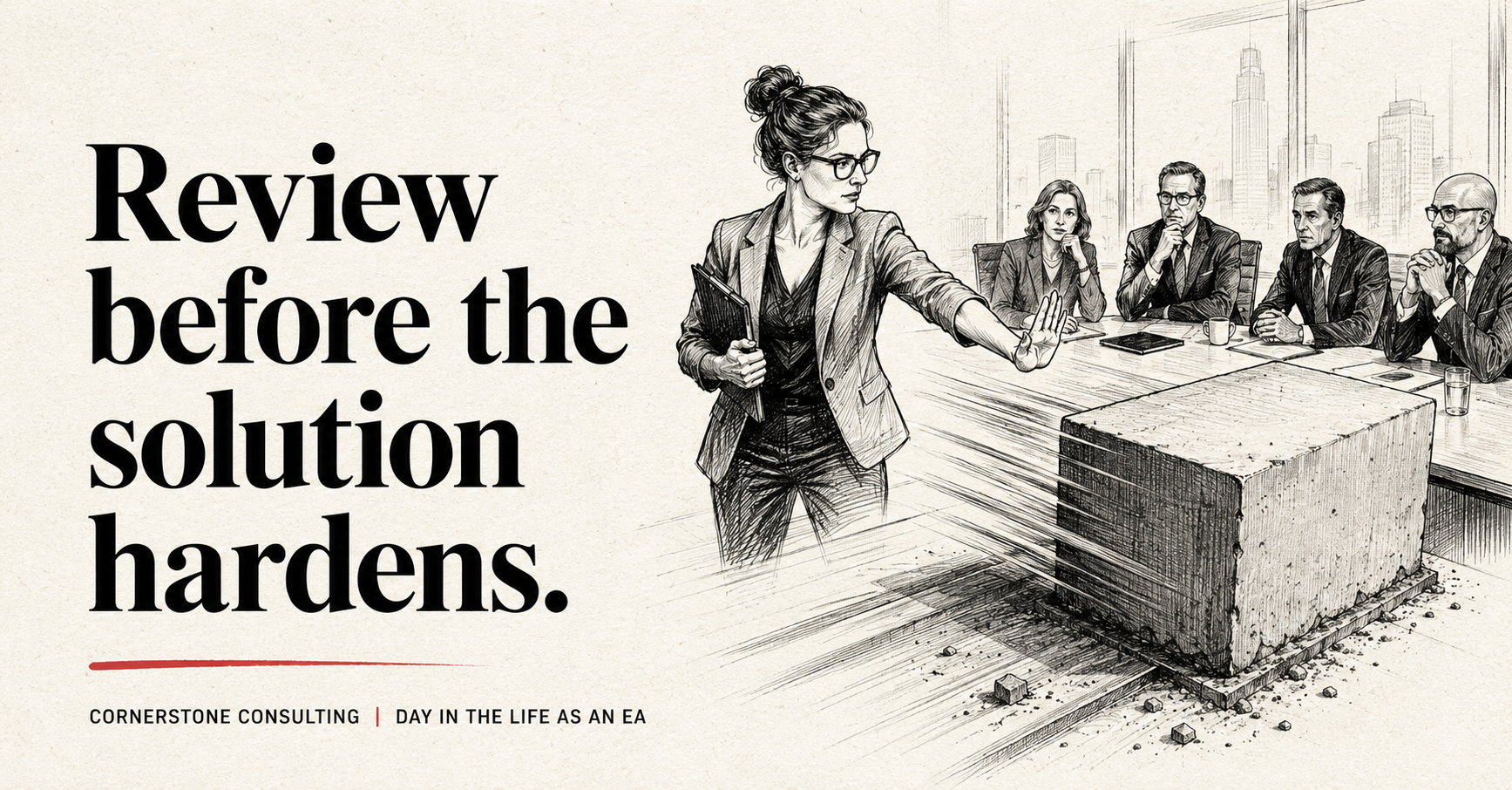
Most architecture reviews start too late.
The solution already has a sponsor, a vendor, and a date.
Here is the review that should happen before momentum hardens.
I have seen projects lose options when architecture arrives after a tool has already won the room. The better work happens earlier: shaping the question, surfacing dependencies, and helping leaders choose with clearer facts before cost, scope, and pride make the solution harder to change.
Architecture review should not start when a team has already selected the tool, shaped the scope, named the vendor, and promised the date. At that point, the review is no longer a decision support moment. It becomes a negotiation with momentum.
For an Enterprise Architect, initiative intake is where the better work begins for his team. Before the solution hardens, the EA can ask: what capability are we improving, what already exists, what data and integrations are affected, what policies or controls apply, who will operate it after go-live, and how does this change the roadmap?
These questions are not bureaucracy. They protect the enterprise from funding another local answer that creates enterprise consequences. A good idea can still duplicate an existing platform, bypass a standard pattern, create a new source of truth, add support cost, or introduce an exception nobody owns after delivery.
The practical shift is simple: move architecture review upstream. At intake, the EA does not need a perfect design. They need enough context to classify the initiative. Is it roadmap-aligned, roadmap-enabling, roadmap-conflicting, a justified exception, a short-term bridge, or a debt decision with an exit path?
This also changes the tone of governance. Instead of arriving late with objections, the EA helps shape the question while leaders still have options. That makes the review feel less like resistance and more like decision clarity.
This is where EA coaching and architecture advisory matter. The goal is not to slow the business down. The goal is to help leaders see trade-offs early enough to make cleaner choices. In SAP and ERP transformation work, this is especially important because a late architecture review often discovers process, data, integration, security, and sustainment impacts after commitments are already public.
The best architecture review feels less like a gate and more like an early conversation with consequences made visible. It gives business sponsors, delivery teams, and executives a shared view of the decision before money, politics, and schedule pressure make the decision harder to change.
Reflection
Where is architecture currently being invited only after the solution has already gained momentum?
Practice
For the next initiative intake, ask six questions before solution selection: what capability changes, what already exists, what data is affected, what integrations are touched, what controls apply, and who will operate it after go-live.
Do you currently have a project on the loose? How can you get engaged before its too late.
Darin Paton is the Owner of Cornerstone Consulting Inc., an Alberta-based enterprise architecture and SAP ERP transformation advisory firm serving organizations across complex business and technology change for over 15 years. 30+ years as an EA and using SAP.

Leave a Reply