

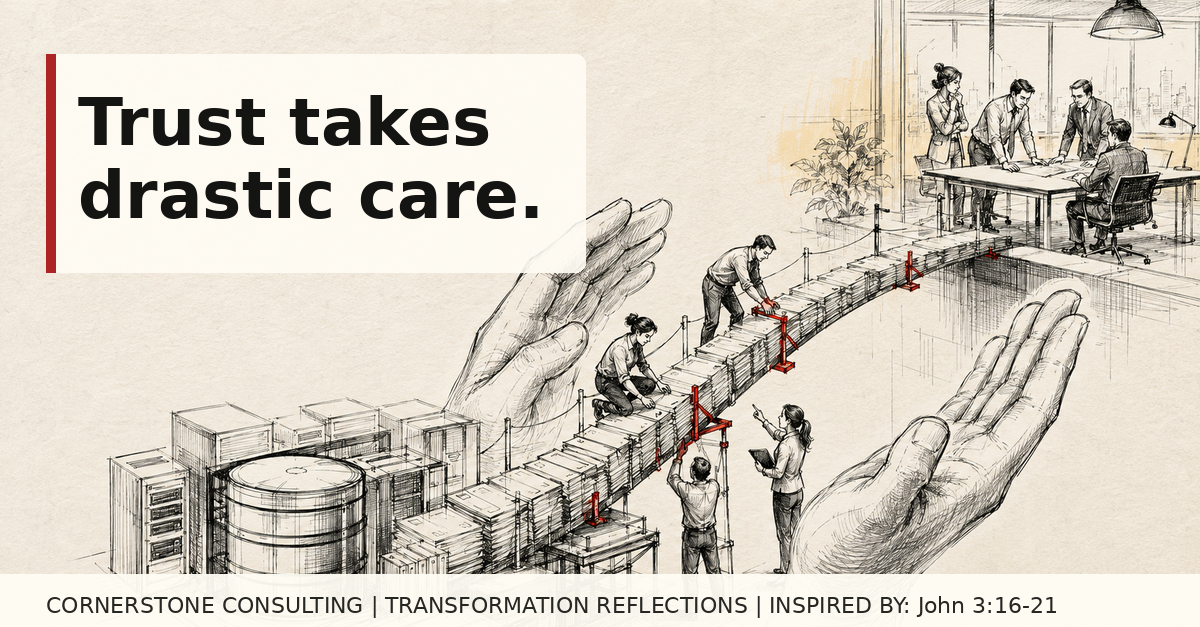
Trusted data is not created by sentiment.
It is created by persistent care.
Sometimes that care has to be drastic.
Many organizations, I am engaged with, underestimate how much care trusted data requires. When teams stay with the hard definitions, ownership gaps, a good cleansing regiment, and lineage breaks, confidence starts becoming operational instead of aspirational.
Trusted data does not attach to the enterprise by accident.
People may want it. Leaders may ask for it. Programs may name it as a dependency. Vendors may assume it will be ready. AI teams may build plans around it. SAP transformation teams may need it for process design, migration, controls, and reporting.
But trust is not created by desire.
Trust is created by persistent care.
That care can feel drastic because it refuses to leave the data alone when it is in trouble. It stays with the difficult definition. It keeps returning to the orphaned owner. It traces the uncomfortable lineage gap. It sits with operations long enough to understand the workaround. It asks why the customer, product, asset, vendor, employee, or financial record cannot yet carry the decision being placed on it.
For an Enterprise Architect, this is not soft work. It is some of the hardest enterprise work there is.
Data with weak attachment creates defensive behaviour. Teams protect their local truth. Functions stop trusting shared reports. Leaders ask for parallel analysis. AI use cases stall. ERP programs spend more time reconciling than improving. Controls become heavier because the underlying confidence is lighter than it should be.
The result is inefficiencies at numerous levels.
The architect’s role is to help the enterprise stay close to the data long enough for trust to become possible. That means engaging data architecture to connect data to capability, process, operating model, system ownership, integration, risk, and decision rights.
EA coaching also matters because leaders often underestimate how personal data issues become. People defend the reports they built, the processes they inherited, and the numbers they have used for years. A disciplined architecture approach gives the organization a less emotional way to repair trust.
Transformation advisory and enterprise architecture services support this kind of work by helping teams turn trusted data from aspiration into operating practice.
Trust takes care, and sometimes care has to stay longer than the problem is comfortable.
Reflection
Where does your enterprise need more persistent care before leaders can honestly call the data trusted?
Practice
Identify one data object that multiple teams distrust. Map the trust gap from the user’s point of view, then define the ownership, lineage, system, process, and control changes needed to rebuild confidence.
Darin Paton is the Owner of Cornerstone Consulting Inc., an Alberta-based enterprise architecture and SAP ERP transformation advisory firm serving organizations across complex business and technology change for over 15 years. 30+ years as an EA and advising SAP transformations.

Leave a Reply