

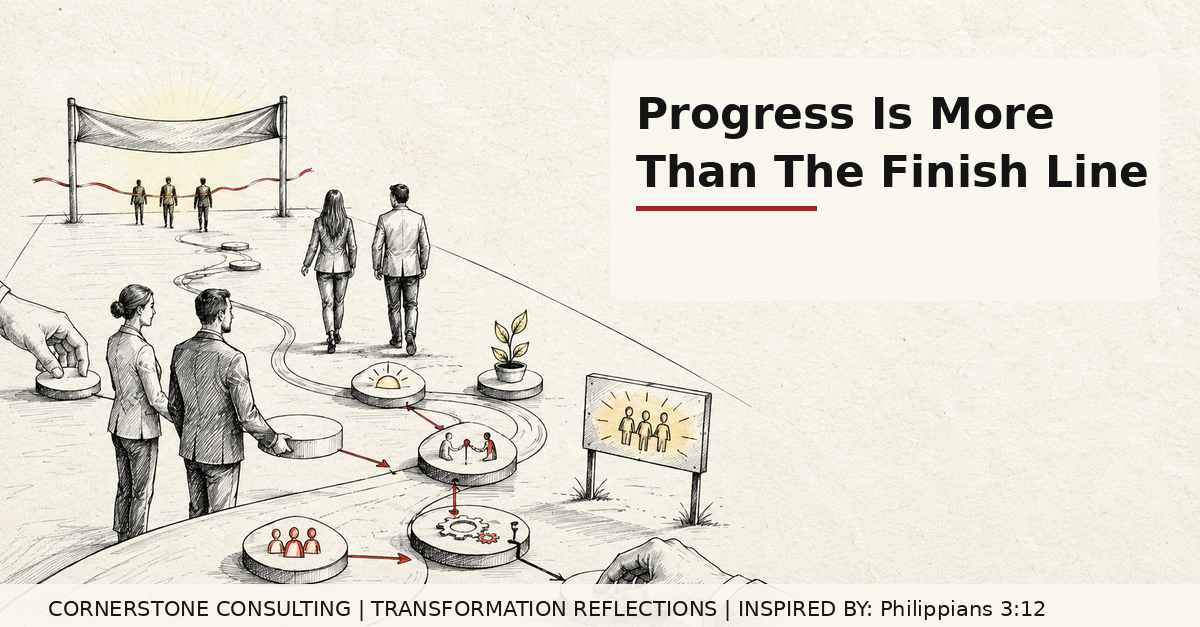
A go-live can become a finish line.
But the enterprise is still learning to walk.
That is where leaders need patience.
I have seen teams rush toward a launch date and miss the learning happening along the way. The better executive conversation was not, “Are we done?” It was, “What is the organization becoming as it moves?”
Many transformations quietly inherit a race mentality. The date is circled. The scorecard points toward launch. Leaders ask whether the team is on track, whether defects are closing, whether training is complete, and whether the cutover plan is ready.
Those questions matter, but they can make the finish line look like the whole point.
A project can reach its destination while the enterprise has not learned how to travel differently. People may still escalate around the operating model. Decisions may still depend on a few heroic individuals. Data may still need manual rescue. Governance may still react after the fact. Benefits may still rely on optimism rather than behavior change.
Transformation asks executives to value the journey without becoming sentimental about it. The journey is where leaders see whether teams are absorbing new decision rights, whether business owners are taking accountability, whether process exceptions are shrinking, whether architecture choices are reducing complexity, and whether the ERP or technology investment is becoming a practical business capability.
The midpoint is not wasted time. It is evidence.
This is where EA coaching can help leaders slow down just enough to see the system. Not to delay delivery, but to notice what delivery is teaching. Which handoffs fail repeatedly? Which decisions return to the same executive table? Which teams still need translation between strategy, process, data, and technology? Which capabilities are forming, and which are only being declared?
The executive challenge is to press on without treating speed as maturity.
A strong transformation does not merely cross a finish line. It leaves behind a business that can keep moving with clearer ownership, steadier decisions, and less dependence on project scaffolding. The journey matters because it reveals whether the enterprise is actually learning the way it must operate next. This does not reduce urgency. It gives urgency a better object: not only reaching the date, but building the habits, ownership, and evidence the business will need after the date.
Reflection
Reflect on whether your transformation rhythm is helping the enterprise learn, or only helping the project arrive.
Practice
In the next steering meeting, add one agenda question: what have we learned about how the enterprise must operate after this project is gone?
Darin Paton is the Owner of Cornerstone Consulting Inc., an Alberta-based enterprise architecture and SAP ERP transformation advisory firm serving organizations across complex business and technology change for over 15 years. 30+ years as an EA and advising SAP transformations.

Leave a Reply