

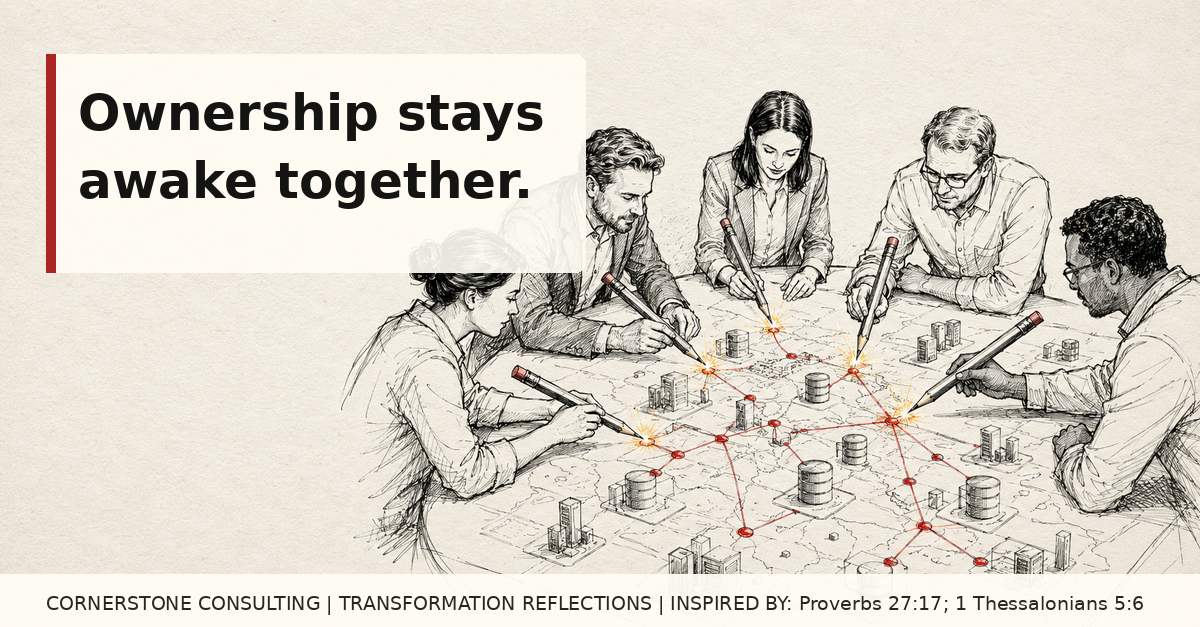
Data ownership gets sleepy in isolation.
It stays alert when peers sharpen each other.
That is architecture work, not meeting noise.
I have seen data ownership becomes stronger when business, integration, risk, and operations peers regularly test the meaning, movement, and consequence of the data together.
Data ownership rarely fails in one dramatic moment.
It usually gets sleepy.
A definition drifts. A field is reused for a new purpose. A report owner changes jobs. A manual reconciliation becomes normal. A project creates a new data feed but never lands the operating ownership. A data steward is named, but no one gives that person decision rights, time, or a peer forum where the messy questions can be sharpened.
That is how trusted data becomes tired data.
For an Enterprise Architect, the answer is not to write a better ownership chart and hope people behave. The work is to design the conditions that keep ownership awake.
Peer review matters. Business stewards need to test definitions with process owners. SAP and integration teams need to show how data actually moves. Risk and cyber need to see control implications. Finance needs to confirm that the measure means what leaders think it means. Operations needs to say where the real workarounds live.
When those peers sharpen each other, data becomes more than an asset label. It becomes a living enterprise responsibility.
This is especially important as organizations push toward AI, automation, ERP modernization, and faster analytics. The more automated the decision environment becomes, the less tolerance there is for sleepy ownership. A weak master-data rule, unclear lineage path, or hidden exception can move through the enterprise faster than a committee can explain it.
Enterprise architecture helps by making the peer system visible. EA coaching helps leaders build the habit of asking who owns the data, who can change it, who feels the impact, who controls the exception, and who will know when the answer is no longer reliable.
Our work around enterprise architecture and SAP-enabled transformation fits quietly into this space: helping organizations turn scattered accountability into practical, repeatable ownership.
Ownership stays awake when it is shared, tested, and used.
Reflection
Where has data ownership in your enterprise become too isolated to stay alert?
Practice
Choose one critical data object and convene a short stewardship review with business, technology, process, and control peers. Do not ask only “who owns it?” Ask “who sharpens the owner’s view?”
Darin Paton is the Owner of Cornerstone Consulting Inc., an Alberta-based enterprise architecture and SAP ERP transformation advisory firm serving organizations across complex business and technology change for over 15 years. 30+ years as an EA and advising SAP transformations.

Leave a Reply