

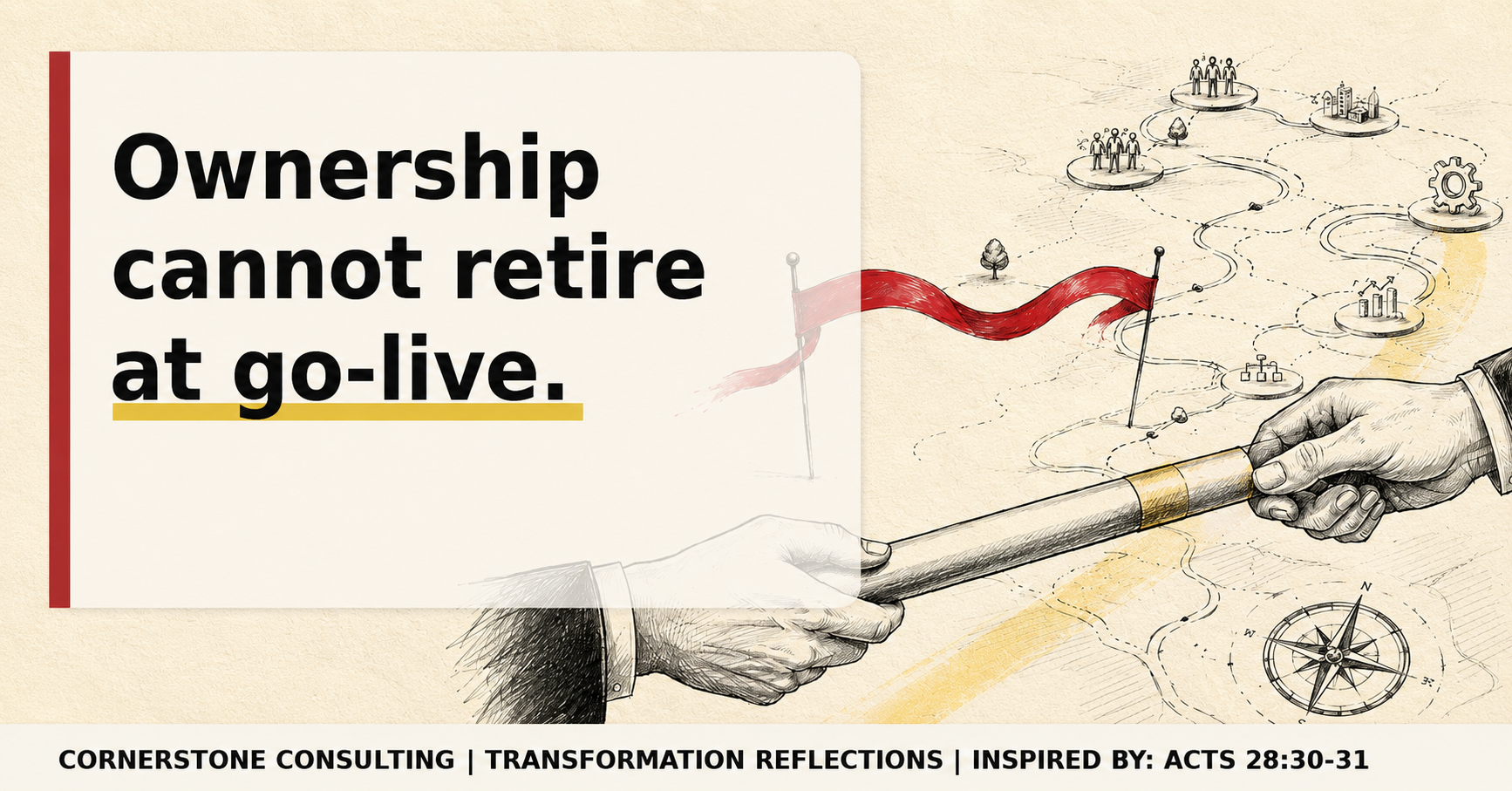
The ribbon gets cut.
The harder work keeps going.
Here is what ownership must prove.
Transformation sponsors breathe out after go-live, only to discover that adoption, data quality, controls, and decision behaviour still needed active executive ownership. The best leaders do not retire at launch. They keep showing up until the business can carry the new capability on its own.
Go-live is often treated like the finish line of modernization. It is rarely the finish line of transformation.
The cutover may be successful. The new platform may be stable. Teams may complete training, reports may run, and the program may close its major risks. Yet the enterprise can still be at the beginning of the real change: learning how to operate differently when the project structure is gone.
This is where executive commitment matters. Modernization needs owners who stay engaged after the public milestone. Not to micromanage the system, but to protect the business outcome the system was meant to enable. If leadership attention disappears too early, old habits return through small exceptions: manual side files, local definitions, informal approvals, delayed decisions, and unresolved process conflicts.
The organization notices what executives continue to inspect. If leaders only ask whether the system is live, people will optimize for technical completion. If leaders ask whether customers are served better, cost is clearer, risk is lower, decisions are faster, and data is trusted, the organization learns that modernization is accountable to business value.
Sustained ownership also protects teams from the lonely middle after launch. This is when process owners need authority, supervisors need coaching, data stewards need backing, and architecture decisions need to be defended against shortcut pressure. It is also when benefits either become real or quietly drift.
Enterprise architecture and EA coaching can help executives keep the right questions alive. Which capabilities are improving? Which operating-model choices remain unresolved? Which ERP or core-system dependencies are still shaping behaviour? Which controls are working in practice? Which business leaders own the result now?
The executive test is not whether the project closed well. It is whether the enterprise can continue the change with disciplined ownership.
Modernization becomes transformation when leaders remain committed long enough for the new way of working to become normal, measurable, and owned.
Reflection
Where has leadership attention moved on before the business outcome was fully owned?
Practice
After a go-live or major release, schedule a 30-, 60-, and 90-day executive capability review focused on outcomes, adoption, data quality, controls, unresolved decisions, and ownership transfer.
Darin Paton is the Owner of Cornerstone Consulting Inc., an Alberta-based enterprise architecture and SAP ERP transformation advisory firm serving organizations across complex business and technology change for over 15 years. 30+ years as an EA and advising SAP transformations.

Leave a Reply