

Most funding decisions do not fail because leaders lack ambition.
They fail because the enterprise baseline is unclear.
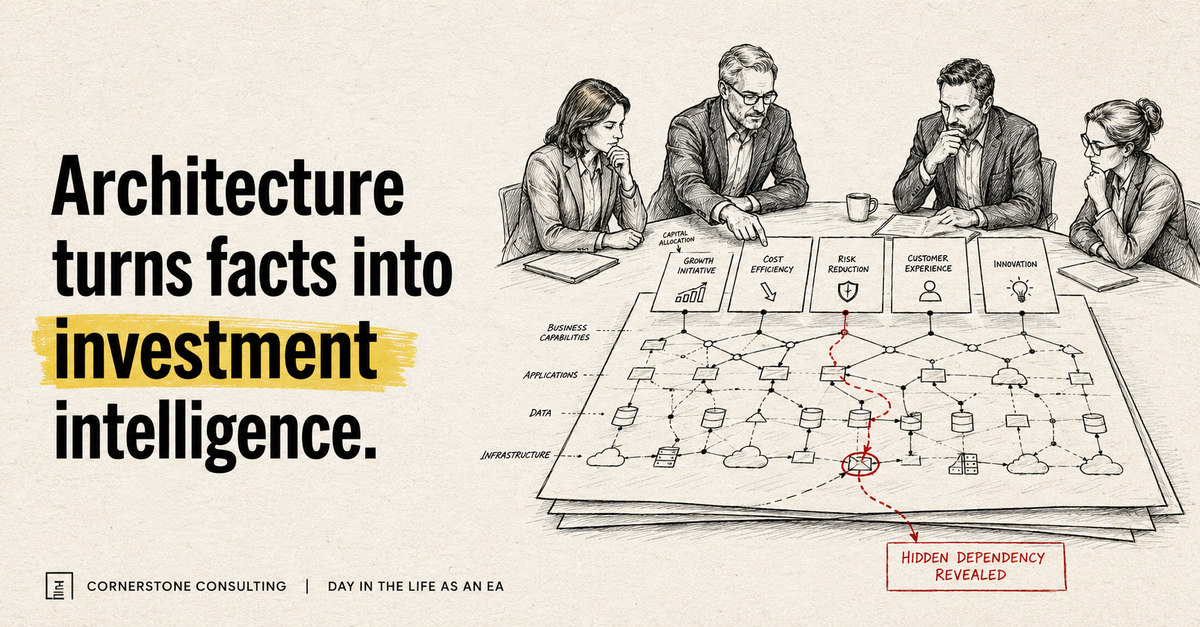
Current-state architecture turns reality into investment intelligence.
I have watched investment discussions change when the current state becomes visible. Assumptions get quieter. Dependencies get funded. Leaders stop debating opinions and start making better enterprise choices.
Most leaders do not ask for current-state architecture because they want more documentation. They ask, often indirectly, because they need more confidence in the next investment decision.
That is the day-in-the-life tension for an Enterprise Architect. A roadmap review, funding discussion, ERP design choice, data platform decision, or integration exception can all sound like separate conversations. Underneath them is the same question: do we know enough about how the enterprise works today to make this decision responsibly?
Current-state architecture becomes investment intelligence when it connects business capability, applications, data, integrations, security, operations, vendors, and risk into one usable view. It shows whether a proposed initiative improves a priority capability, duplicates something already funded, depends on fragile interfaces, creates a control issue, or requires business readiness that has not been planned.
Without that view, investment choices depend on memory, optimism, and whoever has the loudest local version of reality. The enterprise may fund a new tool while an existing platform is underused. It may approve modernization without seeing the data cleanup required first. It may sequence projects in a way that makes delivery teams discover dependencies too late.
With that view, the Enterprise Architect helps leaders compare choices with evidence. The conversation shifts from “Can we start?” to “What must be true for this investment to create value?” That is where EA coaching, architecture governance, SAP and ERP transformation advisory, and practical roadmap discipline quietly earn trust. They make the decision clearer before the money, scope, and expectations harden.
The best current-state architecture is not a museum of what exists. It is a working investment lens. It helps executives decide what to fund, what to defer, what to simplify, what to retire, and what risk must be addressed before delivery begins.
For an Enterprise Architect, the practice is simple but demanding: keep the facts close enough to the decision that architecture changes the quality of the conversation.
TL;DR: Current-state architecture is valuable when it helps leaders invest with better evidence, fewer assumptions, and clearer enterprise tradeoffs.
Reflection
What current-state fact, if made visible this week, would change the quality of the next funding or sequencing decision?
Practice
Before the next investment discussion, bring one current-state view that connects capability, application, data, integration, security, operations, and risk. Use it to name one decision the enterprise should make differently.
Darin Paton is the Owner of Cornerstone Consulting Inc., an Alberta-based enterprise architecture and SAP ERP transformation advisory firm serving organizations across complex business and technology change for over 15 years. 30+ years as an EA and advising SAP transformation.

Leave a Reply