

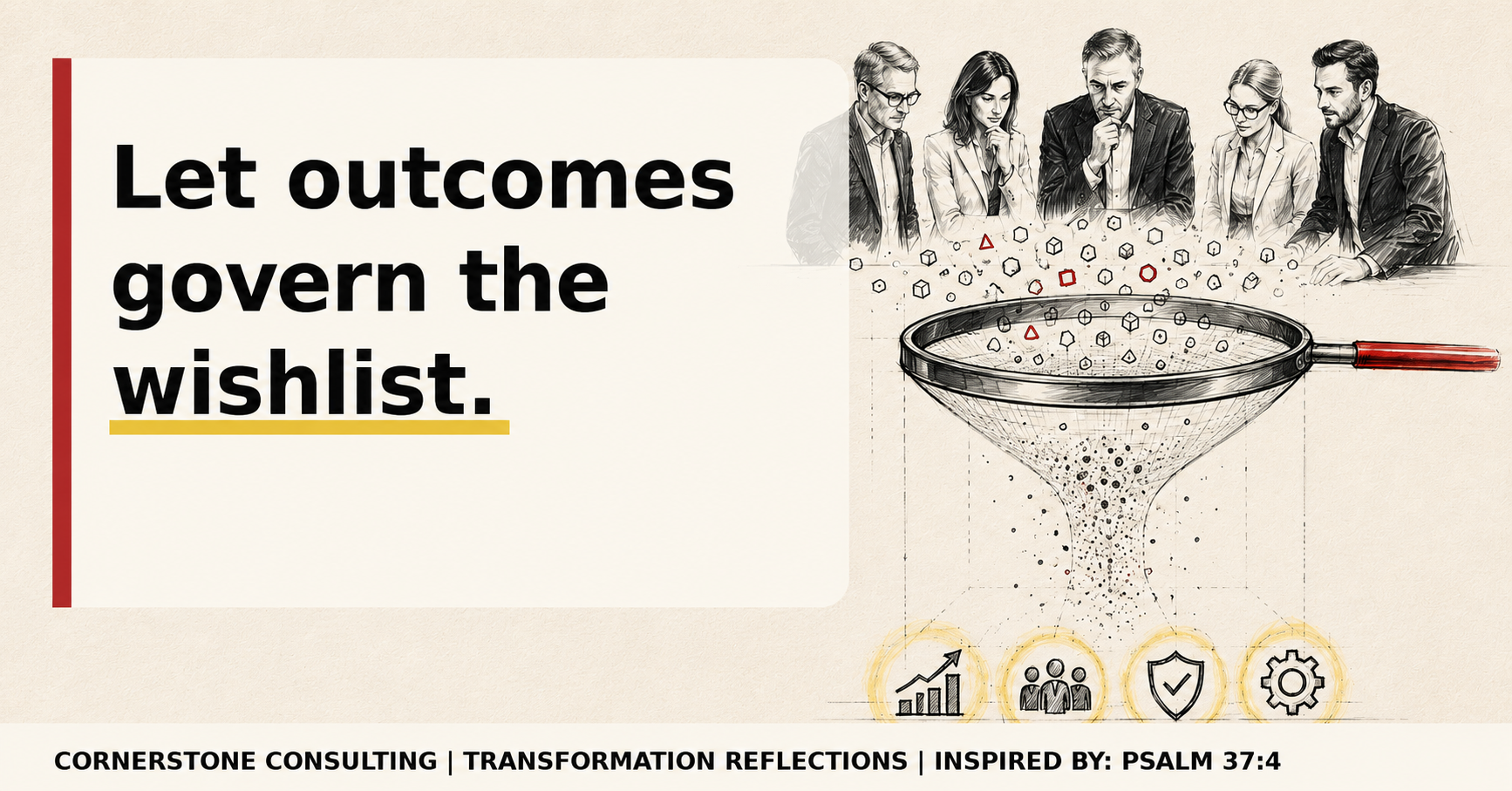
Every modernization has a wishlist.
Not every wish deserves funding.
Here is the filter.
I have watched modernization wishlists expand because every function could name a feature it wanted. The stronger programs used outcomes as the filter. When leaders agreed on the business capability, value measure, and ownership model first, technology choices became sharper and much harder to politicize.
Modernization exposes what an enterprise really wants.
Every function brings a list. Faster reporting. Cleaner handoffs. Better customer visibility. Fewer manual controls. More automation. Easier planning. Stronger analytics. These are not wrong desires. The danger is allowing the wishlist to become the strategy.
A modern platform cannot carry every preference without becoming expensive, complex, and hard to govern. The executive discipline is to ask which desires belong to the future business outcome and which ones are simply familiar habits asking for a better tool.
This is where modernization must be led by outcomes, not appetite. What business result should be materially different? Which capability must improve? Which decision must become clearer? Which risk must reduce? Which cost must become visible? Which customer or employee experience must change? Without those answers, feature demand fills the vacuum.
This discipline is uncomfortable because it forces leaders to choose. A wish may be valid for one function and still weaken the enterprise if it adds variation, cost, or control confusion.
When outcomes govern the wishlist, leaders can make cleaner trade-offs. They can say yes to the features that strengthen the operating model and no to the features that preserve fragmented behaviour. They can protect enterprise data definitions, simplify process variation, and avoid rebuilding old complexity inside new technology.
This is not only a technology conversation. It is a governance conversation. It requires decision rights, value ownership, architecture discipline, and a clear path for exceptions. Enterprise architecture helps translate executive intent into capability design, process boundaries, integration choices, data standards, controls, and benefit measures.
The question for leaders is not, “What do we want the system to do?” The better question is, “What must the enterprise become better able to do?”
Modernization becomes transformation when desires are reshaped by purpose. The platform then serves the outcome instead of becoming a container for every unresolved preference.
Reflection
Where has a technology wishlist become louder than the business outcome it was meant to serve?
Practice
Before approving new modernization scope, require each request to name the business outcome, accountable owner, decision it improves, data or control implication, and the cost of not doing it.
Darin Paton is the Owner of Cornerstone Consulting Inc., an Alberta-based enterprise architecture and SAP ERP transformation advisory firm serving organizations across complex business and technology change for over 15 years. 30+ years as an EA and advising SAP transformations.

Leave a Reply