

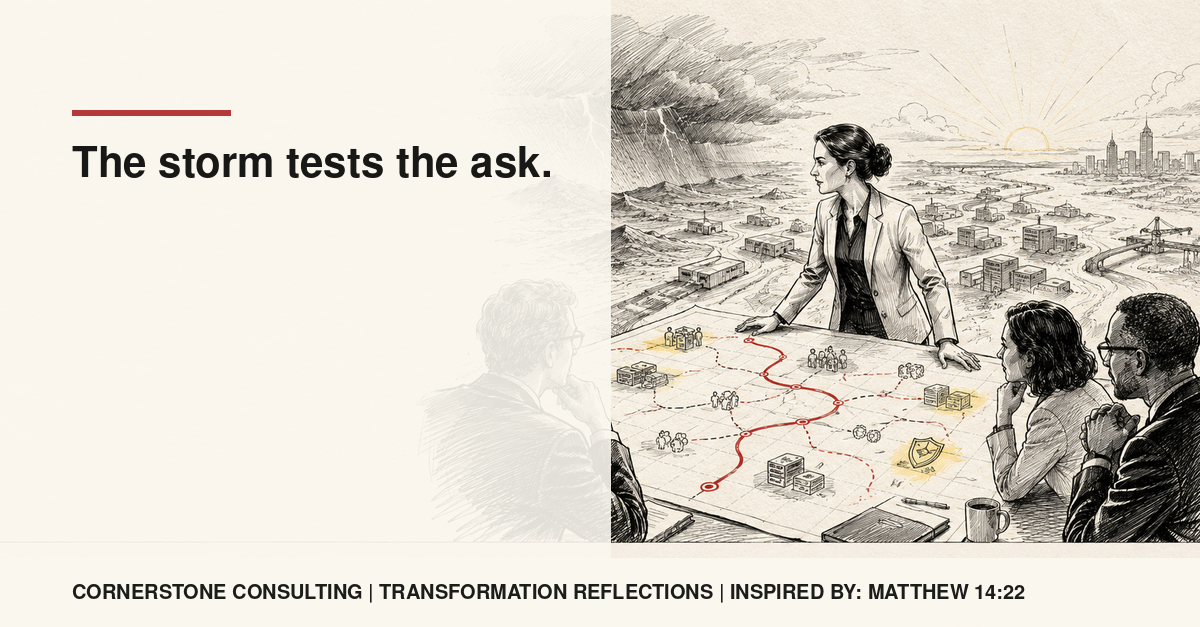
Sometimes architecture is invited because leaders expect calm.
Then the storm arrives.
Here is why that may be the real work.
I have seen transformation storms reveal the truth faster than a clean status deck. The architect’s value is helping leaders separate noise from signal and adjust before commitments become expensive. That is practical advisory work at www.cornerston-ea.com.
An Enterprise Architect is often invited into a transformation with an unspoken expectation: make this easier. Make the map clearer. Make the path less risky. Help everyone feel confident.
That expectation is understandable, but incomplete.
Architecture is not only valuable when it produces calm. It is valuable when it reveals what the enterprise must learn before a commitment becomes too expensive to change. A roadmap, ERP decision, vendor commitment, or operating-model redesign may look sound at approval. Then the storm arrives: unclear ownership, data arguments, integration gaps, control concerns, funding limits, capacity pressure, or local incentives that pull against the enterprise outcome.
That storm does not prove architecture failed. It may prove architecture is finally dealing with the real enterprise.
This article is about why EA is valued but still ignored. One reason is that leaders sometimes invite EA for reassurance and then ignore it when the work exposes friction. The Enterprise Architect has to reframe the ask. The work is not to keep every surface smooth. The work is to help leaders understand what the storm is teaching.
A practical tool is an EA relevance assessment focused on pressure signals. When tension rises, list the decision under pressure, the capability affected, the dependency exposed, the owner needed, the trade-off being avoided, and the evidence required before moving ahead. This turns disruption into usable insight.
EA advisory and transformation coaching can be quietly valuable. It helps the enterprise separate delivery noise from signals that should change sequencing, governance, scope, or readiness.
The storm may not change the destination. But it can change what leaders understand about the journey. When EA helps the enterprise learn under pressure, architecture becomes relevant before the next commitment is made, not after the damage is visible.
Reflection
Where is the enterprise treating architecture as a way to create comfort instead of a way to learn from pressure?
Practice
Create a pressure-signal log for one active transformation. For each tension point, capture the decision under pressure, capability affected, dependency exposed, owner needed, trade-off avoided, and evidence required.
Darin Paton is the Owner of Cornerstone Consulting Inc., an Alberta-based enterprise architecture and SAP ERP transformation advisory firm serving organizations across complex business and technology change for over 15 years. 30+ years as an EA and advising SAP transformations.

Leave a Reply