

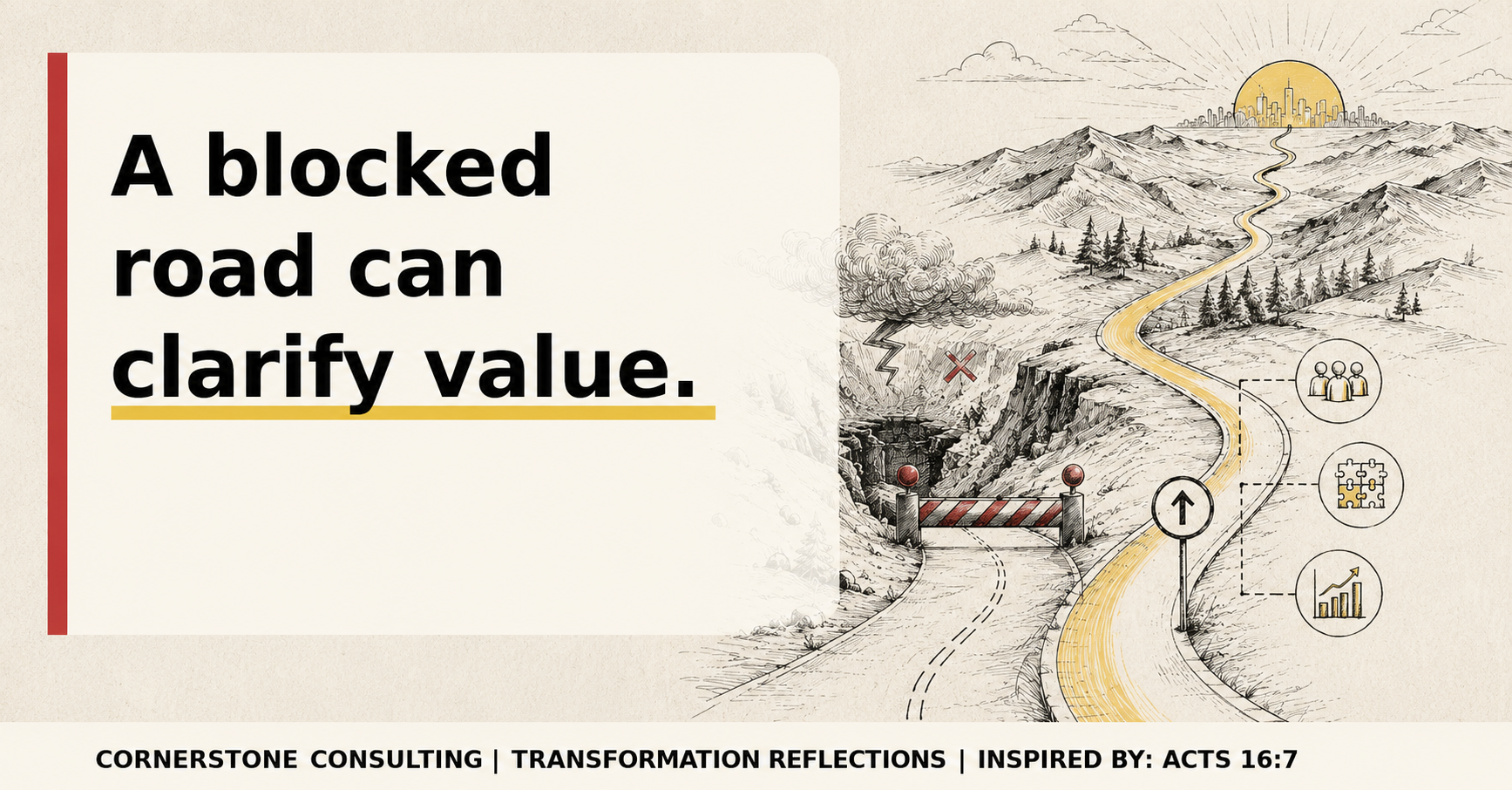
A blocker is not always failure.
Sometimes it is evidence.
Here is how leaders should read it.
I have seen blocked delivery paths frustrate leaders, then reveal the issue everyone needed to understand: weak ownership, unclear data, control gaps, or an operating model that could not support the chosen design. The blocker was not the enemy. It was the evidence that made better transformation possible.
Modernization plans often assume the route is known.
The roadmap is approved, the platform is selected, the integration path is drawn, and delivery teams begin moving. Then a road closes. A data object is not trusted. A regulatory control is weaker than expected. A business process has too many local variations. A dependency in SAP or another core system changes the design. A team cannot adopt the new workflow without changing decision rights.
Executives can treat these blockers as delivery irritation. Or they can treat them as enterprise evidence.
A blocked road may be showing that modernization was about to automate the wrong thing, simplify too little, expose a hidden risk, or move faster than the operating model could absorb. The issue is not whether leaders should tolerate endless delay. The issue is whether they can distinguish noise from meaningful redirection.
The distinction matters. Some blockers deserve immediate removal. Others deserve executive attention because they reveal a design assumption that was never true.
This is where enterprise architecture earns its place. It helps leaders read blockers in context: capability impact, dependency chain, data trust, control exposure, customer effect, cost consequence, and ownership gap. It turns “we are stuck” into “what is this teaching us about the enterprise?”
The strongest modernization leaders do not panic at every closed road. They ask whether the route still serves the business outcome. If it does, they remove the obstacle with urgency. If it does not, they adjust before money, credibility, and energy are spent on a path that cannot deliver value.
This discipline protects transformation from false momentum. Progress is not simply moving forward. Progress is moving toward the outcome with enough evidence to know the path is still sound.
Sometimes the best executive decision is not to force the road open. It is to understand why it closed and choose the route that creates real capability.
Reflection
Where is a current blocker trying to show you something important about the enterprise?
Practice
For one major modernization blocker, ask for a short architecture trace: affected capability, owner, dependency, data issue, control implication, customer or workforce impact, and recommended executive decision.
Darin Paton is the Owner of Cornerstone Consulting Inc., an Alberta-based enterprise architecture and SAP ERP transformation advisory firm serving organizations across complex business and technology change for over 15 years. 30+ years as an EA and advising SAP transformations.

Leave a Reply