
Architecture often gets ignored until tension arrives.
That is where its value can become clearest.
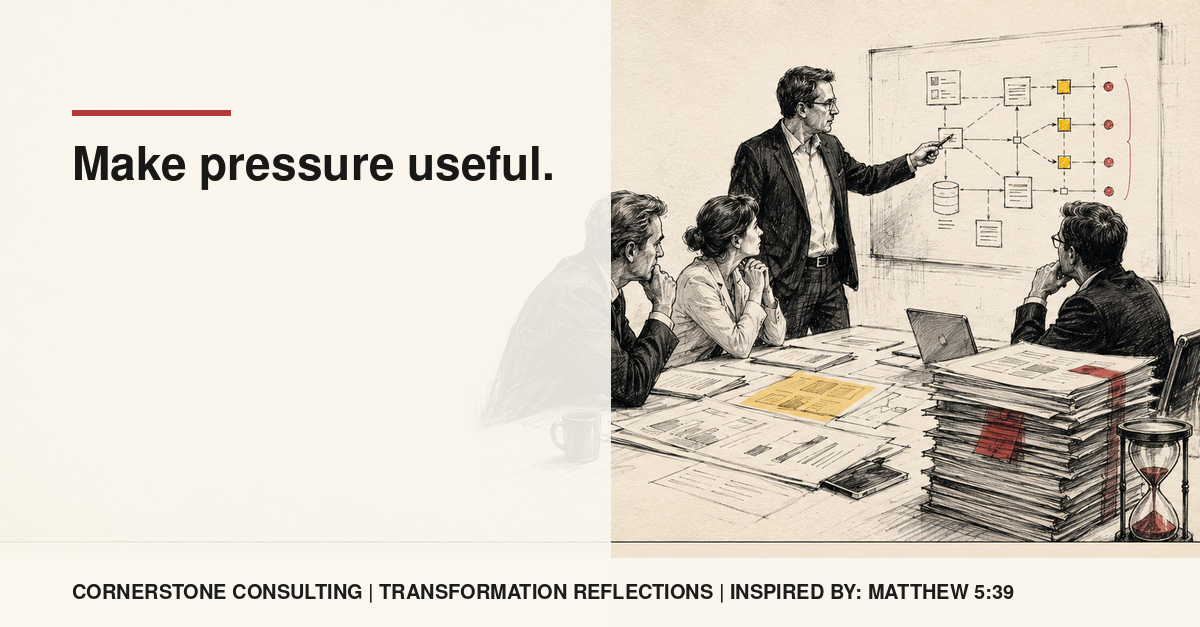
Here is the test: can pressure improve the decision?
I have watched architecture get dismissed in tense rooms until someone calmly showed the downstream consequence. That is the work I care about: helping leaders see risk, ownership, and value early enough to decide better.
Many enterprise architects know the strange compliment of being valued in principle but bypassed in practice. Leaders respect architecture until a decision becomes urgent, personal, political, or expensive. Then the room often wants speed, certainty, and agreement more than consequence.
That moment is not a reason for the architect to withdraw. It is the moment to become more useful.
When a proposal is challenged, misread, or pushed aside, the Enterprise Architect can choose the posture of disciplined service. Not passive compliance. Not defensive correction. Useful pressure. The architect keeps the conversation attached to capability impact, ownership, dependencies, data, controls, SAP and platform consequences, timing, and the real cost of avoidable rework.
A useful architect also distinguishes between resistance and material risk. Some pushback is preference or politics. Some is evidence that ownership, readiness, or accountability is unresolved. The craft is to sort those signals without embarrassing the room.
This is why EA cannot rely on being respected. Respect is too abstract. Involvement is earned when leaders see architecture improve the quality of the decision while the room is uncomfortable.
A practical move is the EA relevance assessment. For each material decision, ask: What enterprise consequence is unclear? What capability or operating model will change? Who owns the outcome after delivery? What decision rights are missing? What risk becomes harder to reverse if we proceed? This keeps architecture from sounding like an approval gate and makes it a business aid.
Cornerstone’s kind of EA coaching matters here because many organizations do not need more architecture theatre. They need an advisor who can stay calm when the room pushes back and still leave leaders with better choices.
The aim is not to win the argument. The aim is to make the decision safer, clearer, and more honest. When pressure can improve the decision, EA stops being an optional review and becomes part of executive judgment.
Reflection
Where is architecture currently being respected in language but excluded when pressure rises?
Practice
Use an EA relevance assessment on one active decision. Name the consequence, owner, dependency, trade-off, and risk that would be missed if architecture stayed outside the room.
Darin Paton is the Owner of Cornerstone Consulting Inc., an Alberta-based enterprise architecture and SAP ERP transformation advisory firm serving organizations across complex business and technology change for over 15 years. 30+ years as an EA and advising SAP transformations.

Leave a Reply