

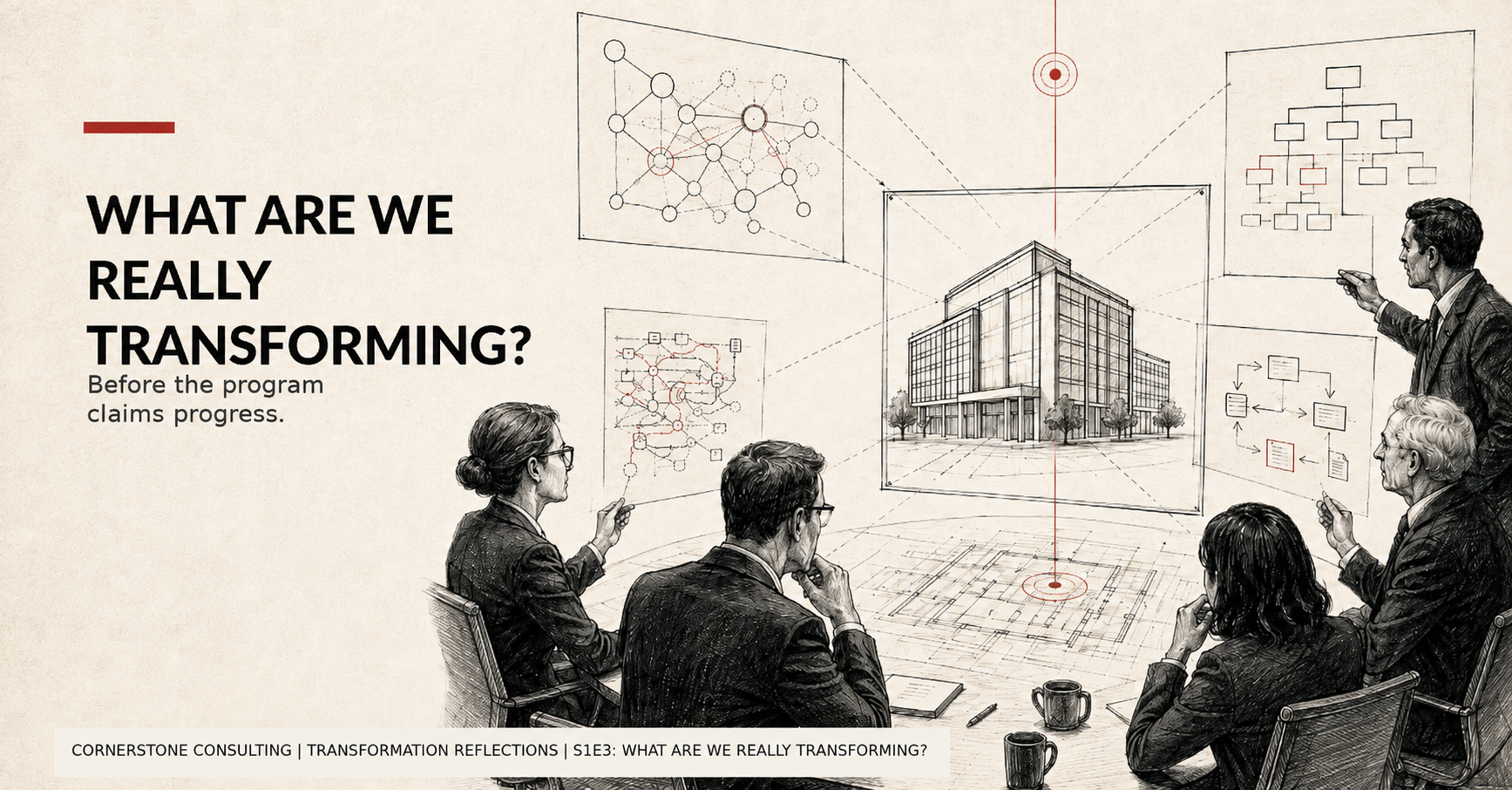
Transformation can hide behind agreement.
Everyone may support the program.
Until you ask what must become different.
I have seen executive teams agree on a transformation name while carrying different expectations of success. The work improved when leaders paused to define the exact enterprise condition that had to become different: decisions, ownership, data, controls, support, capability, and measurable business outcomes.
Many transformation programs begin with broad agreement. Everyone supports the need for change. The board has approved the investment. The sponsor has named the ambition. The program has a roadmap, a platform, and a governance structure.
The problem is that agreement at that level can hide a serious gap.
One leader may believe the transformation is about cost reduction. Another may expect faster decisions. Another may expect stronger controls. Another may expect a better employee or customer experience. None of those expectations are wrong, but they create risk when they are not translated into one shared operating definition.
Executives do not need a longer slogan. They need to define what part of the enterprise must become different.
Is the transformation changing how decisions are made? Then decision rights, forums, escalation paths, and evidence standards need to change. Is it changing how work flows? Then process ownership, handoffs, SAP roles, data quality, controls, and support models need to change. Is it changing how value is created? Then benefits ownership, capability measures, funding choices, and leadership behaviour need to change.
Without this definition, the program can report progress while the enterprise preserves the old model underneath. People attend training but keep the workaround. Governance approves the design but avoids the hard ownership decision. Technology changes the screen, but the business still makes decisions through the same informal routes.
A practical executive test is simple: ask each sponsor to finish this sentence without using the system name or project name: After this transformation, our enterprise will be meaningfully different because…
If the answers conflict, the issue is not communication. It is architecture, ownership, and strategy alignment. The transformation needs a clearer enterprise definition before delivery momentum hardens the wrong assumptions.
The best time to do this is before status turns green. Green status can comfort leaders too early. A shared definition gives them something better: a way to judge whether the organization is actually becoming different, not just whether the program is staying busy.
Reflection
Where are your leaders using the same transformation word while expecting different enterprise outcomes?
Practice
Before the next steering discussion, ask each sponsor to name the exact business condition that must become different. Compare the answers across capability, ownership, decision rights, data, controls, SAP or core-system impacts, support model, and measurable value.
Comments welcome.
Darin Paton is the Owner of Cornerstone Consulting Inc., an Alberta-based enterprise architecture and SAP ERP transformation advisory firm serving organizations across complex business and technology change for over 15 years. 30+ years as an EA and advising SAP transformations.

Leave a Reply