

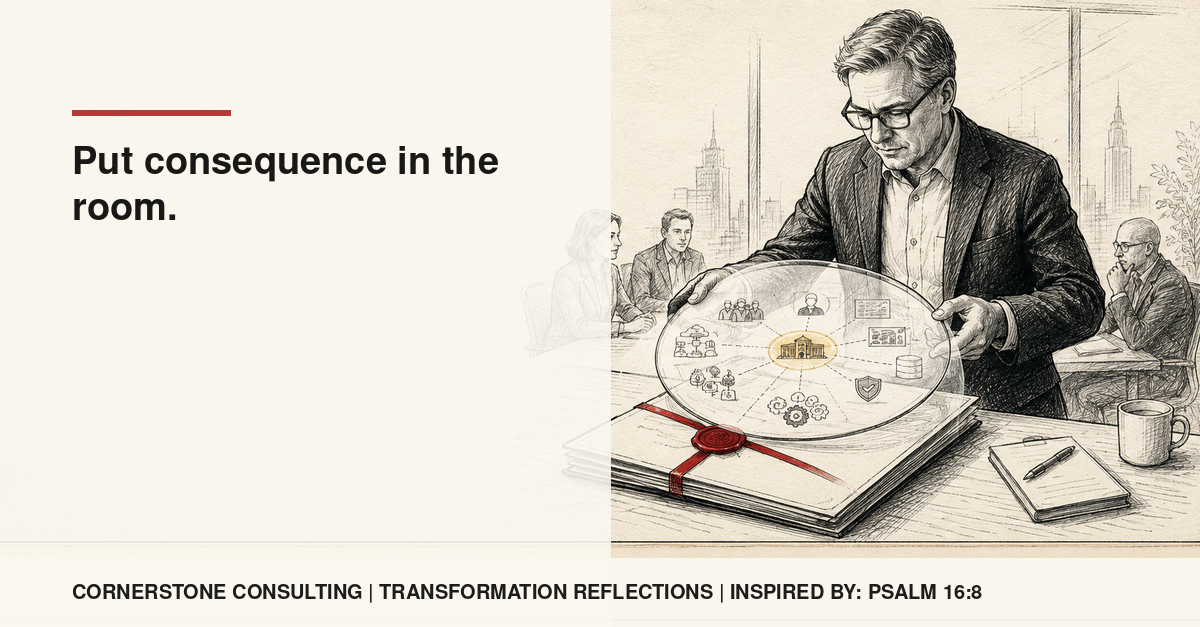
Every executive room has a centre of gravity.
Sometimes it is cost. Sometimes politics. Sometimes urgency.
Architecture helps choose the right focus.
I have watched decisions improve when someone placed consequence beside urgency. The work is not to sell architecture. It is to help leaders see what the enterprise must live with after the decision.
Enterprise Architecture is often ignored because the room is already focused before the architect arrives. The business case has a favorite option. The vendor path looks efficient. The budget window is tight. A senior leader wants momentum. Everyone can say they value architecture, but the decision has already found its center.
The architect’s job is not to fight for attention. It is to put consequence in the room.
Consequence changes the conversation. It asks what this decision will do to capabilities, processes, people, data, controls, applications, integrations, reporting, support teams, and future options. It asks whether the operating model can actually absorb the change. It asks whether the decision rights are clear enough for the outcome to survive after the project team leaves.
This is not bureaucracy. It is executive support. Leaders need a practical way to see what urgency hides.
This focus is especially important in organizations where EA has been treated as a review function. The architect earns a different place by helping the room see what the decision will require from the enterprise, not by asking for attention to architecture itself.
EA can be used before a major decision as a simple focus discipline. If architecture involvement would not change the decision, stay light. If the decision affects enterprise capability, risk, ownership, data, SAP/core platforms, customer experience, or long-term cost, bring architecture close. Make the reason visible. Name the consequence. Put the decision owner and outcome owner in the same conversation.
This is also where EA coaching matters. Many teams do not lack intelligence; they lack a trusted way to hold attention on the right evidence when pressure is high. A good architect helps leaders interpret the enterprise, not admire the artifact.
When consequence is present early, EA stops being a late review. It becomes a quiet reference point beside the decision. The room may still choose speed, cost, or local autonomy. But it will do so with clearer eyes. That is a useful kind of influence.
Reflection
What has become the center of gravity in the current decision: value, urgency, politics, budget, vendor momentum, or enterprise consequence?
Practice
Before one major decision, write a one-page consequence brief covering capability, operating model, data, controls, ownership, SAP/core-system implications, and reversibility.
Comments welcome.
Darin Paton is the Owner of Cornerstone Consulting Inc., an Alberta-based enterprise architecture and SAP ERP transformation advisory firm serving organizations across complex business and technology change for over 15 years. 30+ years as an EA and advising SAP transformations.

Leave a Reply