

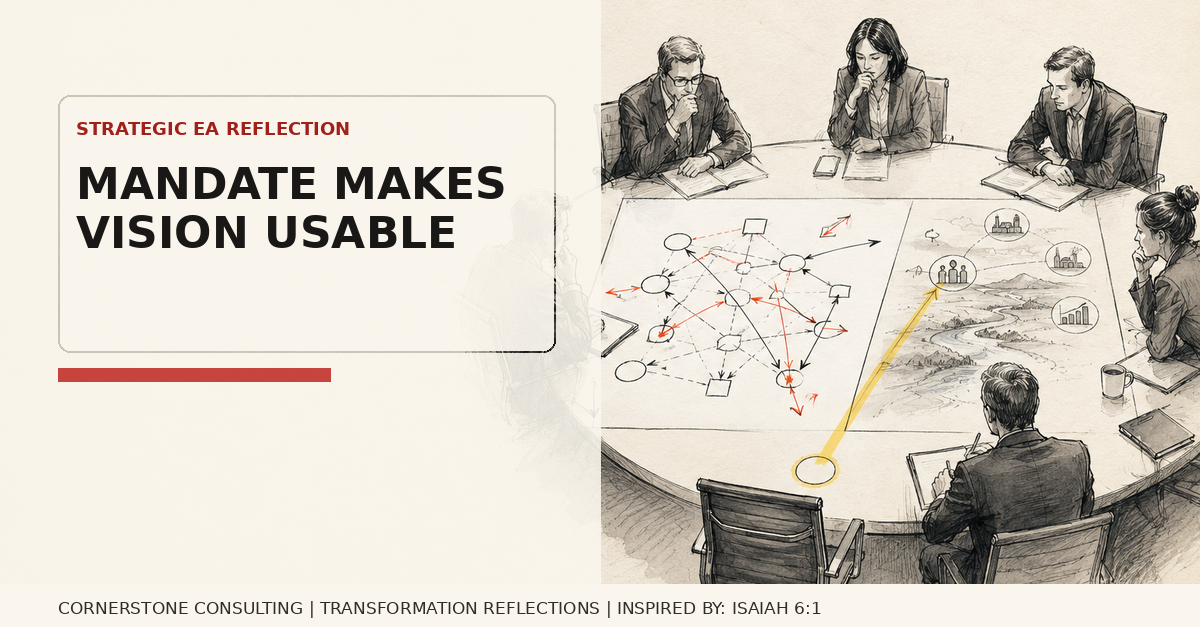
A clear view is not enough.
If nobody knows your mandate, your insight becomes optional.
Here is why authority has to be visible before the decision moves.
I have watched strong architecture insight arrive with no clear authority behind it. The work was right, but the decision path was vague. When mandate is visible early, leaders know when EA is advising, approving, escalating, or helping the enterprise support strategy to execution.
An Enterprise Architect can see the enterprise consequence before the room is ready to name it. That is useful, but it is not sufficient. Insight without a visible mandate often becomes commentary. People may respect the architecture view and still keep making the real decision somewhere else.
That is the quiet risk in “When Architecture Is Accountable but Not Authorized”. The architect is expected to protect coherence, challenge avoidable complexity, surface risk, and help connect strategy to execution. Yet the organization has not made clear when architecture advises, when it approves, when it escalates, and when it simply informs.
This becomes especially painful when leaders face a major commitment. A vendor is preferred. Funding is almost approved. A roadmap is already circulating. The architect sees dependencies across capability, data, operating model, ERP, controls, integration, and support. But if the mandate is vague, the question becomes personal: why are you slowing this down? It should be structural: who owns this decision, and what authority does EA have to expose the consequences before the enterprise is committed?
The practical answer is not a heavier architecture process. It is a visible EA mandate and decision-rights canvas. For each decision type, define the decision owner, architecture role, escalation path, required evidence, and timing. Make it clear where EA is at the strategic planning table to plan, advise, approve, and where it has a duty to escalate material enterprise risk.
That clarity protects everyone. Executives get better decision timing. Delivery teams know what evidence matters. Architects stop relying on personal credibility to carry institutional responsibility. The mandate does not make the architect more important. It makes the decision more honest.
A clear mandate also helps the architect know when to stay light. Not every decision deserves the same level of EA attention. The canvas protects scarce architecture capacity by focusing effort where consequences, reversibility, cost, risk, and enterprise dependency justify involvement.
Reflection
Where is architecture expected to see clearly, but not yet authorized to act clearly?
Practice
Create a one-page EA mandate and decision-rights canvas for three recurring decisions: investment planning/approval, vendor selection, and execution scope change. For each one, name the owner, the EA role, the evidence required, and the escalation route.
Comments welcome!
Darin Paton is the Owner of Cornerstone Consulting Inc., an Alberta-based enterprise architecture and SAP ERP transformation advisory firm serving organizations across complex business and technology change for over 15 years. 30+ years as an EA and advising SAP transformations.

Leave a Reply