

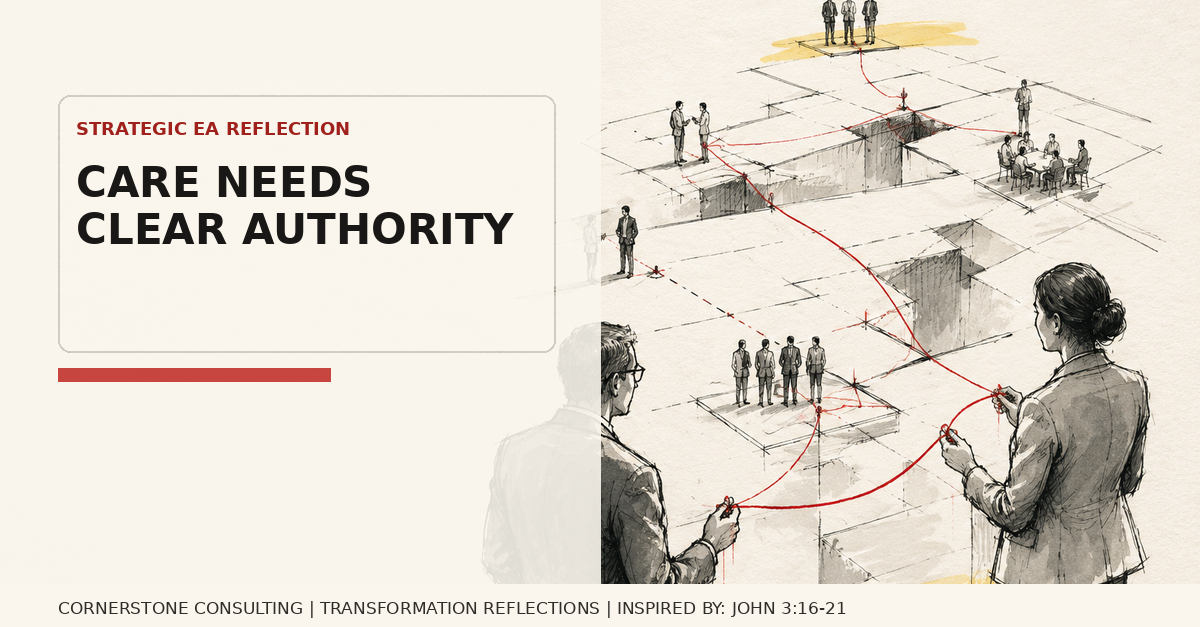
Good intent cannot carry unclear authority forever.
Care has to become structure.
Here is why mandate clarity is an act of enterprise responsibility.
I have watched committed leaders care deeply about outcomes while still leaving teams exposed to unclear authority. The intent was good, but the structure was weak. When the mandate is explicit, care becomes practical: people know who decides, who challenges, who escalates, and who protects the enterprise.
Many organizations care about doing the right thing. They care about delivery, customers, cost, risk, people, and transformation outcomes. Yet care alone does not protect an enterprise when authority is unclear.
That is why When Architecture Is Accountable but Not Authorized matters. An Enterprise Architect is often asked to help the organization make better choices, but the mandate is left informal. Leaders want architecture insight, but they may not define when EA has the right to challenge scope, pause a decision, escalate risk, or require evidence before commitment.
Clear authority is not bureaucracy. It is care made operational. The EA mandate and decision-rights canvas turns good intent into usable structure. It names who owns the decision, when architecture advice is required, what evidence is needed, and where escalation belongs when material enterprise risk appears.
The result is a strange kind of exposure. Everyone may be well intentioned. The sponsor wants progress. Delivery wants momentum. Technology wants a workable solution. Operations wants stability. Risk and controls want assurance. EA wants coherence. But if decision rights are vague, the most vulnerable parts of the enterprise fall into the gap: data ownership, process accountability, integration dependencies, SAP impacts, support readiness, benefit traceability, and long-term complexity.
This also changes how leaders experience EA. Instead of a late objection, architecture becomes a known responsibility built into the operating rhythm. The enterprise can still choose speed, but it does so with clearer ownership of the consequences it accepts.
This is the kind of practical enterprise support Cornerstone Consulting reinforces without turning architecture into an ivory tower. The work is to help leaders protect value, reduce avoidable rework, and make commitments with clearer eyes.
Reflection
When authority is clear, people do not have to guess whether architecture is helping or interfering. They can see the responsibility being carried on behalf of the whole enterprise.
Where is good intent currently compensating for unclear authority in your enterprise?
Practice
Choose one active initiative and map the authority gaps that teams are quietly working around. Convert one gap into a visible decision-right: owner, EA role, required evidence, escalation trigger, and timing.
Comments welcome.
Darin Paton is the Owner of Cornerstone Consulting Inc., an Alberta-based enterprise architecture and ERP transformation advisory firm serving organizations across complex business and technology change for over 15 years. 30+ years as an EA and advising SAP transformations.

Leave a Reply