

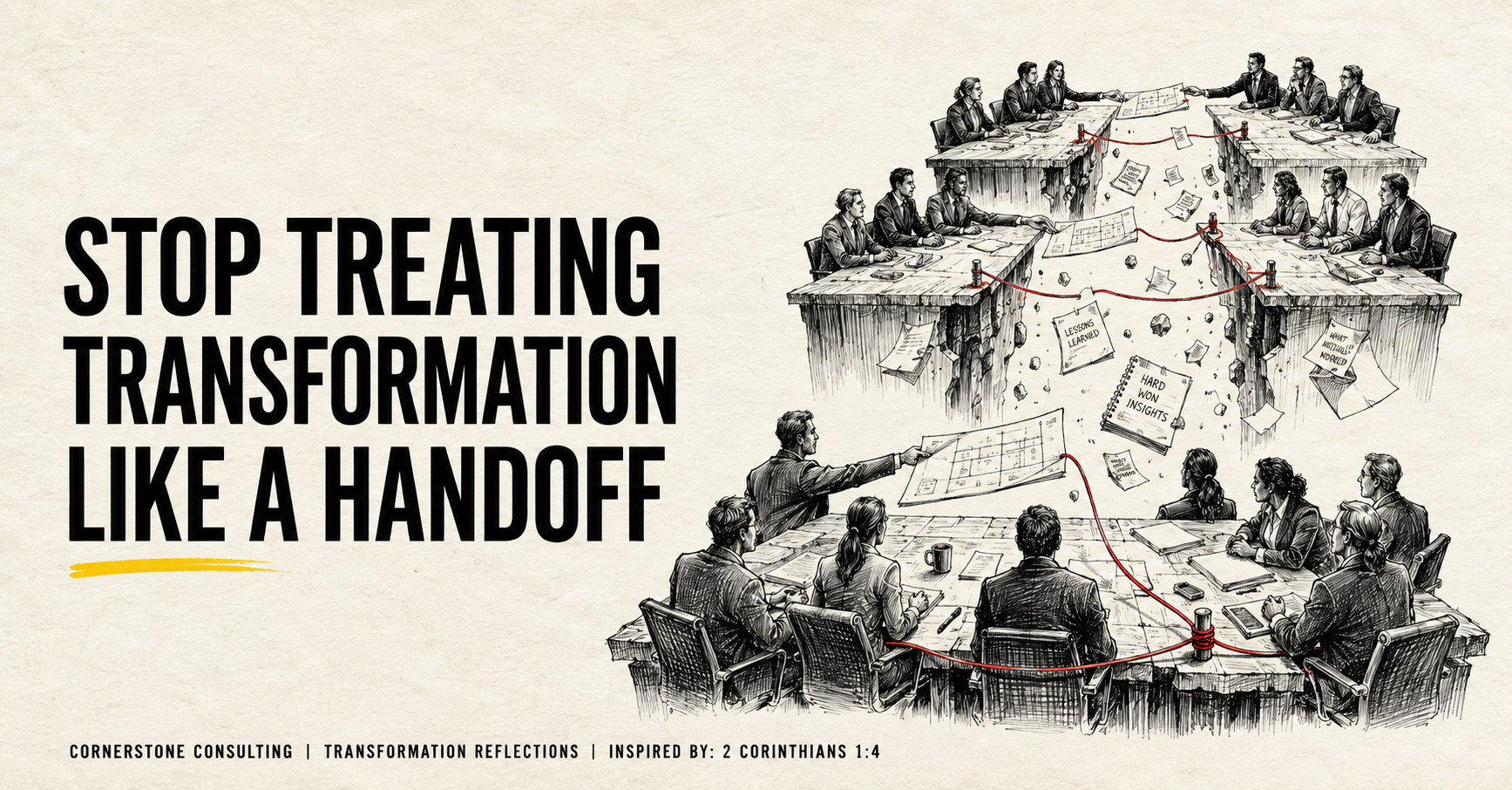
One team designs. Another builds.
The business is expected to absorb the result.
But transformation stalls when support ends at the handoff.
Real change carries learning and ownership across the enterprise.
One of my more bolder titles, and it’s because I have seen difficult transformation moments become useful when leaders carried the learning forward. Support that travels between teams turns pressure into capability, reduces repeated mistakes, and helps the enterprise become stronger through the change rather than merely surviving it.
Transformation is often described as a journey, but many organizations still manage it like a handoff. One team designs, another builds, another tests, another receives the result, and the business is expected to absorb the change. When support does not travel with the work, the enterprise may complete the project while leaving people to struggle alone.
Real change becomes visible when capability is passed on. A leader who has learned from a difficult rollout helps another leader avoid the same blind spot. A team that has wrestled through a new process teaches the next team what actually matters. A support group turns incidents into better design. A steering committee turns disappointment into clearer ownership rather than blame.
This matters because transformation exposes pressure. People lose familiar ways of working. Managers face questions they cannot answer yet. Data issues surface in public. Benefits take longer than expected. The executive response to those moments shapes what the organization becomes.
If leaders treat struggle as failure, teams hide it. If leaders treat struggle as evidence, the enterprise can learn from it. The question is not only what system changed, but whether the organization has become better at helping people operate through change.
Enterprise architecture can support this by connecting lessons across capabilities, process areas, data domains, controls, and governance forums. It prevents each team from relearning the same painful lesson in isolation. It also gives executives a shared language for turning hard experience into better design rather than private frustration.
The practical executive test is simple: can the learning from one part of the transformation strengthen the next part? If not, the organization is collecting experience without building capability.
Support that travels is a sign of real transformation. It means the enterprise is not merely delivering outputs. It is developing the shared muscle to absorb pressure, adjust responsibly, and carry better practice forward.
Reflection
Where is transformation learning staying local instead of strengthening the broader enterprise?
Practice
After the next difficult milestone, ask what was learned, where that learning must travel next, and who owns turning it into better process, data, controls, support, or decision practice.
Comments Welcome.
Darin Paton is the Owner of Cornerstone Consulting Inc., an Alberta-based enterprise architecture and SAP ERP transformation advisory firm serving organizations across complex business and technology change for over 15 years. 30+ years as an EA and advising SAP transformations.

Leave a Reply