

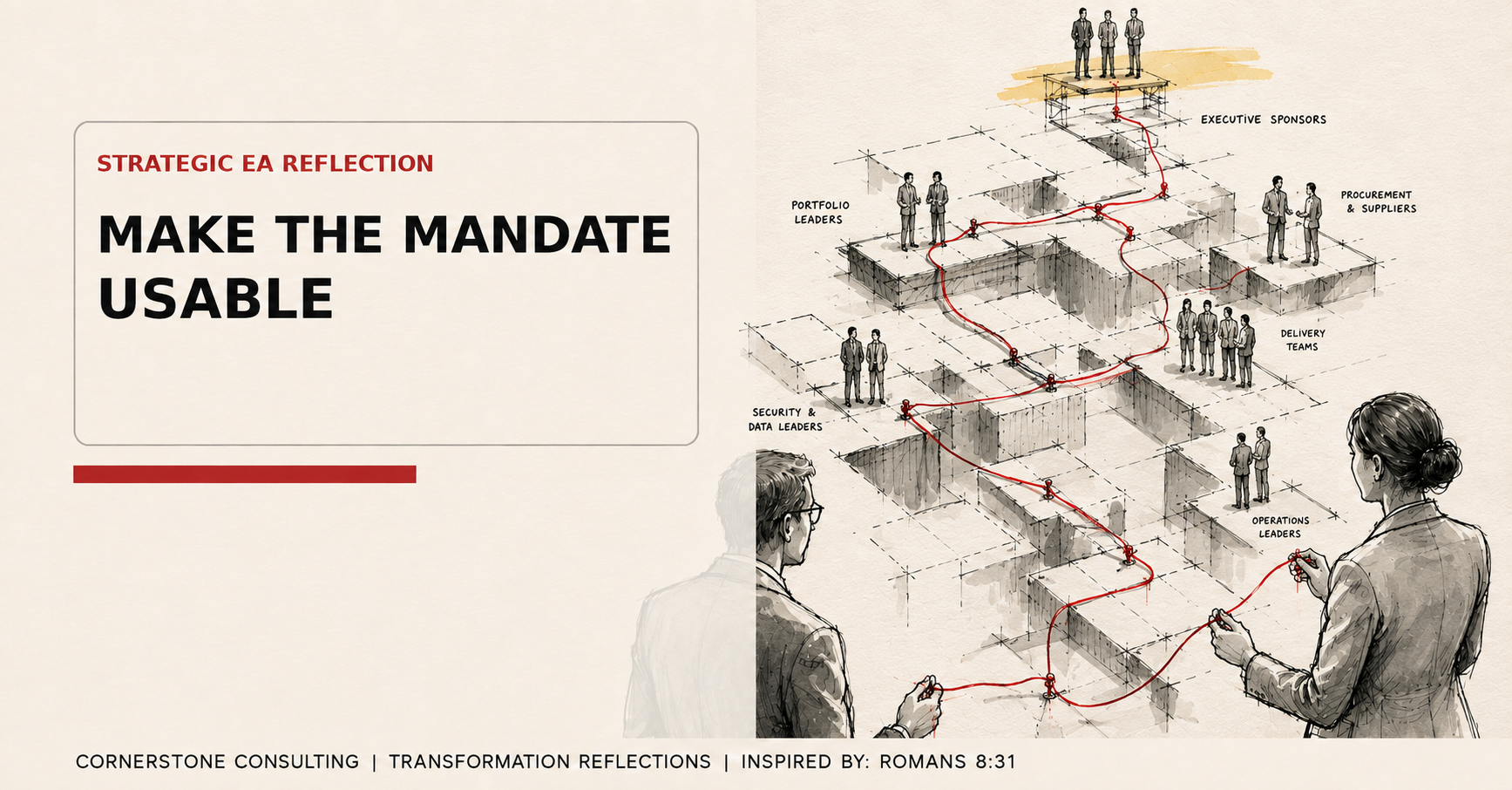
A charter does not create influence.
A usable decision path does.
Make the mandate practical enough for others to follow.
I have watched architecture charters receive executive approval and then disappear into a repository. The mandate became real only when leaders could see which decisions needed architecture, when engagement occurred, and how unresolved risk moved to the right owner.
An enterprise architecture mandate can look strong on paper and remain weak in practice. The charter may describe strategic alignment, governance, standards, roadmaps, and assurance. Yet project teams still do not know when to involve architecture. Executives remain unclear about whether EA advises, approves, or escalates. Architects are left defending their relevance one meeting at a time.
The problem is not always lack of sponsorship. It is often that the mandate is too abstract to guide daily behaviour.
A usable mandate answers practical questions. Which decisions require an enterprise view? What makes a decision material? When should architecture become involved? What evidence must be available? Who decides when business value, delivery speed, security, data, cost, and enterprise coherence conflict?
This is where confidence must be disciplined. Strategic Enterprise Architects should not compensate for ambiguity by becoming louder or more controlling. They should translate the charter into a small number of visible decision paths. For example: architecture advises on reversible, low-impact choices; recommends on cross-capability investments; assures compliance with agreed guardrails; and escalates irreversible or high-consequence exceptions.
The model should also show where architecture has no approval authority. That boundary builds trust. Delivery teams are more likely to engage when they know EA will not turn every conversation into a gate.
A practical mandate also creates consistency across architects. Different teams should not receive different answers based on who attends the meeting. Shared triggers and decision language allow a federated architecture community to support autonomy without fragmenting enterprise accountability.
The result is a mandate others can use under pressure. Portfolio leaders can identify when an investment needs enterprise analysis. Procurement can recognize vendor decisions with long-term lock-in. Programs can see when operating-model readiness matters more than technical design. Executives can understand what risk they are accepting.
A strong mandate is not measured by how much authority it gives architecture. It is measured by whether the enterprise makes better decisions because roles and escalation paths are clear.
Reflection
Could a project leader explain your architecture mandate in practical terms without opening the charter?
Practice
Turn your charter into a one-page decision path. Define materiality triggers, engagement points, decision roles, escalation criteria, and explicit boundaries.
Comments Welcome
Darin Paton is the Owner of Cornerstone Consulting Inc., an Alberta-based enterprise architecture and SAP ERP transformation advisory firm serving organizations across complex business and technology change for over 15 years. 30+ years as an EA and advising SAP transformations.

Leave a Reply