

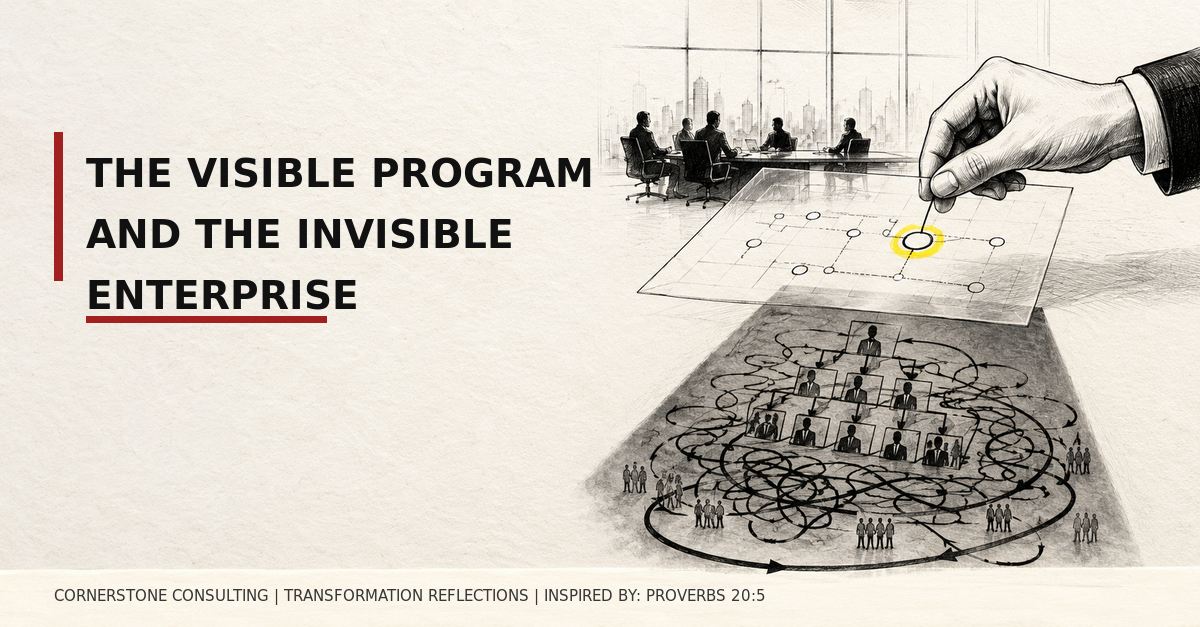
A program announces the future.
Leaders teach the enterprise what is real.
People follow the decisions that repeat.
I have seen teams accept a new design on paper while watching leaders approve exceptions that restored the old model. Confidence changed when executives reviewed their recent decisions together, named the contradiction, and reinforced the same ownership, data, and process principles under pressure.
A transformation program can publish a new operating model, approve new decision rights, and report that leaders are aligned. The visible program may be coherent. The invisible enterprise is still waiting for evidence.
People study what executives do when the new model becomes inconvenient. They notice whether a local exception is challenged or quietly approved, whether a business owner is allowed to defer accountability, and whether delivery pressure overrides the data, control, or process standards leaders previously endorsed. Those moments teach the organization which rules are real.
This is why visible sponsorship can coexist with invisible doubt. A steering committee may endorse enterprise-wide change while repeatedly protecting local priorities. Leaders may ask teams to collaborate while rewarding results that depend on functional optimization. They may assign authority to a new role, then continue seeking decisions from the person who held influence before the program began.
The invisible enterprise is not simply resisting change. It is learning from leadership consistency.
For an Executive, this creates a different kind of transformation measure. Readiness is not only whether the future model is designed. It is whether recent leadership choices reinforce it. Every exception, escalation, funding decision, and performance conversation either increases confidence in the new operating model or restores confidence in the old one.
Enterprise Architecture can make this pattern discussable without turning it into a culture diagnosis. Architects and transformation advisors can connect five recent executive decisions to their consequences across capabilities, data, process ownership, incentives, and governance. The question is not whether each decision was reasonable in isolation. The question is what operating model those decisions are teaching people to trust.
Before the next steering meeting, review the last five material exceptions or escalations. For each one, record the stated future principle (i.e. quality comes first), the decision actually made, the trade-off accepted (i.e. giving up speed to save money), and the behavior the decision is likely to reinforce. Look for a repeated contradiction.
The visible program describes the intended enterprise. Repeated leadership decisions reveal the enterprise people believe will survive.
Reflection
Which repeated leadership decision is teaching people that the old model still wins?
Practice
Complete a five-decision consistency audit before the next steering meeting. Compare each recent exception or escalation with the future operating-model principle it was meant to support, then correct one repeated contradiction.
Comments Welcome
Darin Paton is the Owner of Cornerstone Consulting Inc., an Alberta-based enterprise architecture and SAP ERP transformation advisory firm serving organizations across complex business and technology change for over 15 years. 30+ years as an EA and advising SAP transformations.

Leave a Reply