

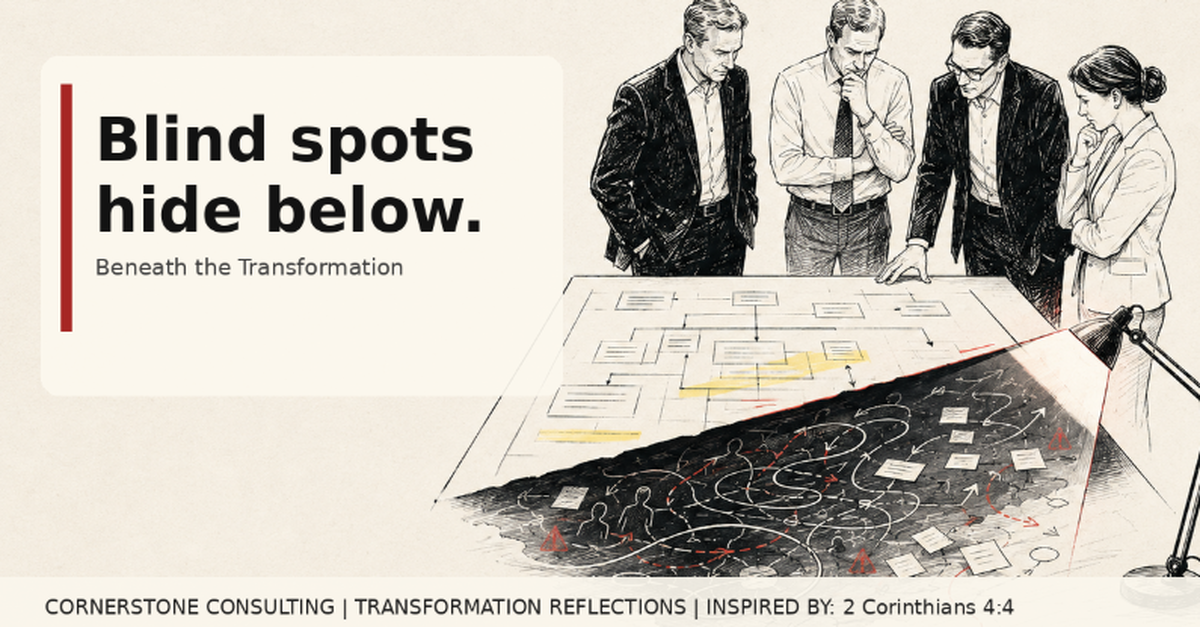
The plan can be green while the enterprise is warning you.
Blind spots rarely announce themselves.
Leaders need better sightlines before hidden reality becomes strategy.
I have seen leaders dismiss weak signals because the formal report looked clean. Later, those signals became the real issue. Better sightlines across ownership, data, controls, and operating readiness help executives see what the plan does not naturally show.
One of the hardest executive risks in transformation is not ignorance. It is confidence in an incomplete view.
A program can report green while people close to the work see something different. They may see business owners who are not truly aligned, teams building local workarounds, data definitions that still conflict, decision rights that collapse under pressure, or benefits that cannot be traced to changed behaviour. These signals often sit beneath the formal plan. They are visible to some people and invisible to others.
That gap should concern an Executive team. Not because every concern is equally important, but because blindness at the top can turn manageable friction into enterprise consequence. When leaders cannot see what others can see, they may keep funding a story that the organization is quietly disproving.
The answer is not to flood executives with noise. The answer is to build better sightlines. Enterprise architecture helps by organizing hidden signals into decision-useful evidence: capability impact, process ownership, data lineage, controls, integration dependencies, ERP and platform consequences, adoption risk, and operating-model readiness. Good architecture does not merely say, something feels wrong. It shows where the enterprise view is incomplete and what decision is now required.
For executives, the discipline is humility without paralysis. Ask where the plan may be hiding reality. Invite challenge from the people closest to handoffs, controls, customers, operations, and data. Require architecture-backed evidence before dismissing concerns as resistance or detail. Make room for uncomfortable evidence before it becomes expensive evidence. That habit protects both value and trust.
Transformation leadership is partly the willingness to let light reach the places the plan does not naturally show. If the formal view is the only view, blind spots become strategy.
The enterprise becomes safer when leaders can say, clearly and without defensiveness, show us what we are not seeing.
Reflection
Where might your current executive view be accurate, but incomplete?
Practice
Invite one architecture-backed challenge view into the next transformation review: what can people closest to handoffs, data, controls, customers, or operations see that executives may not?
Comments Welcome…
Darin Paton is the Owner of Cornerstone Consulting Inc., an Alberta-based enterprise architecture and SAP ERP transformation advisory firm serving organizations across complex business and technology change for over 15 years. 30+ years as an EA and advising SAP transformations.

Leave a Reply