

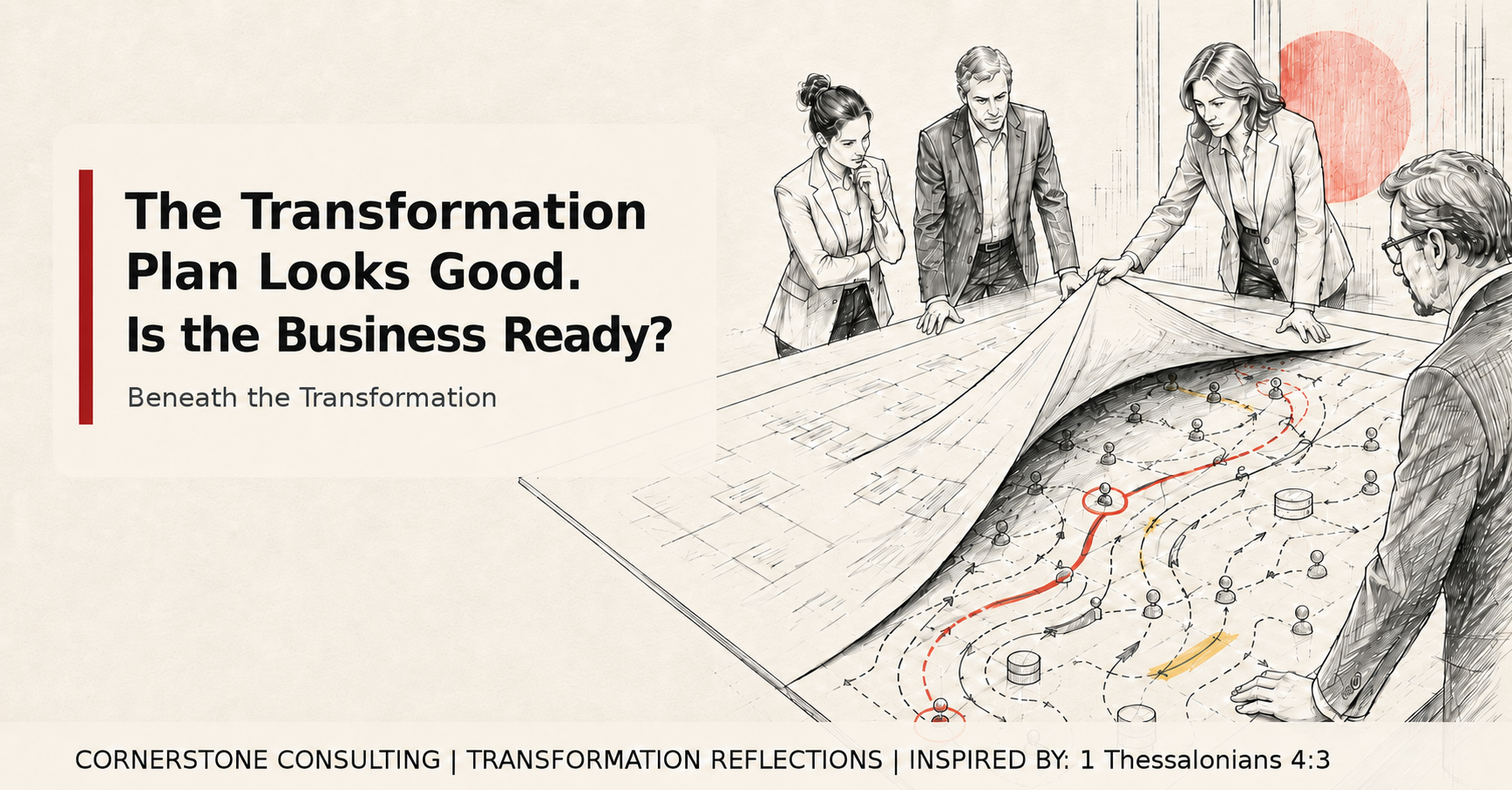
The transformation plan can be on track while the business is not ready.
Unclear ownership, conflicting data, workarounds, and weak decision rights often sit outside the status report.
Here are five operating conditions executives should test before trusting the plan.
I have seen strong programs struggle because leaders trusted the plan before testing the operating reality underneath it. The useful work is often quieter: surfacing ownership gaps, informal decisions, data friction, and capability readiness before those hidden conditions become expensive.
A formal transformation plan can look calm while the enterprise underneath is being stripped down to the truth. That is often uncomfortable for executives, because the plan usually tells a clean story: decisions made, vendors selected, milestones tracked, risks logged, budget watched. But the deeper work asks a harder question. What is actually left when the program language is removed?
The visible plan may say the operating model is changing. The lived enterprise may still have unclear ownership, old decision habits, conflicting data definitions, informal workarounds, and leaders who privately disagree on what success means. None of that makes the program a failure. It means the organization is finally seeing what has been hidden.
Executives can miss this moment by defending the plan too quickly. The instinct is understandable. A lot has been approved, communicated, and funded. But enterprise change needs more than plan confidence. It needs enough honesty to see the informal system beneath the formal one.
This is where enterprise architecture earns its place in the executive conversation. Not as a design review after decisions are made, but as a way to make hidden conditions visible: capability gaps, decision rights, business ownership, integration dependencies, controls, SAP and core-system impacts, data accountability, and benefit traces. Those are not side issues. They are the enterprise that must be able to operate after the transformation language is gone.
For an executive, the practical question is not whether the program looks professional. It is whether the program is revealing enough truth to make the enterprise stronger. If the answer is no, the plan may be protecting activity while the real organization remains unchanged. That is a serious leadership risk.
The most useful transformation review may be the one that strips away the performance of progress and asks what is real enough to endure.
Reflection
Where is the formal plan giving you confidence that has not yet been tested against actual operating behaviour?
Practice
In the next steering review, ask for one page showing hidden ownership, data, integration, control, and decision-right assumptions that could undermine the plan.
Comments Welcome
Darin Paton is the Owner of Cornerstone Consulting Inc., an Alberta-based enterprise architecture and SAP ERP transformation advisory firm serving organizations across complex business and technology change for over 15 years. 30+ years as an EA and advising SAP transformations.

Leave a Reply