

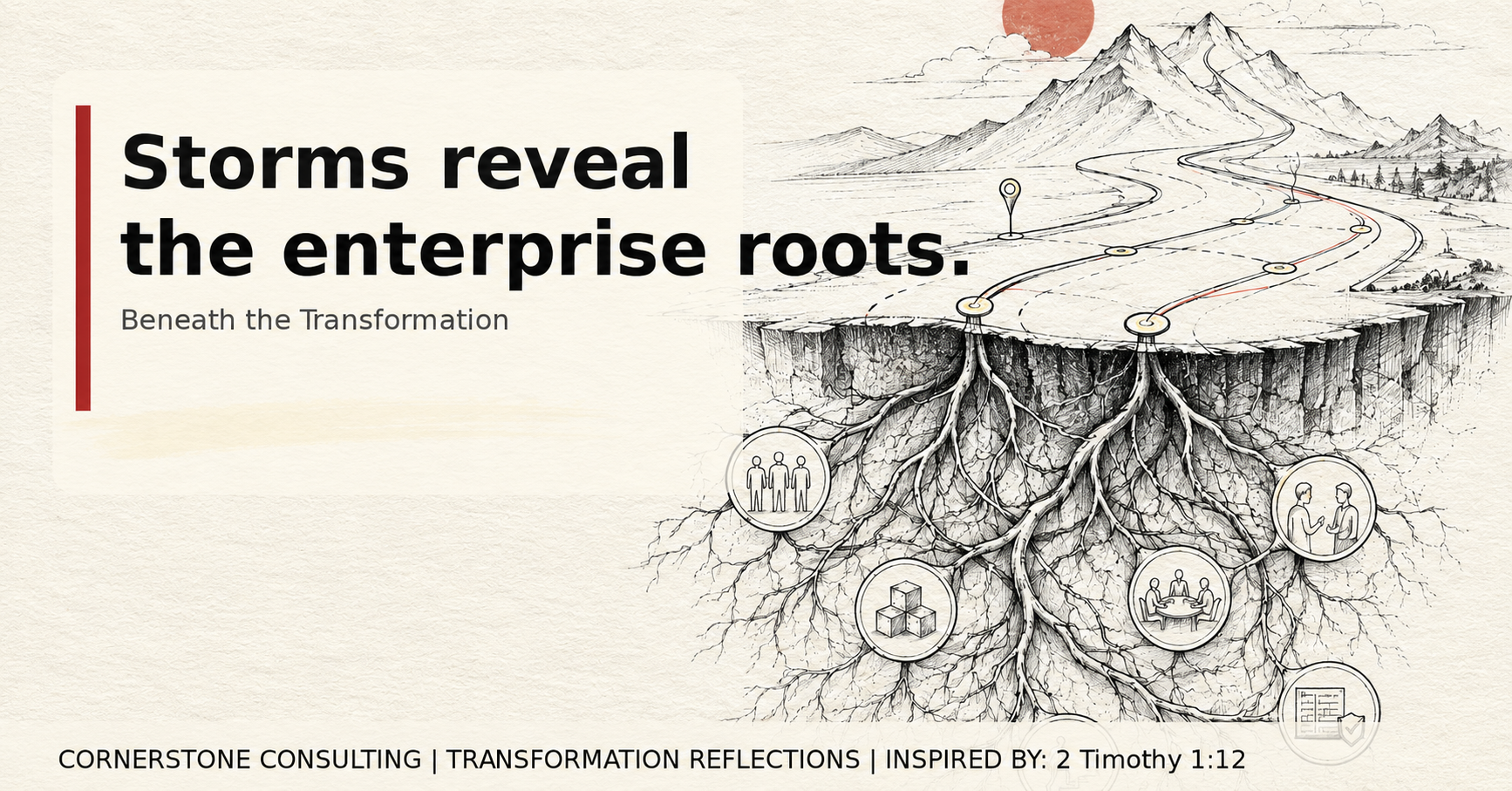
Pressure does not create the root system.
It reveals whether one exists.
A transformation plan is only as strong as the enterprise conditions underneath it.
I have watched transformation pressure expose whether relationships, ownership, and decision paths were real or only assumed. When the roots are shallow, teams escalate everything. When the roots are strong, leaders can see issues early and resolve them with discipline.
A transformation can survive a calm steering committee and still fail under pressure. The difference is often the root system beneath the formal plan.
Most programs are good at showing the visible growth: workstreams, milestones, RAID logs, solution demos, and readiness dashboards. Those matter. But pressure tests what is less visible. When deadlines tighten, when data quality disappoints, when a business unit resists a process change, when an integration decision affects customer service, the enterprise discovers how deep its roots really are.
Those roots are practical. They include trusted relationships between business and technology leaders, clear ownership for outcomes, decision forums that can handle trade-offs, architecture that makes dependencies visible, and operating teams that know how to resolve issues without waiting for heroic escalation.
Executives sometimes treat these as soft matters compared with scope, budget, and schedule. They are not soft. They are structural. A program with shallow roots may look quick and flexible at first, but it can become fragile when real enterprise weather arrives. A slower-growing capability, with stronger ownership and clearer decision paths, may look less impressive early and become far more durable later.
This is why executive sponsorship must go beneath the status report. Ask where teams are relying on personal goodwill instead of designed accountability. Ask which decisions are being delayed because the operating model is unclear. Ask where architecture is exposing root-level dependencies that the formal plan has not yet absorbed. Ask who will still hold the capability when the program team leaves.
EA coaching matters here because leaders often need help seeing the difference between visible delivery motion and the enterprise roots that make change sustainable. The work is not to admire the plan. The work is to strengthen what will hold when the plan is tested.
A transformation with deep roots can bend under pressure without losing its direction.
Reflection
Which transformation pressure point is revealing whether your enterprise has deep roots or only visible activity?
Practice
Ask each executive owner to name the relationship, decision forum, data owner, control owner, and operating team that will support the capability when pressure rises.
Comments Welcome
Darin Paton is the Owner of Cornerstone Consulting Inc., an Alberta-based enterprise architecture and SAP ERP transformation advisory firm serving organizations across complex business and technology change for over 15 years. 30+ years as an EA and advising SAP transformations.

Leave a Reply