

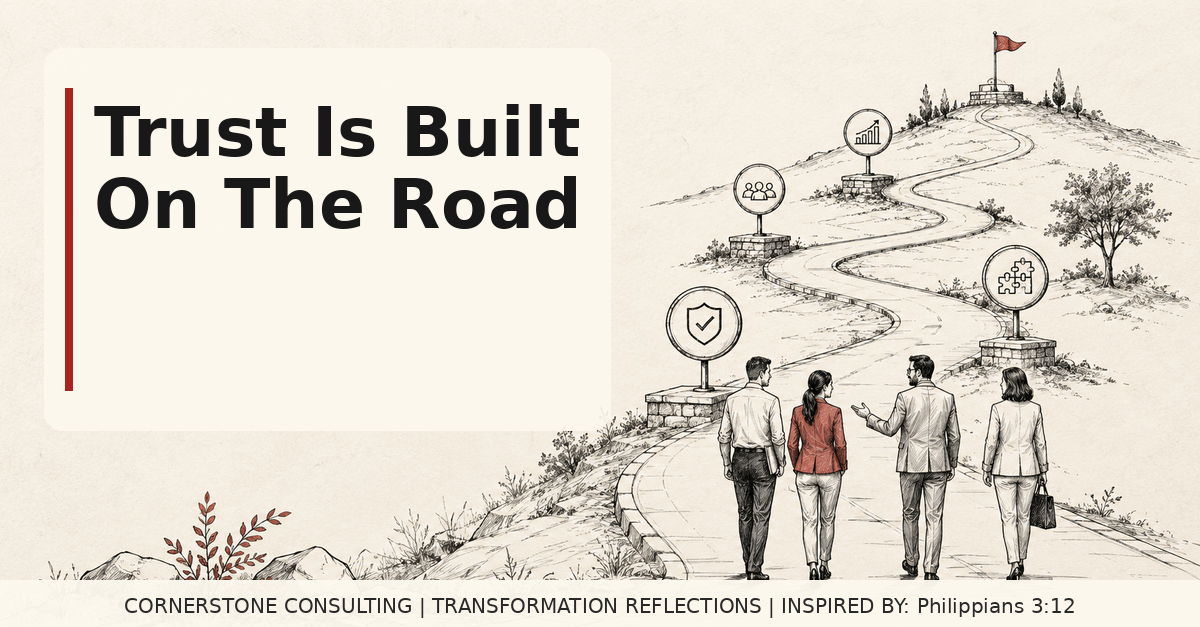
Architecture trust is not won at the finish line.
It is earned through the road leaders walk with you.
An Enterprise Architect becomes useful when the journey itself improves judgment, pacing, and ownership.
I have watched leaders trust architecture more when they experience its value along the way, not only at a final review. Good EA makes the journey clearer through small decisions, visible trade-offs, and practical checkpoints. More reflections at https://www.cornerstonea.com/.
Enterprise Architecture often tries to win trust at the end of the race. The team prepares the final architecture pack, the target-state view, the principles, the roadmap, and the recommendation. Then it hopes leaders will accept the conclusion.
That is a hard way to build influence.
Enterprise Architects earn trust on the road, not only at the destination. Leaders need to experience architecture as a practical guide while choices are still forming. They need help seeing what a decision will enable, what it will constrain, what it will cost, and what it will make harder to reverse. If architecture only appears at the final gate, it can feel like judgment after the fact.
The journey matters because enterprise decisions mature through contact with reality. A transformation idea may begin as a clean business case, but the route soon exposes dependencies, data gaps, SAP or core-platform constraints, operating-model impacts, control issues, vendor assumptions, and capacity limits. These are not distractions from the destination. They are the road that proves whether the destination is credible.
The Enterprise Architect brings value by pacing that journey. Instead of rushing to sell a perfect target state, the architect helps leaders learn as they go. The work becomes a series of useful checkpoints: What capability are we changing? Who owns the decision? What evidence has changed? What risk is now visible? What trade-off needs executive attention?
This does not slow the enterprise when done well. It prevents false speed. The organization moves with more confidence because architecture has been present in the small turns, not just the final approval.
The practice is simple but demanding: make architecture useful before it is complete. Show up early. Ask practical questions. Clarify consequences while leaders still have room to adjust. Trust is rarely built by one impressive presentation. It is built when the road itself becomes clearer because the architect is walking it with the enterprise.
Reflection
Am I waiting for the final architecture answer, or am I helping leaders make better decisions throughout the journey?
Practice
Create a short decision-checkpoint rhythm for one active initiative: capability impact, ownership, key dependency, new risk, and next decision. Use it every two weeks so architecture value is felt while the work is moving.
Comments Welcome
Darin Paton is the Owner of Cornerstone Consulting Inc., an Alberta-based enterprise architecture and SAP ERP transformation advisory firm serving organizations across complex business and technology change for over 15 years. 30+ years as an EA and advising SAP transformations.

Leave a Reply