

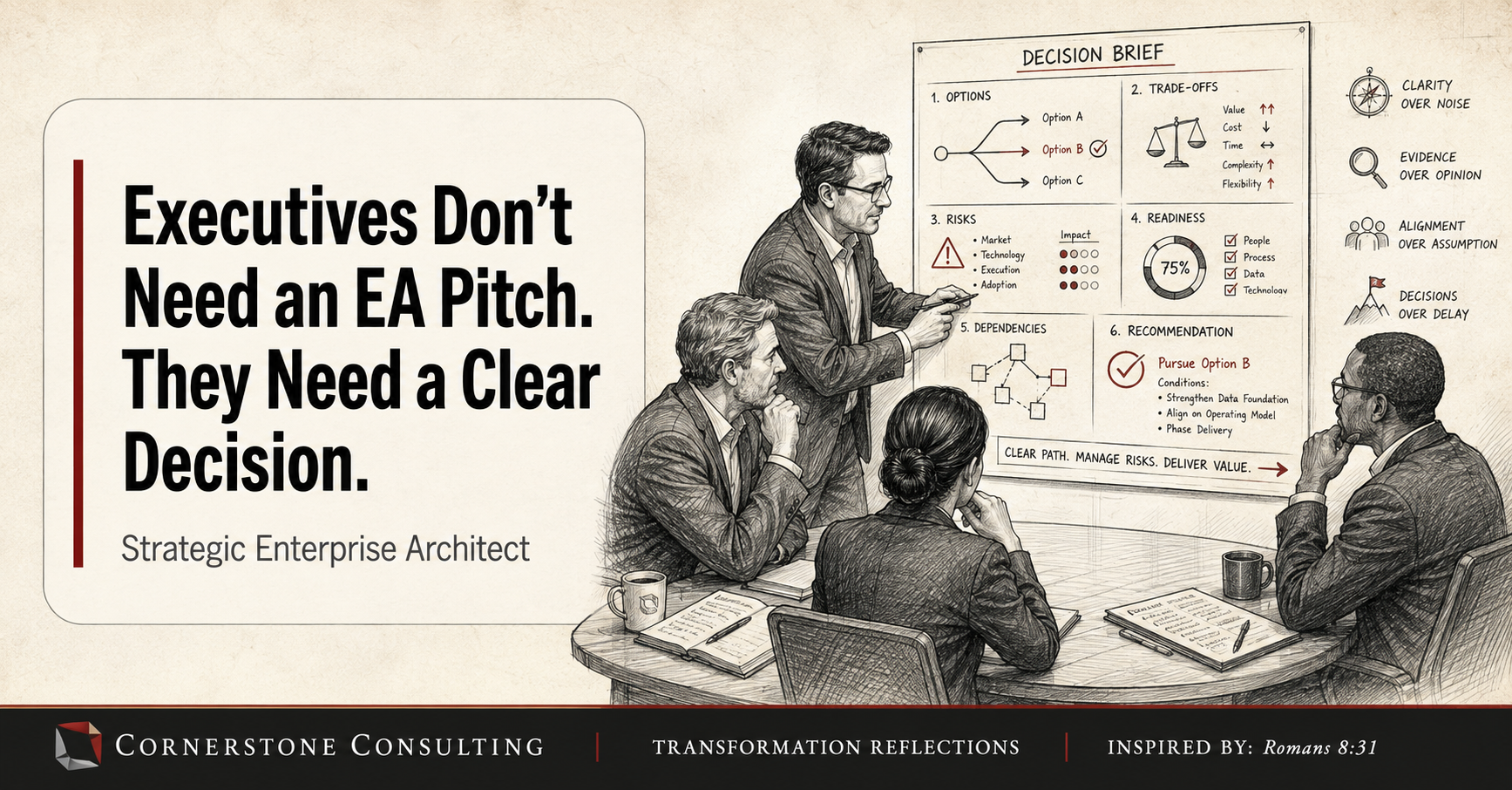
Trying to sell enterprise architecture can make executive conversations harder.
Leaders are usually trying to resolve a decision, not understand an architecture function.
Start with the decision they need to make
I have seen architecture teams respond to skepticism by explaining the function more forcefully. Trust improved only when they stopped defending EA and calmly framed the decision, evidence, options, consequences, and recommendation leaders needed.
Enterprise Architects sometimes enter executive conversations expecting to prove that enterprise architecture deserves a seat at the table. When leaders question the function, the instinct is to explain its scope, frameworks, governance responsibilities, and strategic importance.
That usually makes the conversation harder.
Executives do not need another internal discipline asking to be recognized. They need confidence that a difficult choice can be understood and acted upon. The architect creates that confidence by making uncertainty governable.
For one live decision, separate facts from assumptions. Show the outcomes leaders are protecting, the risks each option accepts, the dependencies that could change the result, and what would be difficult to reverse. Name the owner of the final trade-off. Then offer a recommendation in plain business language.
This is stronger than an architecture sales pitch because it lets usefulness carry the message. Finance can see downstream cost. Operations can see readiness. Delivery can see sequencing. Security and data leaders can see where their concerns intersect. Executives can see what they are deciding rather than being asked to endorse architecture as a concept.
Confidence also requires restraint. Do not exaggerate avoided cost, claim certainty the evidence cannot support, or imply that architecture owns the outcome. State what is known, what is uncertain, and what evidence would change the recommendation.
Over time, leaders will associate architecture with calm judgment under pressure. They will invite it earlier because previous conversations improved decisions—not because someone persuaded them that EA is important.
The strongest case for enterprise architecture is a decision that became clearer, faster, safer, or more valuable because the enterprise view was present.
Reflection
When you defend enterprise architecture, are you helping leaders decide—or asking them to validate the function?
Practice
Prepare a one-page decision confidence brief: outcome, facts, assumptions, options, dependencies, reversibility, risk owner, and recommendation. Remove anything that does not change the decision.
Comments Welcome
Darin Paton is the Owner of Cornerstone Consulting Inc., an Alberta-based enterprise architecture and SAP ERP transformation advisory firm serving organizations across complex business and technology change for over 15 years. 30+ years as an EA and advising SAP transformations.

Leave a Reply