

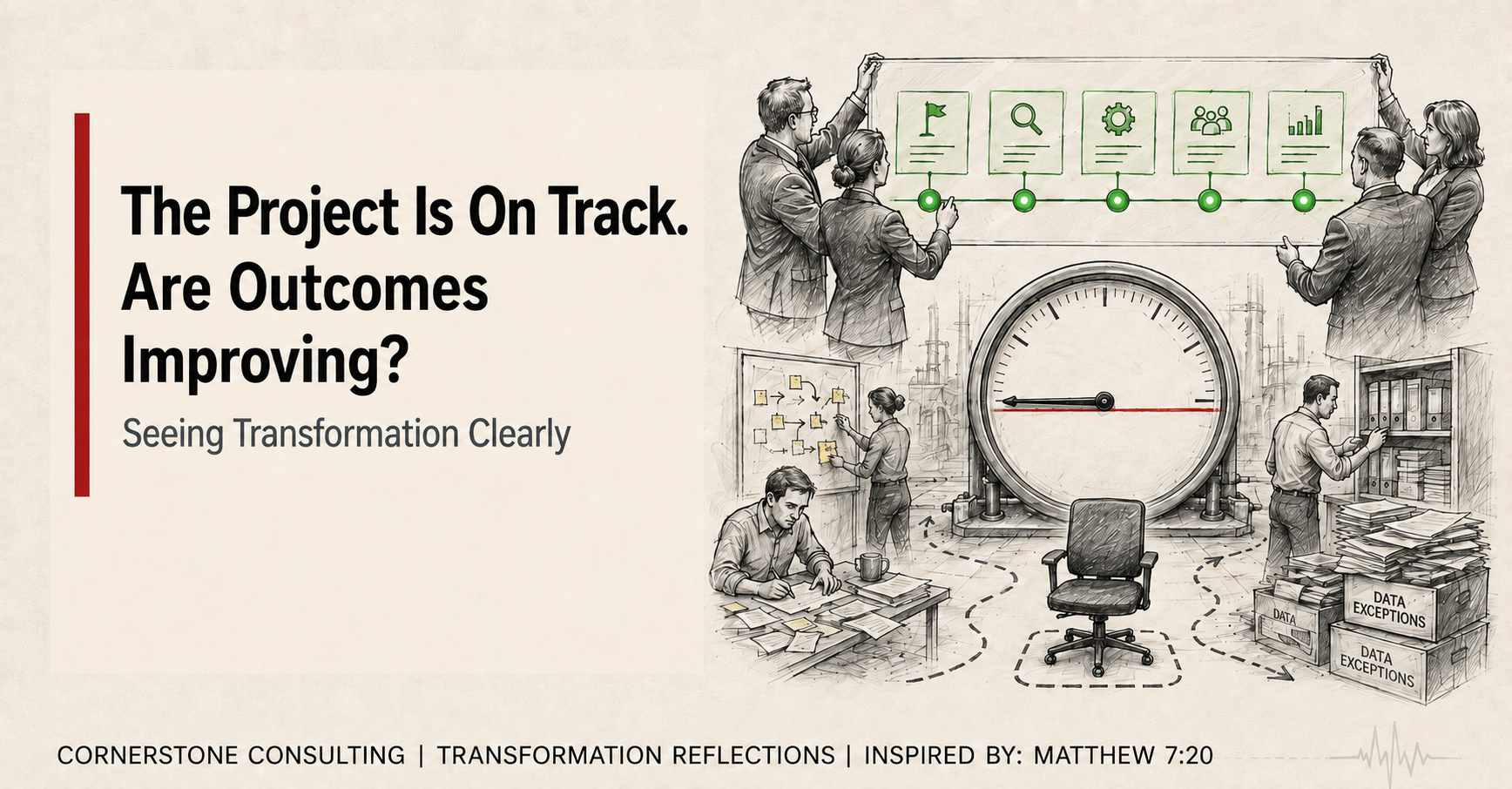
Milestones show what the program completed.
Outcomes show whether the enterprise improved.
Your steering meeting needs both.
I have seen transformation teams produce impressive volumes of activity while the operating result barely moved. The turning point came when leaders stopped asking only what had been completed and began asking what had changed. That shift connected delivery to ownership, behaviour, capability, and measurable business consequences.
A transformation can be busy, on schedule, and still fail to move the enterprise.
Green milestones are reassuring. Designs approved. Testing complete. Training delivered. Defects falling. Go-live dates protected. These measures tell executives whether the program is moving.
They do not tell them whether the organization is improving.
Activity is easy to count because it sits inside project control. Progress is harder to see because it appears across business outcomes, behaviour, capability, and ownership. A process can be signed off while cycle time stays flat. Training can reach 98 percent while managers still depend on the project team. A system can stabilize while data exceptions continue to require heroics.
The risk is not bad reporting. It is incomplete evidence. When governance rewards delivery volume, teams naturally produce more visible activity. Executive attention can then concentrate on throughput while the reason for the transformation fades into the background.
A stronger dashboard connects each major activity to an expected enterprise change.
For every workstream, identify three forms of evidence: one operating result, such as fewer exceptions or faster decisions; one capability signal, such as business ownership or improved data stewardship; and one behaviour signal, such as teams using the new process without informal escalation.
Then ask one question at every steering meeting: What changed in the enterprise because this work was completed?
The answer may be early, imperfect, or qualitative. That is acceptable. The purpose is not to manufacture certainty. It is to make the gap between output and outcome visible soon enough to act.
Enterprise Architecture helps by tracing how project deliverables connect to capabilities, information, process, roles, and operating consequences. It gives leaders a way to test whether the pieces being delivered are combining into a stronger enterprise rather than a completed program.
A transformation should not be judged by how much motion it creates. It should be judged by the evidence that the organization can now do something better, faster, safer, or more sustainably than before.
Green milestones show movement.
Changed outcomes show progress.
Reflection
Which green milestone in your transformation is not yet supported by evidence of a changed business outcome, stronger capability, or new behaviour?
Practice
Add one outcome line to every major workstream report. Name the expected operating result, capability signal, and behaviour signal. At the next steering meeting, ask what changed because the activity was completed and what evidence supports the answer.
Comments Welcome
Darin Paton is the Owner of Cornerstone Consulting Inc., an Alberta-based enterprise architecture and SAP ERP transformation advisory firm serving organizations across complex business and technology change for over 15 years. 30+ years as an EA and advising SAP transformations.

Leave a Reply