

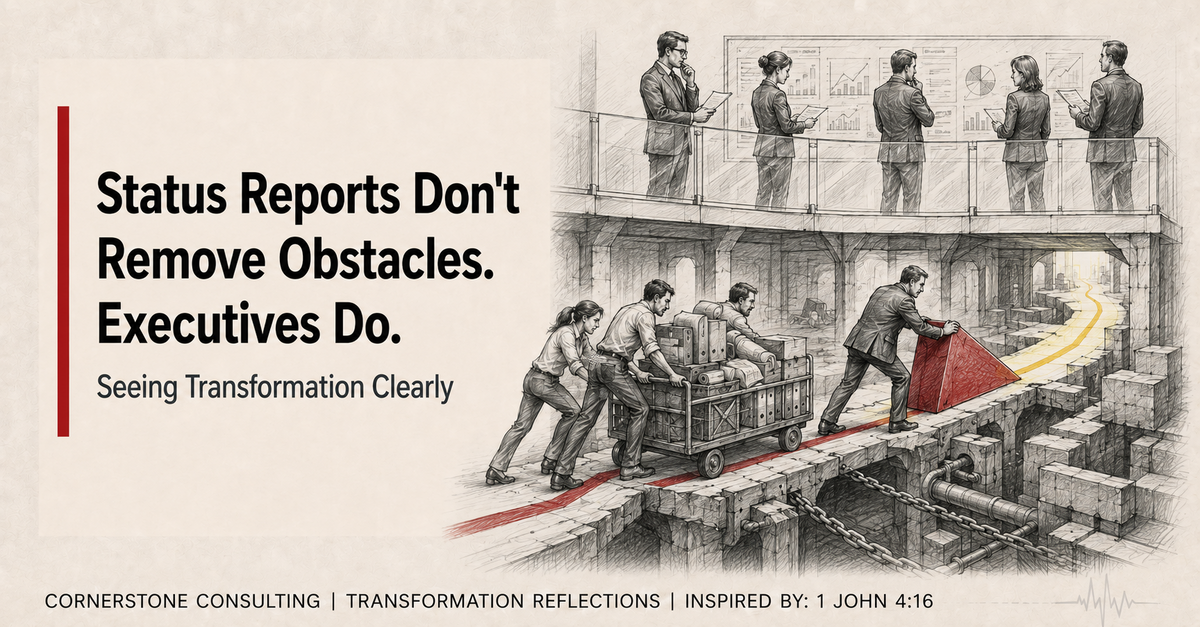
Weekly reports show motion.
They do not resolve unclear authority, competing priorities, or weak ownership.
Progress begins when executives remove what teams cannot.
I have watched teams work hard while executive attention stayed too far from the real friction. Progress improved when leaders asked what conditions teams needed, then used architecture and operating-model insight to remove obstacles instead of only reviewing status.
Activity is not progress when leaders only inspect effort from a distance.
Many transformation programs create a rhythm that makes executives feel informed. Weekly reports arrive. Workstreams update their status. Issues are sorted by colour. Leaders can see motion, pressure, and effort. But the people doing the work may still be carrying unclear decisions, weak ownership, competing priorities, and practical obstacles they cannot remove by themselves.
Progress needs more than surveillance. It needs close executive attention.
Close attention is not micromanagement. It is the disciplined habit of understanding what the enterprise is asking people to carry. It notices where decisions are slow because authority is unclear. It notices where teams are busy because the operating model was not designed well enough. It notices where adoption is weak because leaders funded a system but not the new way of working around it.
This kind of attention changes the quality of leadership. The executive stops asking only, “Are they on track?” and starts asking, “What do they need in order for the enterprise to become different?”
That question creates better evidence. It draws attention to the conditions that make progress real: decision rights, business ownership, data accountability, process clarity, support readiness, controls, capability adoption, and benefit ownership. It also gives architecture and transformation advisors a useful role. They can help leaders see the hidden dependencies between people, process, technology, information, and value.
The strongest transformations are not pushed forward only by pressure. They are guided by leaders who know the work closely enough to remove the right friction.
Executives do not need to attend every workshop or approve every detail. But they do need to stay near the evidence. When leaders understand the real burden of change, they can tell the difference between productive effort and wasted motion.
Activity tells you people are moving. Close attention tells you whether the enterprise is being helped to change.
Reflection
Where are teams showing effort, but still lacking the executive attention needed to remove the real enterprise friction?
Practice
Choose one workstream and ask what leaders could remove, clarify, fund, decide, or protect this month so progress becomes easier to prove.
Comments Welcome
Darin Paton is the Owner of Cornerstone Consulting Inc., an Alberta-based enterprise architecture and SAP ERP transformation advisory firm serving organizations across complex business and technology change for over 15 years. 30+ years as an EA and advising SAP transformations.

Leave a Reply