

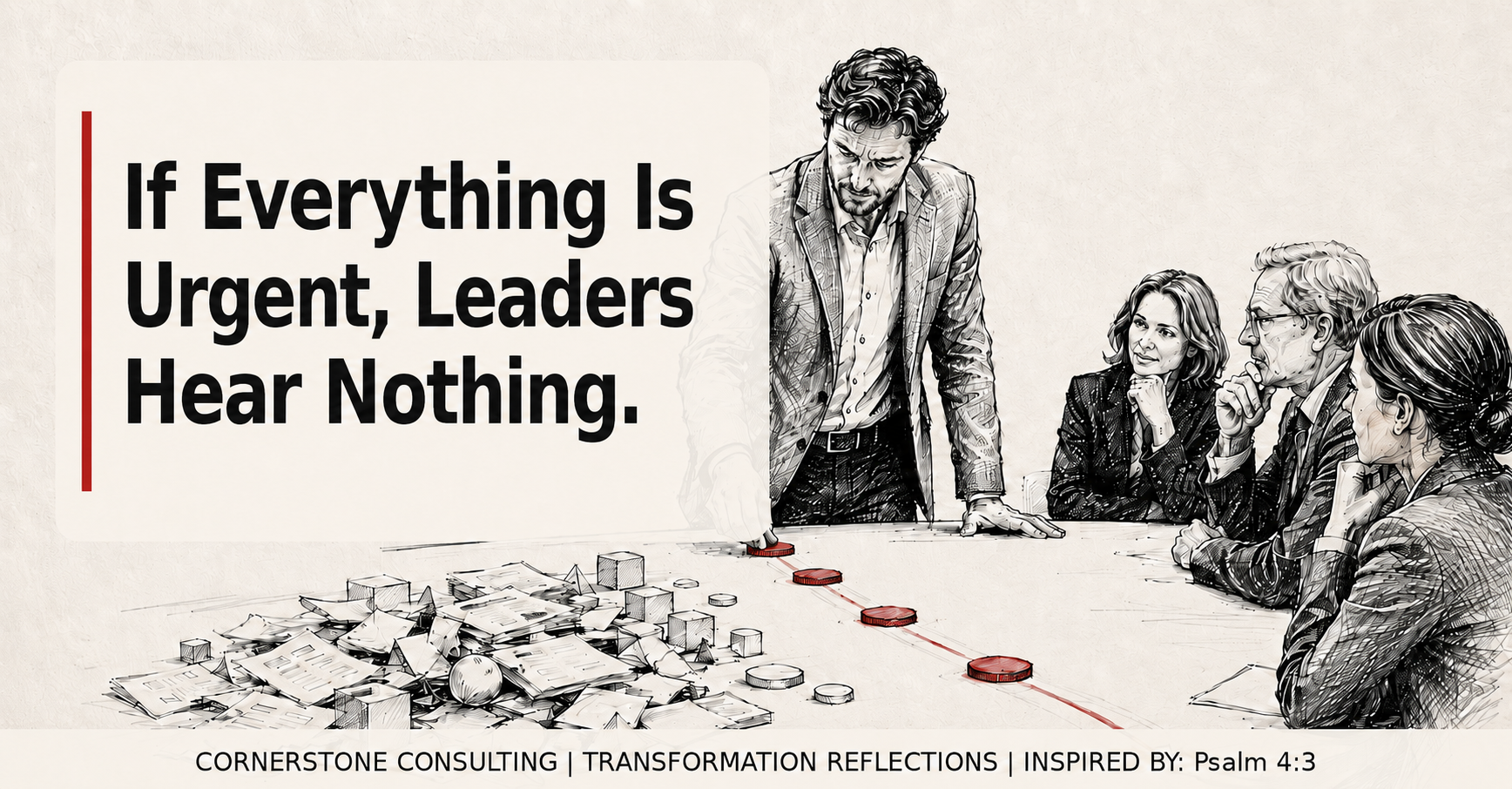
A crowded architecture message weakens real warnings.
Prioritize evidence that can change commitment, sequence, or risk.
Let the rest wait.
I have seen architecture become trusted when it separates the few signals that matter from the noise of methods, artifacts, and opinions. Leaders do not need everything. They need the consequence they cannot afford to miss. More reflections at https://www.cornerstonea.com/.
On many enterprises, architecture is present but not set apart. It becomes one more voice in a crowded room: another review, another diagram, another principle, another process step, another request for compliance.
The Enterprise Architect has to offer something different. Not louder. Not more complex. More useful.
The useful signal is the part of architecture that helps leaders see what they could not see clearly enough before. It may be the dependency that changes the sequence. It may be the decision right that no one owns. It may be the data definition that will break reporting after go-live. It may be the SAP or core-platform constraint hidden behind a confident plan. It may be the control issue that turns a local shortcut into enterprise risk.
This is why the architect cannot simply sell Enterprise Architecture as a discipline. The discipline is valuable, but leaders respond to the signal it produces. They need to know which issue deserves attention now, which trade-off can wait, which exception needs an owner, and which commitment should not be made until the operating model is ready.
Being set apart in this work requires judgment. If every architecture concern is treated as equally urgent, leaders eventually hear none of them. The architect must distinguish hygiene from hard gates, preferences from principles, and interesting information from decision-critical evidence. That is not reductionism. It is service.
The best architecture voice in the room may be the one that says, Here are the two things that will decide whether this works. Everything else can be handled, but these cannot be vague.
A Strategic Enterprise Architect earns influence when architecture becomes a trusted signal. The role is not to display the whole architecture universe. It is to help the enterprise know what matters enough to shape the next decision.
Reflection
What architecture signal am I uniquely responsible to make clear for leaders right now?
Practice
For one active decision, classify architecture concerns into four groups: background hygiene, design guidance, executive trade-off, and non-negotiable condition. Bring only the executive trade-off and non-negotiable condition to the next leadership conversation.
Comments Welcome
Darin Paton is the Owner of Cornerstone Consulting Inc., an Alberta-based enterprise architecture and SAP ERP transformation advisory firm serving organizations across complex business and technology change for over 15 years. 30+ years as an EA and advising SAP transformations.

Leave a Reply