

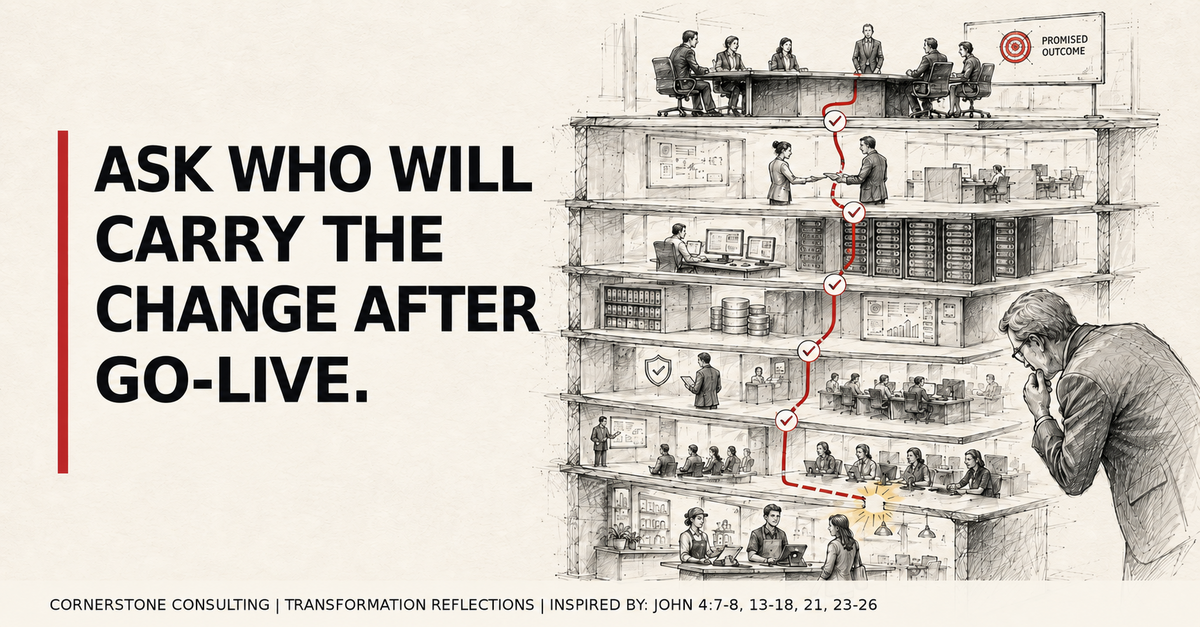
Transformation often fails at the boundary.
Not the plan boundary.
The human, process, and ownership boundary.
I have seen programs stay busy inside their own structure while the real enterprise boundary remained untouched. Progress became clearer when leaders traced outcomes across process, data, controls, support, and user behaviour, then listened to the people living with the gaps.
Activity is not progress when it stays inside the groups that already agree.
Transformation programs often become busy inside their own structure. The program team meets. The vendor delivers. The design authority reviews. The steering committee decides. Work moves through the formal channels, and the machinery can look impressive.
But meaningful progress usually has to cross a boundary.
It crosses from project language into operations. From system design into customer experience. From executive intent into middle-management behaviour. From process maps into real exceptions. From technology configuration into data ownership, controls, training, support, and measurable business outcomes.
If those boundaries are not crossed, activity stays trapped in the program. The enterprise may receive a new solution, but the lived work remains thirsty for clarity.
Executives should pay attention to who is still outside the conversation. Sometimes the missing voice is a frontline team that understands the exception path. Sometimes it is a process owner who will inherit the operating risk. Sometimes it is finance, compliance, cybersecurity, data governance, customer service, supply chain, or the support team that will carry the consequences after go-live.
Progress becomes more credible when leaders approach those boundaries with humility. Not every answer sits in the boardroom or the program plan. Some of the most important evidence sits with the people who experience the gaps first.
Enterprise architecture helps by making those boundaries visible. It can connect capability, value stream, process, data, application, integration, control, support, and ownership views so leaders can see where progress is stopping short.
The goal is not to invite everyone into every decision. The goal is to know which boundary must be crossed before the decision can be trusted.
Activity counts what the program has done. Progress tests whether the enterprise has been reached.
When leaders measure only internal motion, transformation can remain impressive but incomplete. When they test boundary-crossing evidence, they begin to see whether the change is actually reaching the people, processes, and outcomes it was meant to serve.
Reflection
Which boundary must your transformation cross before activity becomes credible progress?
Practice
Pick one promised outcome and trace it across the boundary from strategy to process, system, data, control, support, and user behaviour. Ask where the evidence stops.
Comments Welcome
Darin Paton is the Owner of Cornerstone Consulting Inc., an Alberta-based enterprise architecture and SAP ERP transformation advisory firm serving organizations across complex business and technology change for over 15 years. 30+ years as an EA and advising SAP transformations.

Leave a Reply