

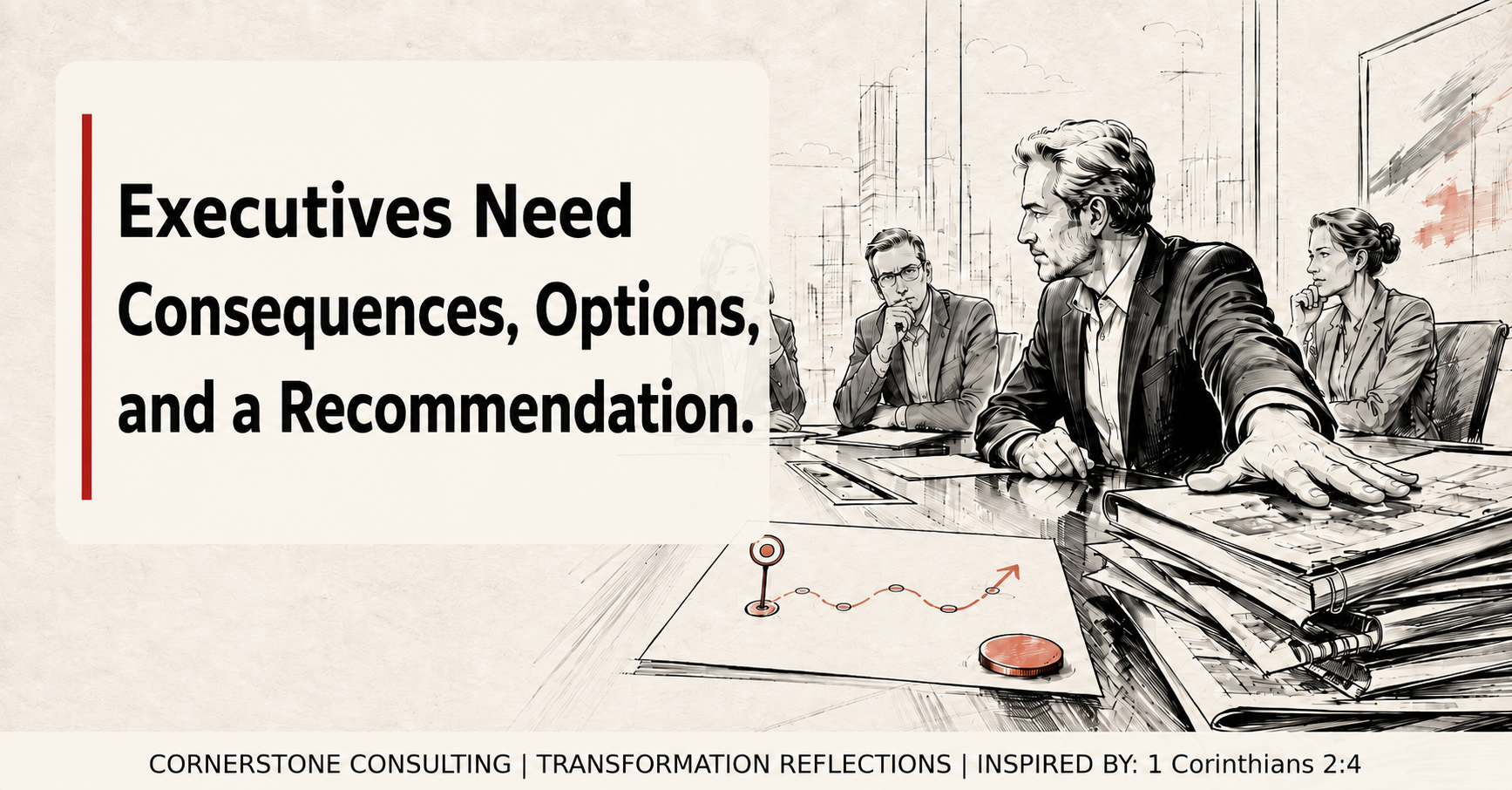
Do not make leaders decode the architecture deck.
Explain what happens, what choices exist, and what you recommend.
Keep the method behind the message.
I have seen architecture teams gain trust when they stop defending the method and start clarifying the decision. The shift is simple but demanding: make cost, risk, speed, ownership, and enterprise consequence easier for leaders to see. More daily reflections at https://www.cornerstonea.com/.
An Enterprise Architect can enter a room with a polished framework, a complete set of diagrams, and a vocabulary that proves professional discipline. None of that means the room is ready to listen.
The quiet risk is that architecture starts performing for itself. The model becomes the message. The artifact becomes the evidence. The review deck becomes the work. Leaders may respect the discipline in theory, but they still move ahead without it because they cannot see how it changes the decision in front of them.
This is where the architect has to stop selling Enterprise Architecture and start translating enterprise consequence. The executive question is rarely, Do we need a framework? It is usually, What happens if we fund this? What risk are we accepting? Which capability improves? What will this do to cost, speed, data, controls, integration, SAP or core systems, and future options?
When the architect answers those questions plainly, architecture becomes useful before it becomes formal. A capability map becomes a way to expose duplicated investment. A dependency view becomes a warning about sequencing. A decision-rights canvas becomes a way to prevent confusion after go-live. A value scorecard becomes a way to test whether architecture is improving outcomes rather than producing activity.
This also requires restraint. The architect may know far more than the room needs. Influence grows when the architect can fast from unnecessary detail long enough to let the real issue become visible. The goal is not to impress the room with architectural completeness. The goal is to leave leaders with a better decision than they had before the conversation began.
For the Enterprise Architect, value is not proven by how much architecture is shown. It is proven by whether the enterprise can see the decision, own the trade-offs, and act with less avoidable complexity.
Reflection
Where am I using architecture language to prove expertise when the room needs decision clarity?
Practice
Before the next executive conversation, reduce the architecture message to four lines: the decision, the enterprise consequence, the options, and the recommendation. Keep the method available, but do not make it the centre of the conversation.
Comments Welcome
Darin Paton is the Owner of Cornerstone Consulting Inc., an Alberta-based enterprise architecture and SAP ERP transformation advisory firm serving organizations across complex business and technology change for over 15 years. 30+ years as an EA and advising SAP transformations.

Leave a Reply