

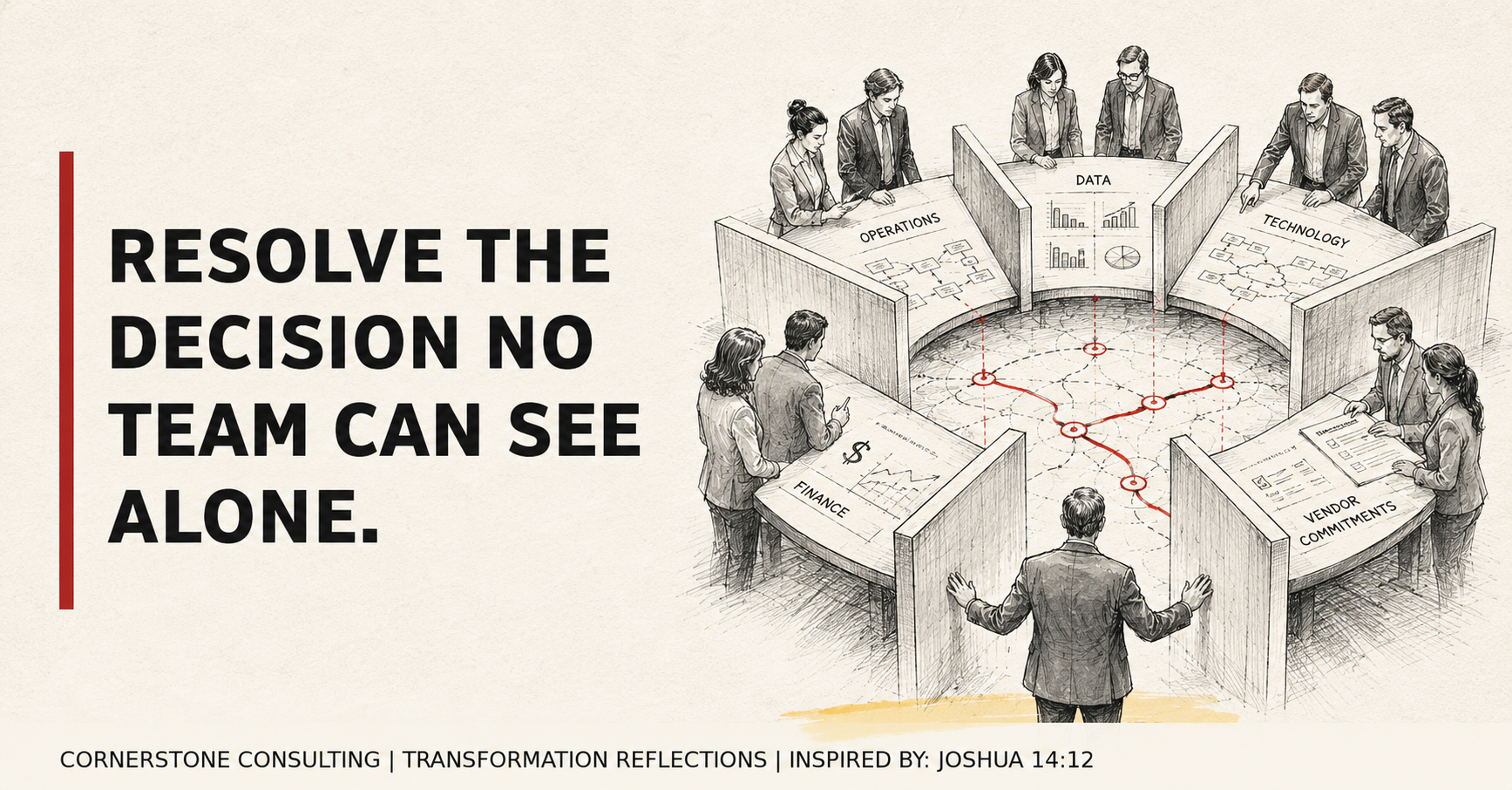
Speed, cost, ownership, and readiness live in different places.
A local view will miss the enterprise consequence.
Connect the evidence before the decision is made.
I have seen architecture practices stay busy with standards while the enterprise struggled with vendor dependency, fragmented ownership, duplicated capability, and an unready operating model. Credibility changed when architects helped leaders frame and resolve one consequential cross-enterprise decision. More daily reflections at: https://www.cornerstonea.com
Enterprise architecture can spend years trying to demonstrate value through maturity models, artifact counts, repository coverage, and governance activity. These measures may help manage the practice, but they rarely answer the executive question: what became better because architecture was involved?
An Enterprise Architect should choose a hard enterprise problem where a cross-boundary view can materially improve the outcome.
The problem might be a vendor commitment that reduces future choice, a transformation that assumes business readiness, an AI initiative without dependable data ownership, or a local solution that creates enterprise cost. These issues matter because no single function can see or own all the consequences.
The architect’s contribution is practical. Define the decision. Identify the business outcome at risk. Connect the affected capabilities, operating model, information, applications, technology, suppliers, and controls. Show credible options and trade-offs. Identify what must be true for the preferred path to work.
This is not an invitation to claim every difficult problem. The architect should select an issue where enterprise perspective is genuinely needed and where sponsorship exists for a real decision. The goal is not to become the hero; it is to make complexity understandable and actionable.
Hard problems reveal whether architecture can work across organizational incentives. Business units may prioritize speed. Programs may protect scope. Vendors may emphasize their solution. Finance may focus on committed cost. Architecture creates value by showing how those reasonable local views interact as one enterprise system.
When leaders can make a better decision because hidden dependencies and consequences became visible, the practice no longer needs to sell itself. Its relevance is experienced.
Architecture earns trust in the difficult territory where fragmented decisions would otherwise create lasting constraint.
Reflection
Which enterprise problem would best demonstrate architecture value because it crosses boundaries and changes an executive choice?
Practice
Create a one-page problem-to-value brief: decision, outcome at risk, affected capabilities, dependencies, options, trade-offs, accountable leader, and the architecture intervention required.
Comments Welcome
Darin Paton is the Owner of Cornerstone Consulting Inc., an Alberta-based enterprise architecture and SAP ERP transformation advisory firm serving organizations across complex business and technology change for over 15 years. 30+ years as an EA and advising SAP transformations.

Leave a Reply