

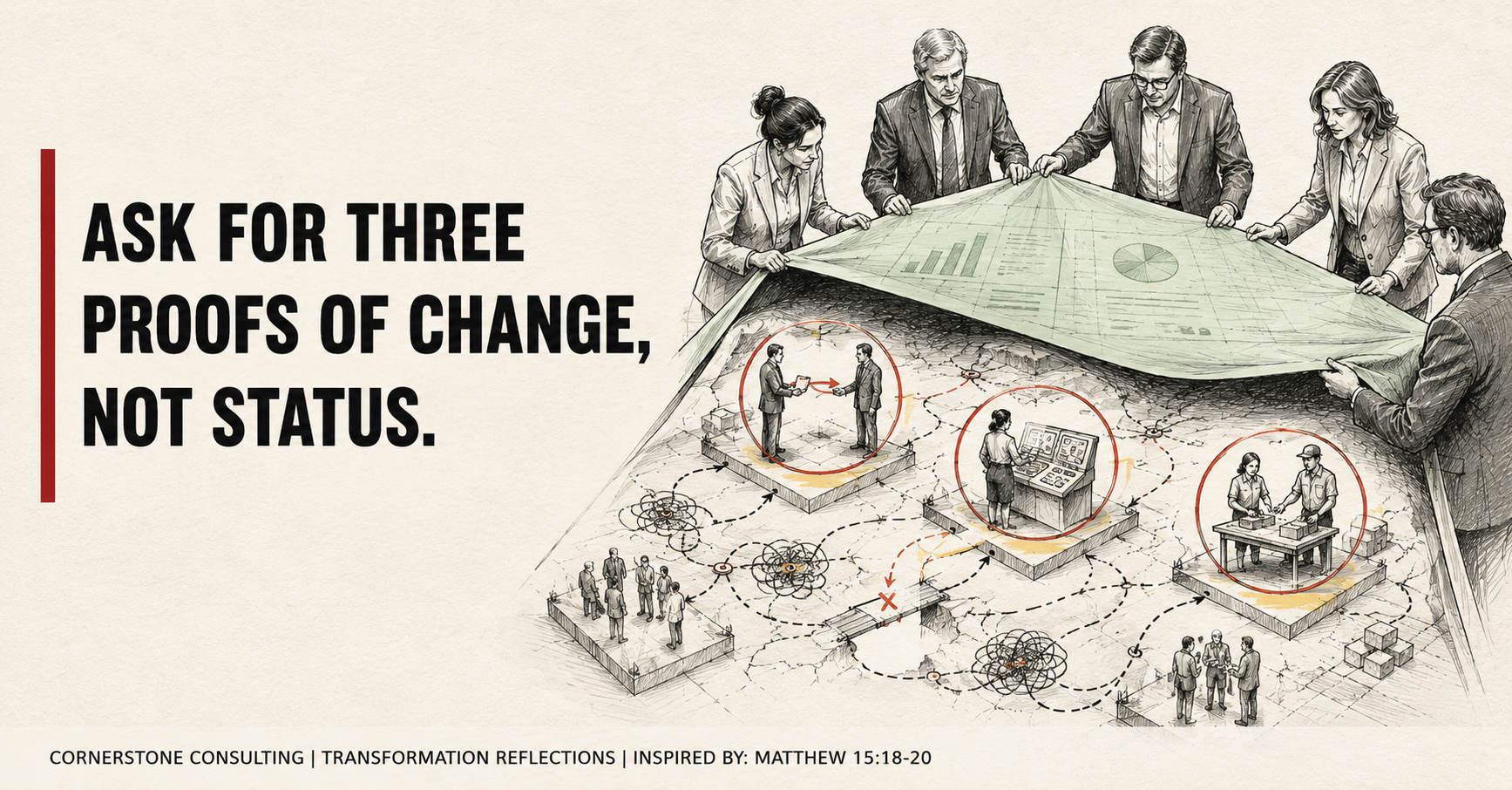
The dashboard is green.
That does not prove the enterprise changed.
Ask for three examples of changed operating evidence.
I have seen projects look well governed while the enterprise underneath stayed unchanged. The better conversations started when leaders asked for evidence of changed capability, not just status. That is where architecture, operating-model design, and honest transformation coaching begin to matter.
Activity is not progress when the activity is only proving that the project machine is moving.
A transformation can have a healthy cadence, full attendance, signed minutes, updated RAID logs, and a green executive dashboard while the underlying enterprise conditions remain untouched. The meetings are real. The work is real. The effort may even be intense. But none of that proves the organization is becoming more capable.
The harder executive question is not, “Are people busy?” It is, “What is being revealed by the work?”
If the same decisions are still being escalated, the same owners are still unclear, the same data issues still require manual repair, the same process exceptions still need heroic intervention, and the same benefits are still described as future hope, then activity has become a covering layer. It gives leaders something visible to review while the real condition of the enterprise stays mostly unexamined.
This is where enterprise architecture matters quietly. Architecture helps leaders look beneath the project rhythm and ask whether capability, operating model, information, governance, technology, people, and ownership are actually changing together. It turns progress from a reportable feeling into an evidence discipline.
Executives do not need another dashboard full of motion. They need a clearer view of what the motion is producing.
Meaningful progress leaves traces. Decisions become faster or better. Accountability becomes clearer. Workarounds shrink. Data becomes trusted. Controls become easier to operate. Teams need less translation between strategy, process, system, and customer impact. Benefits move from slide language into operating evidence.
Those traces do not appear by accident. They have to be named, owned, reviewed, and protected while delivery pressure is still high.
The honest test of transformation is not how polished the program looks from the outside. It is what the work is exposing on the inside, and whether leaders have the courage to act on what they see.
Reflection
Where is your executive team accepting clean status as evidence, when the real enterprise condition still needs diagnosis?
Practice
At the next steering meeting, ask for three examples of changed operating evidence, not only milestone completion. Look for decision quality, ownership clarity, data reliability, control readiness, and benefit movement.
Comments Welcome
Darin Paton is the Owner of Cornerstone Consulting Inc., an Alberta-based enterprise architecture and SAP ERP transformation advisory firm serving organizations across complex business and technology change for over 15 years. 30+ years as an EA and advising SAP transformations.

Leave a Reply