

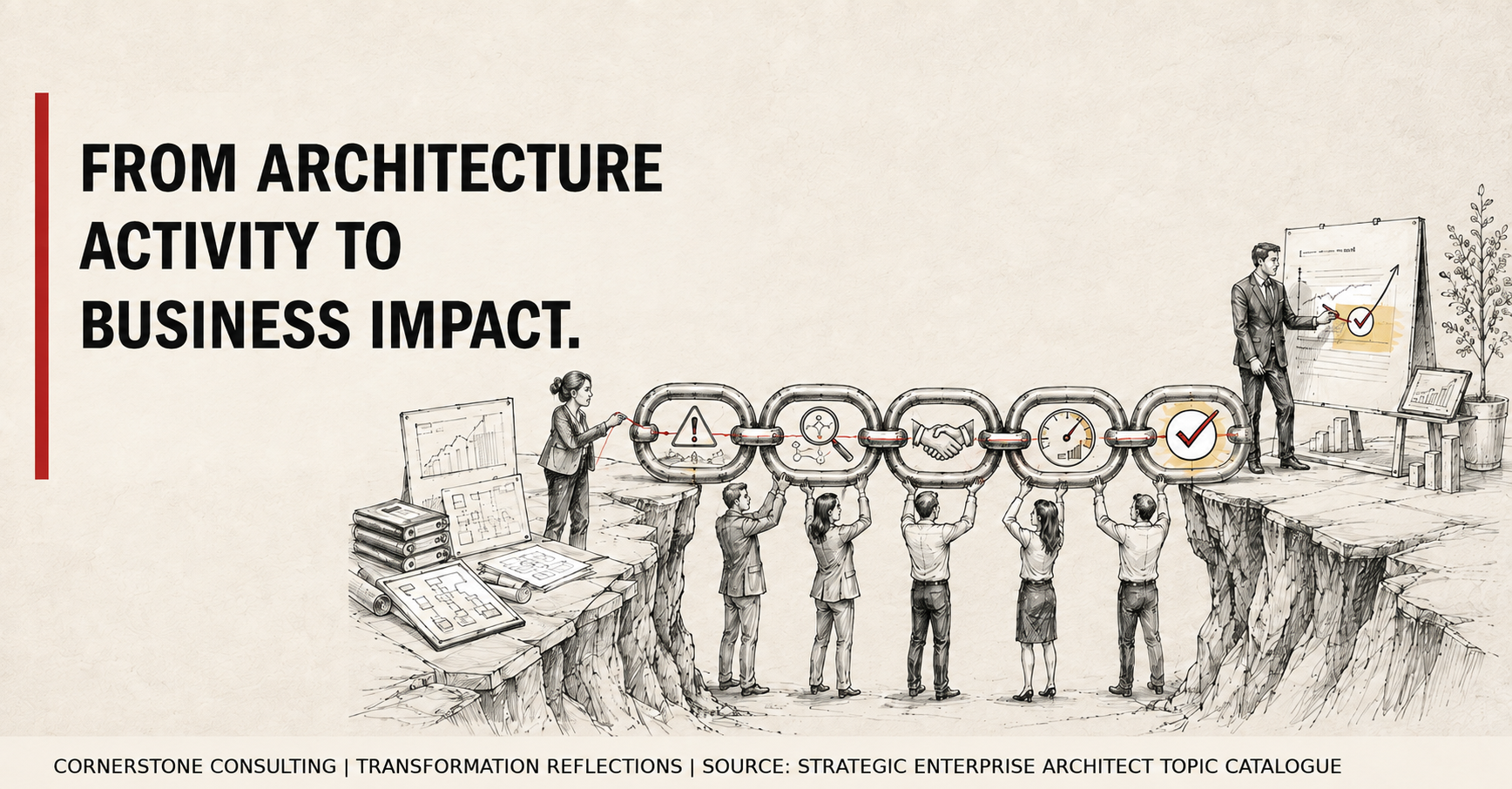
Architecture teams can count everything they produce.
That does not prove anything changed.
Impact needs a traceable chain.
I have seen architecture teams report reviews, models, standards, and roadmaps while sponsors still asked what changed. The conversation improved when we traced one intervention through the decision it altered, the commitment it changed, and the outcome someone else could verify. That evidence was smaller than the activity report, but far more credible. Read more at https://www.cornerstonea.com/.
Architecture practices often measure what they can count: reviews completed, models updated, standards applied, exceptions processed, and roadmaps published. These figures describe workload. They do not show whether the enterprise made a better commitment.
The overarching theme of this episode is that business impact needs a traceable chain, not a confident claim.
For each material intervention, an Enterprise Architect should record five links: the enterprise concern, the architecture insight, the decision or commitment that changed, the earliest observable indicator, and the business outcome an accountable leader can verify. If one link is missing, the impact story is incomplete.
Consider a global ERP design. The activity may be a process and data review. The architecture insight may reveal that two business units expect incompatible ownership of the same customer data. The decision change is not the completed review; it is the sponsor assigning enterprise decision rights before build. A leading indicator might be fewer unresolved design exceptions. The later outcome could be less redesign, clearer control ownership, or a more credible deployment sequence.
This chain also prevents architecture from claiming too much. EA rarely owns the full business result. Finance, operations, product, data, risk, procurement, vendors, and delivery teams all contribute. Architecture should state its contribution precisely and ask those peers to confirm whether the decision, readiness, cost exposure, or execution path actually changed.
An EA value scorecard should therefore combine evidence, not applause. Track the baseline, intervention, changed commitment, indicator, outcome, evidence owner, and review date. Include both positive impact and activity that produced no material change. The second category is useful: it shows where governance can be reduced, where engagement came too late, or where the architecture method needs coaching.
Independent transformation assurance and architecture practice enablement become valuable when they help leaders test this chain without inflating avoided cost or protecting busywork.
Before the next steering meeting, choose one architecture activity from the last month. Trace it forward until another leader can confirm the consequence. If the trail stops at the artifact, report activity. If it reaches a changed enterprise outcome, report impact.
Business impact begins where the architecture activity ends.
Reflection
Where does your EA impact story stop: at the artifact, the changed decision, or the verified outcome?
Practice
Take one completed architecture activity and build a five-link impact chain: enterprise concern, architecture insight, changed commitment, leading indicator, and verified outcome. Assign an evidence owner and review date. If the chain stops at the artifact, report activity rather than impact.
Comments Welcome
Darin Paton is the Owner of Cornerstone Consulting Inc., an Alberta-based enterprise architecture and SAP ERP transformation advisory firm serving organizations across complex business and technology change for over 15 years. 30+ years as an EA and advising SAP transformations.

Leave a Reply