

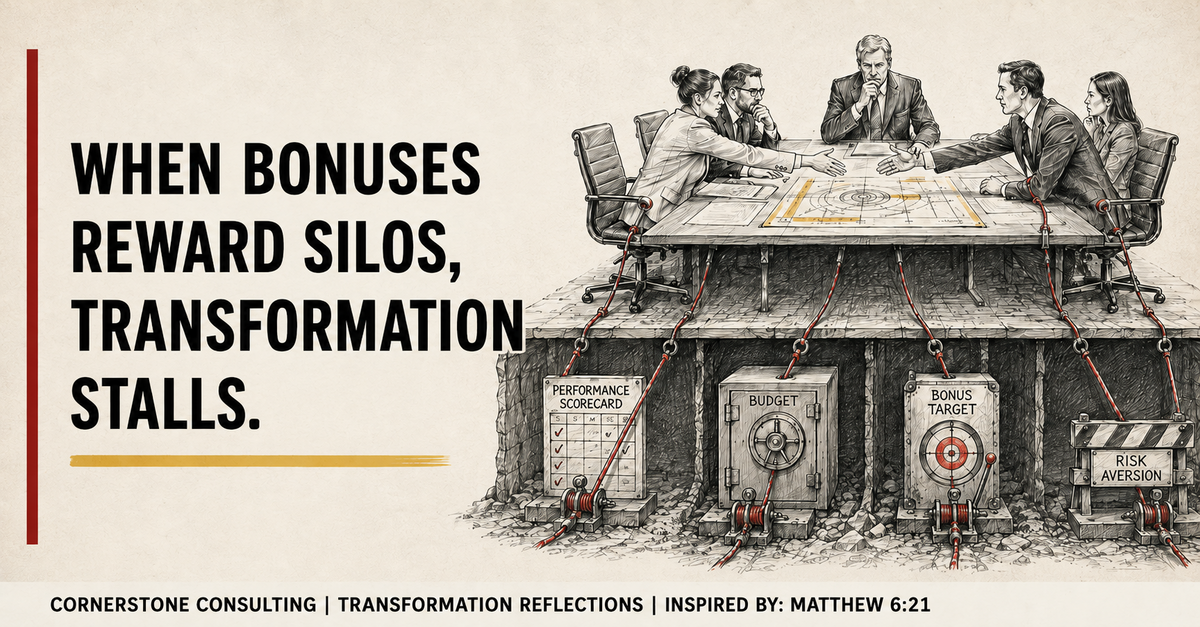
People are not ignoring the transformation.
They may be responding rationally to budgets, bonuses, and risk.
Here is the incentive conflict leaders should review.
I have watched organizations survive difficult transformations and then forget the very lessons that made survival possible: who stepped up, what broke, and what the enterprise learned.
Transformation creates evidence. Some of it is visible in deliverables, decisions, and milestones. Some of it is quieter: the moment a business owner finally took accountability, the workaround that exposed a weak policy, the dependency nobody had named, or the team that learned how to operate across boundaries.
Those moments should not disappear when the program moves on.
Executives often inherit a strong bias toward the next issue. Once a decision is made, attention shifts. Once a risk is closed, the dashboard clears. Once the go-live passes, the organization rushes into stabilization. But if leaders do not mark what the enterprise learned, the same lesson gets paid for again in the next transformation.
The deeper work is to turn memory into capability.
That means recording the decisions that changed the outcome, not just the dates they were made. It means naming the operating-model assumptions that failed, the data owners who became essential, the controls that needed earlier involvement, and the leadership behaviours that restored confidence. It also means noticing the positive patterns: who collaborated well, which governance forum actually helped, and where architecture made consequences clearer before money or scope hardened.
Enterprise architecture can serve as the enterprise memory system for transformation. Capability maps, dependency traces, decision logs, ownership models, and post-implementation reviews help executives preserve what was learned in a form the next initiative can reuse. Cornerstone’s EA and SAP transformation advisory work can help turn these lessons into practical governance, coaching, and operating-model improvements.
A program that only delivers an output may end with a celebration. A program that leaves behind stronger organizational memory gives the next transformation a better starting point.
This is not nostalgia. It is disciplined executive learning. The point is to preserve the evidence while it is still fresh enough to shape standards, governance, coaching, and support. Otherwise the next program begins with confidence but without the memory that could have made it wiser.
Reflection
What has your organization learned the hard way that has not yet been turned into repeatable capability?
Practice
Create a transformation memory review: list the five lessons the enterprise must carry into the next major initiative, with an owner for each.
Comment Welcome
Darin Paton is the Owner of Cornerstone Consulting Inc., an Alberta-based enterprise architecture and SAP ERP transformation advisory firm serving organizations across complex business and technology change for over 15 years. 30+ years as an EA and advising SAP transformations.

Leave a Reply