

Executives remember who helped them see clearly before risk became expensive.
That memory starts with one practical signal.
What will architecture make visible this week?
I have watched architecture teams gain trust through small, useful signals: a dependency named early, a decision clarified, a risk translated, a trade-off made visible. Over time, those small moments changed who was invited into the important conversations.
Enterprise Architects can be tempted to wait for the big moment: the executive presentation, the steering committee, the architecture board, or the transformation checkpoint where everyone finally sees the enterprise picture.
But influence is often built in smaller moments.
A quiet dependency note before a funding decision. A one-page impact summary before procurement narrows the options. A question that exposes a missing data owner. A short explanation of how a local workaround will become enterprise cost. A practical reminder that SAP configuration, process ownership, controls, and reporting cannot be separated without consequence.
These moments may look small, but they teach the enterprise what architecture is for.
If architecture only shows up as a formal deliverable, leaders may treat it as process. If it shows up as timely evidence that helps them avoid confusion, rework, and hidden cost, leaders begin to treat it as decision support. That is the move from architecture activity to business impact.
The small things also protect credibility. An Enterprise Architect does not need every conversation to become a complete enterprise model. Sometimes the most useful contribution is one clear distinction: this is a delivery issue; that is an operating-model issue. This is a local preference; that is an enterprise dependency. This is a technology choice; that is a business capability decision.
Small evidence compounds because executives remember who helped them see clearly before the risk became expensive.
So the question is not whether your architecture practice has enough artifacts. The question is whether your daily architecture work is leaving evidence leaders can use. A decision improved today can become trust tomorrow. A clarified dependency today can prevent a stalled transformation next month.
This also changes how architects spend their time. Instead of preparing another broad explanation of EA, look for one practical signal the enterprise can act on now. The small signal may be a missing owner, an unresolved assumption, a weak control, or a dependency that needs sequencing. Make it useful before it becomes noisy.
Reflection
Which small architecture signal, if made visible this week, would help leaders make a better decision?
Practice
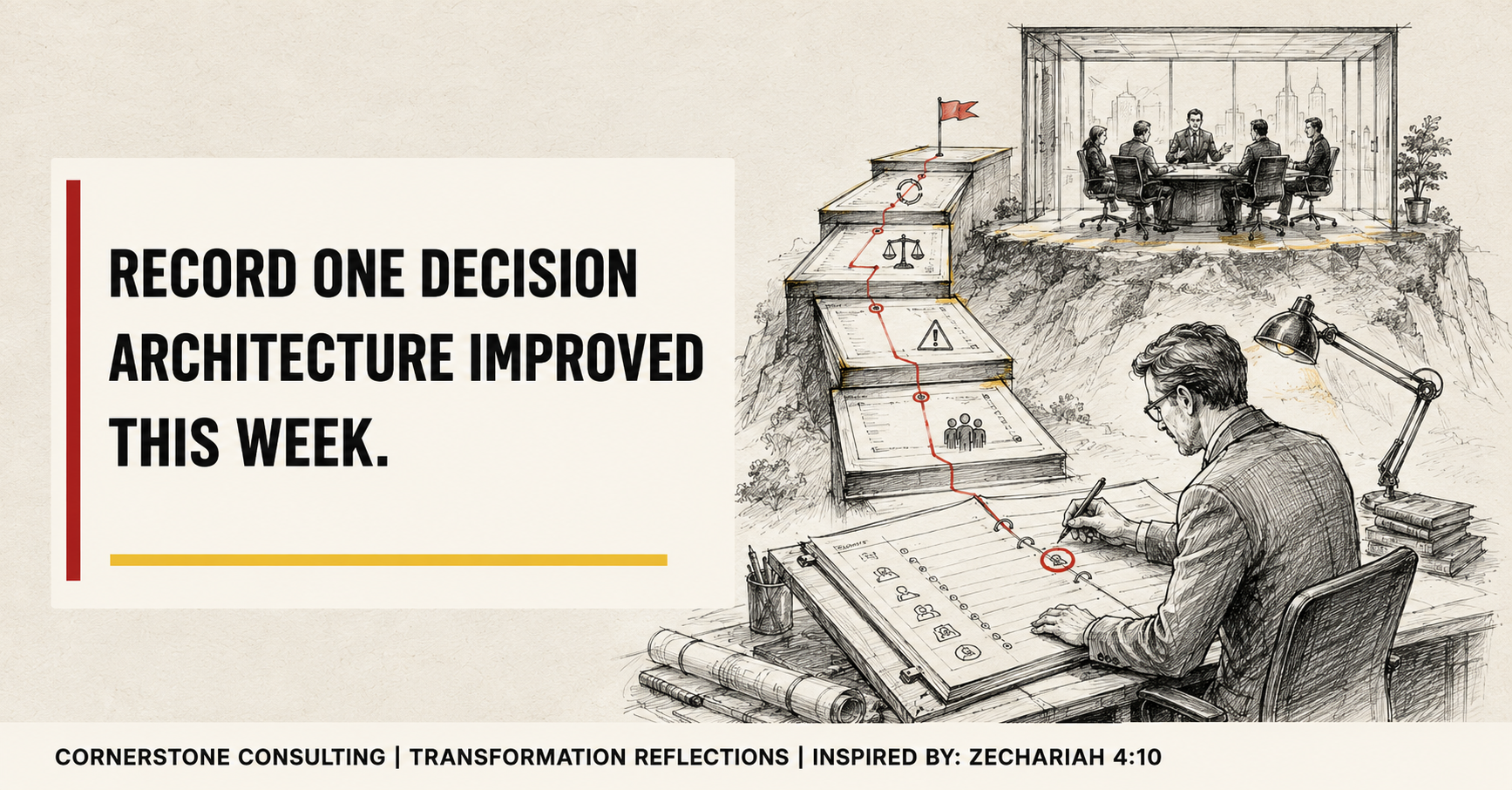
Start a weekly “small evidence” log. Capture one decision, dependency, risk, or ownership issue where architecture changed the conversation. Share the pattern monthly with the sponsor.
Comments Welcome
Darin Paton is the Owner of Cornerstone Consulting Inc., an Alberta-based enterprise architecture and SAP ERP transformation advisory firm serving organizations across complex business and technology change for over 15 years. 30+ years as an EA and advising SAP transformations.

Leave a Reply